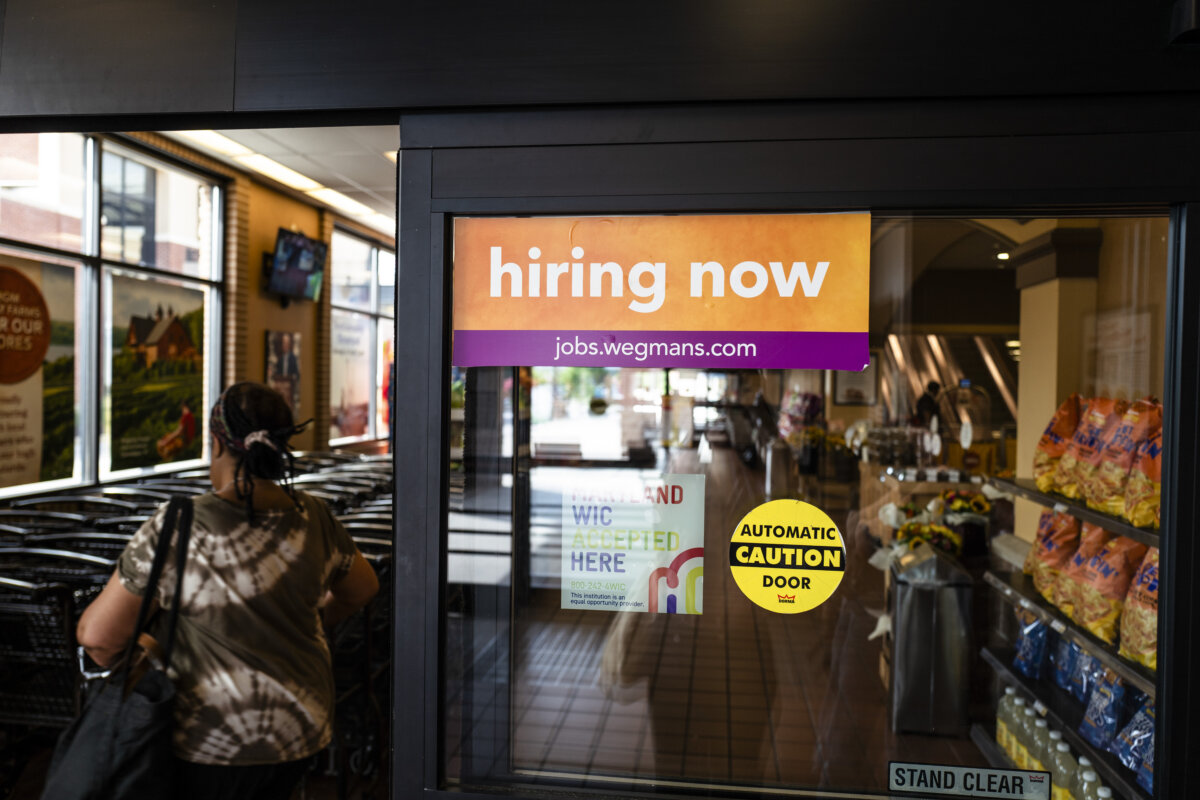

Some Americans seeking a job change are now finding themselves faced with the reality of a smaller job pool and lower salary jumps, according to a recent report from the Bank of America (BOA) Institute.
Although the job change rate has risen since the beginning of 2025, the estimated rate at the end of July was just 2 percent above the 2019 average and has been trending downward since the 2022 peak of more than 26 percent, according to the report.
The Bureau of Labor Statistics’ August’s report showed that nonfarm payroll employment added 73,000 jobs in July, representing just a small change from April. The unemployment rate—at 4.2 percent at the end of July—also remained steady. Employment in health care and social assistance increased, and federal employment decreased.
Those currently employed and seeking higher paychecks may be disappointed, as the BOA report showed that pay raises for new company hires are falling by about 7 percent—dipping by more than 3 percentage points below the 2019 average.
“We believe the slowdown in pay raises is one of the primary reasons why the job change rate is slowing,” Taylor Bowley, an economist at the BOA Institute, told The Epoch Times. “We’ve moved from the ‘great resignation’ period to the ‘great hesitation period.’”
Bowley also noted that the current heightening business uncertainty could also spill over into the remainder of 2025.
“It will be interesting to watch into the holiday season with seasonal hirings, as well as other sectors of the economy,” she said.
Unemployment Factors
The BOA Institute, quoting a University of Michigan Consumer Sentiment Index in its report, indicated that the fear of unemployment reached a 10-year high in March. It described the current economic sentiment as “low-fire, low-hire,” noting the stagnant job growth and unemployment findings by the Bureau of Labor Statistics.
Among the unemployed, the number of new entrants grew by 275,000 in July, to 985,000. New entrants are unemployed people who are looking for their first job.
In July, the number of long-term unemployed—those jobless for 27 weeks or more—increased by 179,000 to 1.8 million. The long-term unemployed accounted for 24.9 percent of all unemployed people.
White-Collar versus Blue-Collar Jobs
The BOA Institute noted that white-collar job hopping has slowed significantly and that wage disparities are widening between higher- and lower-income earners. It also found that industries such as finance and information services have a greater share of employees with monthly pay periods, which could suggest that job changes in these industries are decreasing.
“There definitely seems to be less of an attrition rate in these higher-earning industries,” Bowley said.
For blue-collar industries such as manufacturing, construction, or retail, she said changing jobs and receiving higher wages is a quick way to increase income growth.
“If there are less opportunities to change jobs or [get] higher wages when doing so, that could have an effect on consumer spending down the road,” Bowley said.
Experts Weigh In
Ken Persel, founder and principal of Persel Group, a Florida-based executive search firm, told The Epoch Times that he believes that the BOA Institute data reveal fear among today’s employees.
“It’s called ‘job hugging’ in a tough market where even top professionals cling tightly to their main paycheck,” he said. “They’re worried about their mortgage, lifestyle, and the stability needed for long-term goals.”
Ongoing layoffs and the threat of artificial intelligence (AI) are now being used to justify restructuring, according to Persel.
“Despite the desire for and allure of stability, the promise that a single, loyal career path can guarantee both executive success and financial security is largely broken,” he said.
As a result, Persel said, professionals are forced to create a new “success playbook,” which includes maximizing their value in their primary position and developing multiple revenue streams through consulting work.
Andrea Jill Miller, CEO of LeadWell Company in Washington, agrees that the BOA Institute study is showing a new reality. A leadership and performance coach, Miller told The Epoch Times that the old rules of job hopping might not be paying off like they once did.
“The big salary bumps that once rewarded a move have shrunk, or even disappeared, for many,” she said. “In a world that feels increasingly uncertain, professionals, especially younger ones, might be trading the thrill of a quick pay raise for the comfort of stability. They’re looking for more than just a bigger paycheck; they’re also seeking opportunities to grow.”
Miller also believes that companies are beginning to step up to the plate when it comes to maintaining their talent.
“Instead of just watching good people walk out the door, they are now actively investing in their employees,” she said. “We’re seeing more companies offering things like internal promotions, mentorship, and training programs to help their people grow from within.”
BOA’s Global Research team also found that job prospects may remain challenging for younger employees, as global trade tensions could add to economic uncertainty. Meanwhile, other sectors may start to seriously embrace AI, potentially crowding out the entry-level positions.
Tom Vinkler, founder of the Arizona-based Hirello employment coaching firm, told The Epoch Times that AI is starting to reshape entire roles, especially in white-collar employment.
“AI is promising enormous gains in savings and efficiency, and executives have every reason to believe those gains will come eventually,” he said. “But no one knows which departments will be transformed first, how lean operations can truly become, or what timelines to expect.”
Vinkler noted that as fewer people switch jobs, fewer positions open up, which further tightens the market.
“This self-reinforcing cycle makes employees even more hesitant to jump,” he said.
For those who are willing to take the risk and look for something new, Vinkler cautioned that job searches today can often stretch into a six- or 12-month project.
“This often makes stability far more attractive than the gamble of moving,” he said.
 Friends Read Free
Copy
Facebook
Tweet
Friends Read Free
Copy
Facebook
Tweet