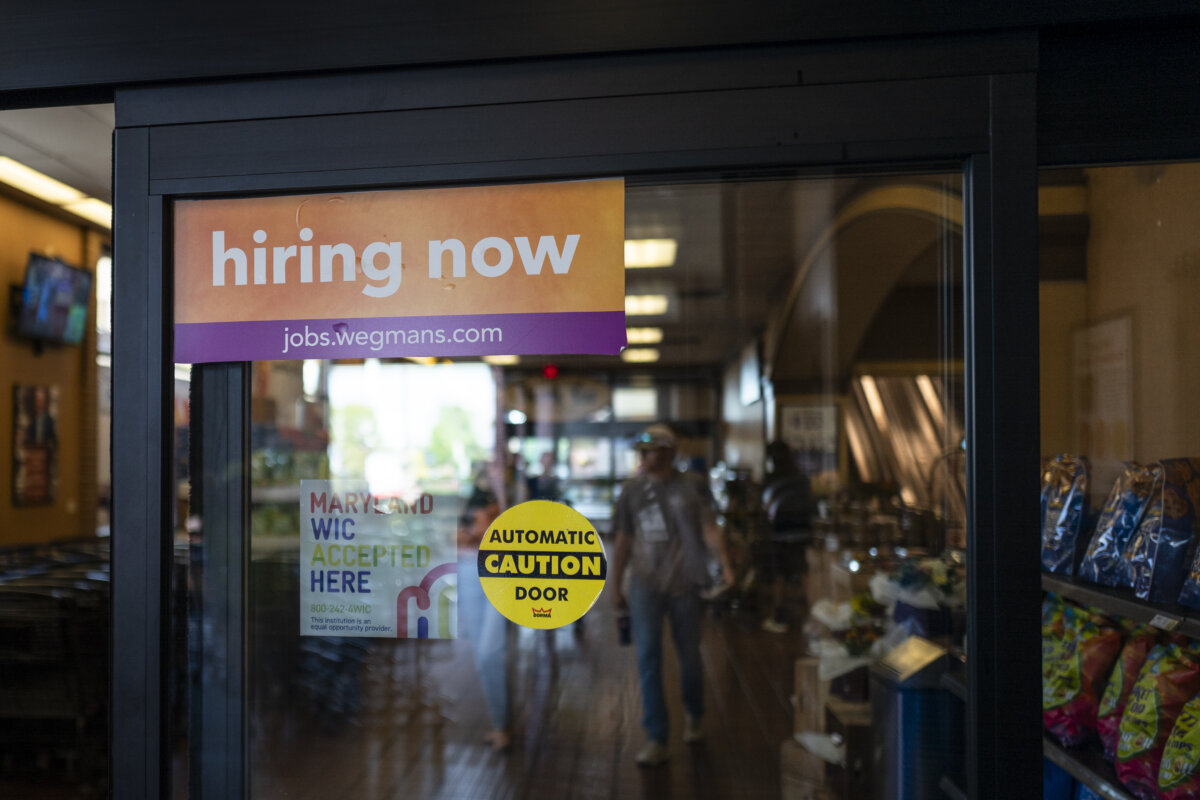

Private employers unexpectedly cut 32,000 jobs in September, marking the steepest decline since March 2023 and signaling renewed weakness in the U.S. labor market.
The figures, released on Oct. 1 in ADP’s National Employment Report, also showed a downward revision to August payrolls—from an initially reported gain of 54,000 to a loss of 3,000.
Economists had penciled in a September gain of 50,000.
“Despite the strong economic growth we saw in the second quarter, this month’s release further validates what we’ve been seeing in the labor market, that U.S. employers have been cautious with hiring,” Nela Richardson, chief economist at ADP, said in a statement.
The service-producing sector lost 28,000 positions, led by leisure and hospitality (negative 19,000), professional and business services (negative 13,000), and financial activities (negative 9,000). This offset the gains observed in education and health services (33,000) and information technology (3,000).
In the goods-producing sector, private companies eliminated 3,000 positions, with construction accounting for a significant portion of the decline.
Wage gains were little changed for job-stayers, remaining at 4.5 percent. Pay gains for job-changers eased to 6.6 percent from 7.1 percent.
Additionally, small- and medium-sized businesses accounted for all of the private-sector job losses, while large companies (with 500 or more employees) added 33,000 workers.
Meanwhile, the Bureau of Labor Statistics reported on Sept. 30 that the number of job openings ticked up by 19,000 to a slightly higher-than-expected 7.227 million in August.
“The big picture is that America still has a low hire, low fire, low gear job market,” Bill Adams, chief economist at Comerica Bank, said in a note emailed to The Epoch Times.
“The last government data release … shows that the job market is holding in low gear. Layoffs and hires are both low.”
Government Shutdown
The ADP figures come as the U.S. government shut down after Republicans and Democrats failed to reach a funding agreement. This was the first government closure since late 2018.
Should the shutdown persist over the next few days, key data will not be released, including the Department of Labor’s weekly jobless claims and the Bureau of Labor Statistics’ September jobs report.
The market consensus pointed to 223,000 initial jobless claims. Experts also forecast 50,000 new jobs and the unemployment rate holding steady at 4.3 percent.
Still, this could have implications for the financial markets and monetary policy, as investors and the Federal Reserve will rely on private sector indicators to assess the health of the labor market.
In addition to the ADP’s monthly figures, global outplacement firm Challenger, Gray and Christmas will release employers’ planned layoffs for last month on Oct. 2. Trading Economics projects the firm will report 150,000 planned job cuts.

Another looming threat, says Bankrate senior economic analyst Mark Hamrick, is that President Donald Trump has threatened mass terminations of federal workers in the event of a shutdown.
“Typically, hundreds of thousands of federal workers face temporary furloughs during shutdowns and receive back pay once the congressional stalemate ends and the government reopens,” Hamrick said in a statement to The Epoch Times.
Monetary Policy Implications
The Federal Reserve will hold its next two-day policy meeting on Oct. 28 and Oct. 29. Investors are penciling in a second straight quarter-point interest rate cut, according to the CME FedWatch Tool.
Over the past week, Fed officials have stated that the U.S. labor market remains intact, but downside risks are forming, which justified the central bank restarting its rate-cutting cycle last month.
“My baseline outlook doesn’t see the labor market softening much further—but there are risks. In particular, I see some increased risk that labor demand may fall significantly short of supply, leading to a more meaningful and unwelcome increase in the unemployment rate,” Boston Fed President Susan Collins said in prepared remarks at a Sept. 30 Council on Foreign Relations event.
But Fed Vice Chair Philip Jefferson, speaking at a Sept. 30 Bank of Finland event, noted that both sides of the institution’s dual mandate—maximum employment and price stability—are under threat.
“Considering the outlook I described, I see the risks to employment as tilted to the downside and risks to inflation to the upside. It follows that both sides of our mandate are under pressure,” he said in a speech.
The updated Summary of Economic Projections—a periodic survey of officials’ expectations for the economy and policy—suggested a more conservative outlook for interest rates compared to what the financial markets had penciled in prior to the September Federal Open Market Committee meeting.
Policymakers project two more rate cuts this year and another in 2026, with the benchmark federal funds rate expected to settle at 3 percent by the end of 2027. By comparison, traders anticipated a more aggressive Federal Reserve, with the median policy rate expected to hover at around 2 percent by the end of next year.
 Friends Read Free
Copy
Facebook
Tweet
Friends Read Free
Copy
Facebook
Tweet