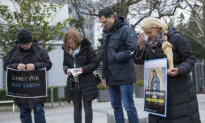

New Jersey Gov. Mikie Sherrill signed legislation on Thursday that can potentially criminalize conducting prayers outside abortion centers in the state, according to pro-life organization New Jersey Right to Life (NJRTL).
The bill, S2260, aims to strengthen protections for people seeking reproductive healthcare services such as abortion in New Jersey, as well as the healthcare professionals who provide such services, according to an Aug. 20 statement from the governor’s office.
The new law makes it a crime to threaten, intimidate, physically block, or injure patients or providers of reproductive healthcare.
The legislation creates a new crime of “interference with reproductive health care services,” according to a July 1 legislative fiscal estimate of the bill.
The measure does not explicitly call for banning prayers outside abortion centers but authorizes taking civil actions against a person deemed to be unlawfully interfering with another individual’s reproductive healthcare services.
In such cases, a court can award compensatory damages, injunctive relief, punitive damages, and other relief to the victims. The bill classifies it as a fourth-degree crime that can attract a fine of up to $10,000, 18 months’ imprisonment, or both. If victims suffer bodily injuries, the prison term and fines increase.
In an Aug. 20 statement, NJRTL condemned the bill, arguing it provides “sweeping legal immunity” to abortion service providers.
NJRTL executive director Marie Tasy said that terms such as “intimidate,” “coerce,” and “threat” are subjective and based on individual feelings, which makes the bill’s language a “serious danger” to free speech.
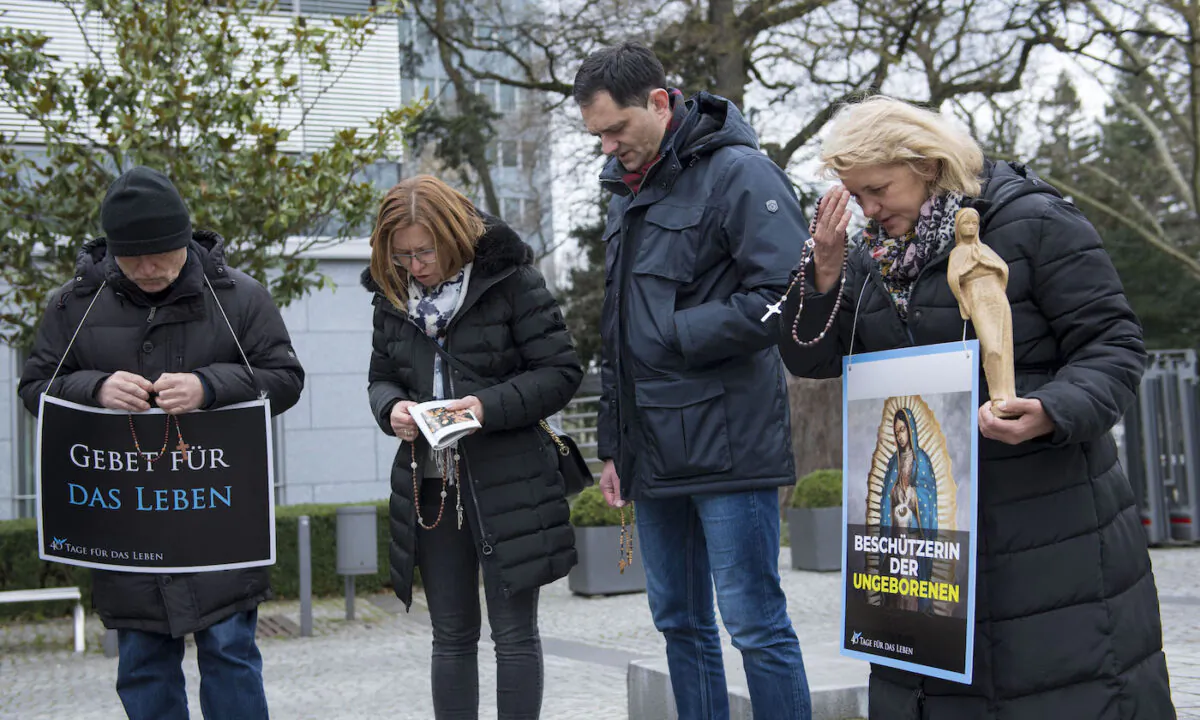
“Peaceful sidewalk counseling, prayer, holding signs, or simply offering help and alternatives outside a facility can easily be labeled ‘intimidation’ by someone who claims to feel threatened, leaving pro-life advocates open to criminal charges that are difficult to disprove and chilling constitutionally protected expression,” Tasy said.
Tasy alleged the new law to be a “deliberate act of defiance” against the most basic of human rights—the right to life for children in the womb. She accused Sherrill of creating vague new criminal penalties to silence people who object to what she said were “radical policies.”
“That is not compassion. That is blatant extremism. Women deserve meaningful support and genuine alternatives, not a state government focused on expanding protections for abortion,” Tasy said.
In its statement, Sherrill’s office defended the signing of the bill, with the governor saying that the state stands “firm in defense” of people’s reproductive choices such as abortion.
The measure also includes “gender-affirming care,” or transgender treatments, under the definition of protected reproductive healthcare services.
State entities are restricted from assisting certain out-of-state investigations or legal actions seeking to impose liability on those who receive or provide protected reproductive healthcare. The bill prevents licensing boards from taking action against a healthcare provider solely for offering reproductive healthcare that is protected under law.
“No one should fear intimidation or violence for seeking healthcare, and no healthcare professional should fear punishment from another state for providing care that is legal in New Jersey,” Sherrill said in the statement.
A similar law has been enacted in Ireland, where an abortion “buffer zone” of 150 meters around hospitals was created. Any action in this buffer zone aimed at influencing someone’s decision to get an abortion can be criminalized.
In May, a retired pastor was convicted of breaching the abortion buffer zone law after he preached outside a hospital.
Buffer zones around abortion clinics have come into force in England and Wales since 2024.
The Epoch Times reached out to the Sherrill’s office for comment but did not receive a response by publication time.
New York Bill
Another state bill that seeks to shield reproductive centers from interference is also facing criticism. New York’s Senate Bill S8599 aims to ban groups from demonstrating within 25 feet of a reproductive healthcare facility or place of worship.
Agudath Israel of America, an advocacy group for American Orthodox Jewry, supported the bill in a Jan. 7 statement, arguing that the protection of places of worship was important given rising anti-Semitic incidents in New York.
However, the Foundation for Individual Rights and Expression (FIRE) criticized the bill in a Feb. 13 post. The legislation’s 25-foot ban on demonstrations would cover a wide range of places of worship and reproductive healthcare facilities, including abortion and fertility clinics.
There are thousands of locations across New York that will be covered under the bill, FIRE said, warning that banning demonstrations around each of these locations will create First Amendment dead zones where officers can put people in prison for any protest activity. And in densely populated regions, many of these zones would overlap.
The bill is currently in the New York Senate.
 Friends Read Free
Copy
Facebook
Tweet
Friends Read Free
Copy
Facebook
Tweet