
U.S. wholesale inflation was tame in June, sending few signals that President Donald Trump’s tariffs could cause price pressures in the coming months.
According to data released by the Bureau of Labor Statistics on July 16, the producer price index (PPI)—a measure of prices paid for goods and services by businesses—was zero percent in June from an upwardly revised 0.3 percent in May.
This came in below the consensus forecast of a 0.2 percent gain.
Economists and monetary policymakers monitor the PPI because it can serve as an early indicator of future consumer prices, as it is located near the beginning of the supply chain.
In the 12 months ending in June, PPI inflation eased to a lower than expected 2.3 percent.
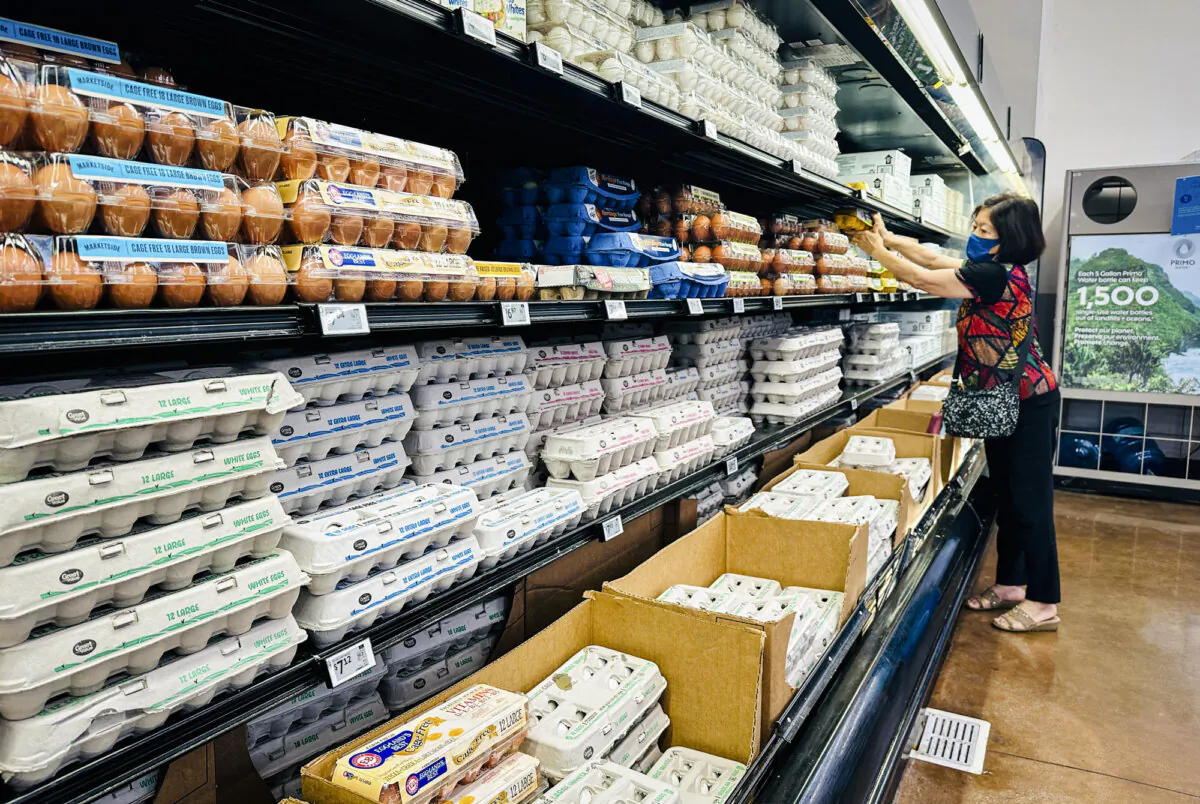
Goods inflation rose by 0.3 percent, driven by a 0.8 percent surge in prices for communication and related equipment, which are sensitive to tariffs. Eggflation continued to subside in June, as prices for eggs for fresh use declined by nearly 20 percent.
Prices for services fell by 0.1 percent, with much of the decline attributed to a 0.9 percent decrease in the cost of transportation and warehousing services.
Core wholesale inflation, which strips out the volatile components of food and energy, was also muted in June.
Core PPI inflation came in at zero percent after rising by 0.4 percent in May. On a year-over-year basis, inflation in core producer prices slowed to 2.6 percent from an upwardly adjusted 3.2 percent.
Both core readings came in below market estimates.
Inflation in PPI excluding food, energy, and trade was also at zero percent in June, slowing to an annualized rate of 2.5 percent.
Market Reaction
Benchmark indexes for the U.S. stock market were in positive territory in pre-market trading following the latest inflation report.
U.S. Treasury yields were mostly in the red. The benchmark 10-year yield fell by nearly 3 basis points to below 4.46 percent.
The U.S. dollar index, a gauge of the greenback against a weighted basket of currencies, was little changed.
“Disinflation remains, but the Fed will be undeterred in keeping rates steady until September,” Jamie Cox, managing partner for Harris Financial Group, said in a note emailed to The Epoch Times.
As long as the labor market remains solid, Cox does not expect the Federal Reserve to lower interest rates in a meaningful way.
The rate-setting Federal Open Market Committee will hold its policy meeting later in July, and investors overwhelmingly expect the central bank to leave rates unchanged. The futures market anticipates a quarter-point rate cut to the benchmark federal funds rate—a key rate that influences business, consumer, and government borrowing costs—in September.
In prepared remarks at the World Affairs Council of San Antonio, Dallas Federal Reserve President Lorie Logan said that the effects of tariffs could take time to appear in the inflation data.
“Tariffs on intermediate goods, such as parts used to assemble new cars, take time to show up in the prices of finished products,” Logan said on July 15. “And some retailers are waiting to raise prices until they see where tariff rates settle.”
At the same time, Logan said she believes it is “quite plausible” that inflation could end up being “less persistent” and “less responsive” to the president’s sweeping tariffs.
Monetary policymakers have routinely expressed the need to be patient before pulling the trigger on restarting the rate-cutting cycle, as they digest tariff-related data.
Tariffs and Inflation
Economic observers are still determining whether Trump’s tariffs are showing up in the inflation data.
In the June consumer price index (CPI) report, inflation rose by 0.3 percent monthly, and the headline annual inflation rate increased to 2.7 percent. Core inflation also increased by 0.2 percent, and the year-over-year number ticked up to 2.9 percent.
A deeper dive would reveal mixed signals.
The indexes for new vehicles and used cars and trucks declined by 0.3 percent and 0.7 percent, respectively. Apparel, meanwhile, surged by 0.4 percent.
According to the Bureau of Labor Statistics, much of the June increase was driven by shelter and energy costs.
“Inflation pressure will likely remain acute for the rest of the summer,” Jeffrey Roach, chief economist for LPL Financial, said in a note emailed to The Epoch Times. “Tariffs have not materially impacted inflation metrics yet, so we should expect some further pressure in the coming months.”
Roach expects inflation to stabilize later this year amid slowing consumer demand and businesses examining possible trade shocks.
Others, including economists at RBC, have said they believe tariff pressures are forming in the data, but lower auto prices “are masking the full extent.”
“But signs of tariff pressures are showing up in other goods, notably recreation and household furnishings and supplies,” the RBC economists said in a July 15 note.
The pre-tariff rush to purchase foreign products and fill inventories could offer a buffer to higher prices in durable goods, “delaying the full impact of tariffs until later this year,” they stated.
According to Jay Woods, chief global strategist at Freedom Capital Markets, the inflation and tariff situation remains uncertain.
“Clearly, inflation remains sticky, but it is far from changing course. The continued tariff uncertainty remains just that—uncertain,” Woods said in a note emailed to The Epoch Times.
The next piece of the inflation puzzle will be trade prices.
Data for import and export prices will be released on July 17. Estimates suggest that import prices will rise by 0.3 percent, while export prices are expected to remain unchanged.
 Friends Read Free
Copy
Facebook
Tweet
Friends Read Free
Copy
Facebook
Tweet