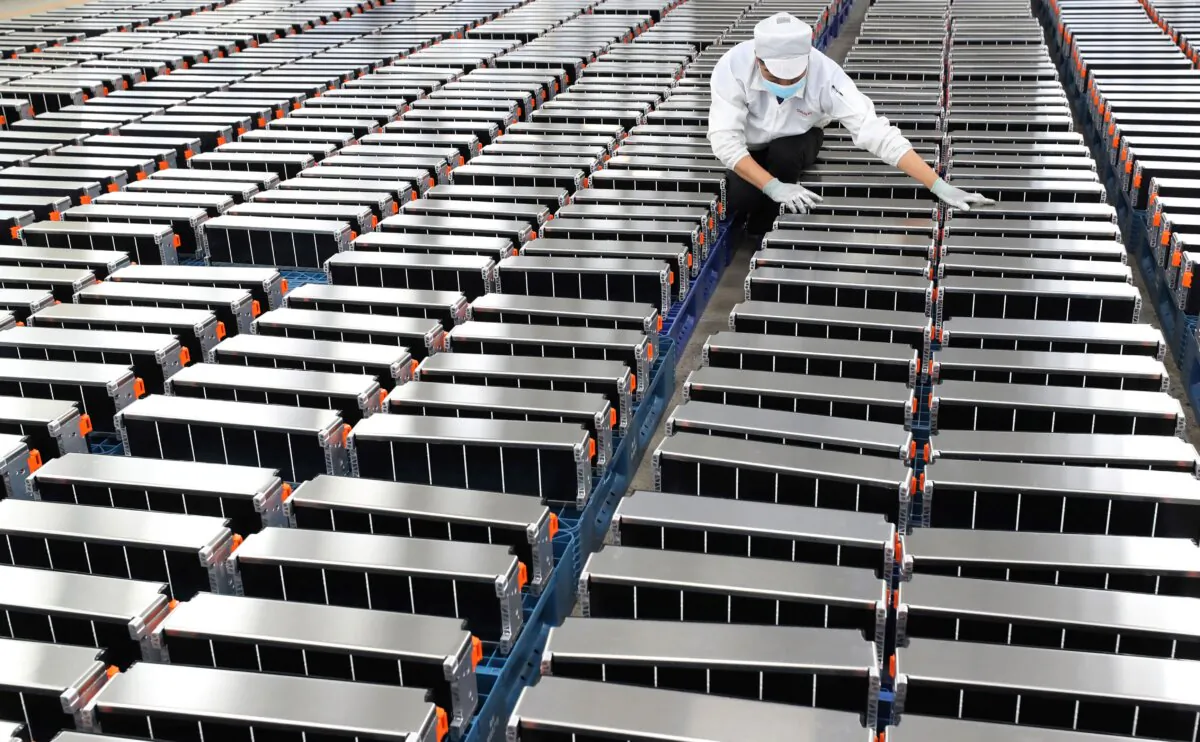

The United States dominated the rare-earths industry in the 1980s with domestic miners leading the world in extraction and U.S. scientists spearheading breakthroughs in using these 17 elements to develop permanent magnets and new generations of batteries.
However, within a decade, China became the world’s leading producer of rare earths and critical minerals essential in modern electronics, including those with military applications, and by 2024, it commanded a near monopoly, with its industries controlling 90 percent of the global rare-earths refining market.
How did that happen?
Many factors contributed, but as Rep. Raja Krishnamoorthi (D-Ill.) said during a Nov. 19 House Select Committee on the Chinese Communist Party hearing, “the story of Magnequench” exemplifies how the Chinese Communist Party (CCP) orchestrated a decades-long strategy to diminish, if not destroy, competitors’ manufacturing capacity—most notably, that of the United States.
General Motors (GM), a pioneer in developing permanent magnets, created Magnequench in 1986. The Pentagon was its primary customer for neodymium-iron-boron magnets used in precision-guided munitions.
Magnequench began manufacturing magnets in 1987 in Anderson, Indiana. When GM restructured in the early 1990s, it divested itself of a number of subsidiaries. Magnequench was put up for sale.
In 1995, Sextant Group, an investment consortium, purchased Magnequench for $56 million.
U.S.-based Sextant’s CEO was Archibald Cox Jr., son of the Watergate prosecutor, but the group was largely financed by Chinese investors, including San Huan New Material Chair Zhang Hong and executives with the China National Non-Ferrous Metals Import & Export Corp.
The Pentagon opposed the sale, citing concerns about Chinese investors owning 62 percent of a company that it relied on. That same year, the U.S. International Trade Commission cited San Huan for “patent infringement and business espionage,” resulting in a $1.5 million fine.
However, the State Department, seeking to establish good relations with China, didn’t object. The Committee on Foreign Investments in the United States approved the purchase, requiring only that it remain in the United States for 10 years.
Within two years, the two Chinese firms’ shares were transferred to CCP-owned Onfem Holdings, run by Wu Jianchang, who, like San Huan’s Zhang Hong, was a son-in-law of Deng Xiaoping, leader of the Chinese Communist Party from 1978 to 1989.
Sextant Group, essentially now owned by Onfem Holdings, in 2000 purchased Indiana General, another magnet plant, in Valparaiso, Indiana. That same year, it closed Magnequench’s Anderson factory. In 2004, it shut down the Valparaiso plant.
As a result, “America now cannot build a single guided missile without permission from Beijing,” Michael Dunne wrote in a June 2025 report in The Dunne Insights Newsletter. “America’s defense industrial base had been hollowed out for $56 million: the cost of a single F-35 fighter jet.”
“The story of Magnequench” is not an exception. It’s a rule of the CCP’s “playbook.”
“Over the span of 30-plus years, China grabbed different parts of the critical minerals industry, developed a loaded gun, and pointed it directly at American industry,” House Select Committee on the CCP Chair Rep. John Moolenaar (R-Mich.) said.
A Contrived Chokehold
The committee hearing focused on a 52-page report that includes 13 initiatives designed to overcome China’s rare-earths and critical minerals dominance, and 12 findings illustrating how the CCP manipulates markets.
According to the report, China-based processors refine 85 percent to 90 percent of the world’s rare earths, produce 90 percent of its magnets and 80 percent of its batteries, and control at least 75 percent of the global market for at least 30 of the 54 commodities deemed “essential to national security” by the U.S. Geologic Survey in its 2025 Critical Mineral List.
U.S. manufacturers are 100 percent import-reliant for 12, and more than 50 percent import-reliant for 29, of those 54 commodities. Since April, the CCP has imposed export restrictions on 12 rare earths—classified collectively as one critical mineral on the survey’s list—including five in October. It suspended those latter restrictions for a year following trade negotiations with President Donald Trump.
According to the report, for decades, the CCP has subsidized “state mining champions with tens of billions of dollars, including zero‐interest loans, to support its global acquisition of mining assets,” totaling “$57 billion.”
This “gives Beijing the ability to raise and lower prices” and “effectively makes it illegal to publish prices that deviate from CCP directives,” the report reads.
The probe says that the CCP “maintains a chokehold over midstream refining. While [China] cannot control where mineral deposits are located, it can control where resources are refined.”
“[This] decades-long strategy … involved luring in mostly Western companies to collaborate with [China-based] companies, then selling products significantly below existing market participants’ prices to put competition out of business,” the report reads. “Finally, after establishing its dominance, [the CCP] wielded this market clout as a geopolitical weapon.”
Citing Deng Xiaoping’s 1992 quote “The Middle East has oil; China has rare earths,” Krishnamoorthi said the CCP isn’t shy about these goals, referring to a “fascinating” 2020 memo by executives with CATL—the world’s largest electric vehicle battery-maker—that “the transaction price tends to be low, even to the point of being lower than production costs.”
China-based processors and manufacturers selling products below cost to kneecap competitors is a fact of doing business for U.S.-based industry, Lithium Americas CEO Jonathan Evans, MP Materials Executive Vice President Matthew Sloustcher, and Niron Magnetics CEO Jonathan Rowntree agreed.
Just this month, Sloustcher said, not only did CATL CEO Robin Zeng Yuqun acknowledge that “predatory pricing” was standard CCP-mandated business practice, but CATL was “now stopping production … as they achieved their goal of lowering lithium prices” to eliminate competition and would now raise prices.
The executives praised the Trump administration’s initiatives to allocate at least $1 billion in federal money to acquire stakes in mining and processing firms to advance projects.
Examples include the Department of Energy’s 5 percent stake in Lithium Americas and 5 percent share in its Nevada project, and its 10 percent stake in Trilogy Metals’ Alaska mineral development; and the War Department’s 15 percent stake and $400 million stock purchase in MP Materials.
But several panelists questioned whether this is too little, too late.
“We’re chasing tails here,” Rep. Carlos Gimenez (R-Fla.) said. “I don’t think we’re ever going to get to the point that we’re going to be able to compete with the Chinese. I really don’t. I just think if we even try, they’ll take steps to make sure it fails. They’ll embargo us or whatever, and then we’ll ‘cry uncle’ and that’s it.”
U.S. Producers Targeted
The executives offered insights into how the CCP is targeting their operations to bankrupt them. “The story of Magnequench,” they confirmed, is not a singular tale but an anthology.
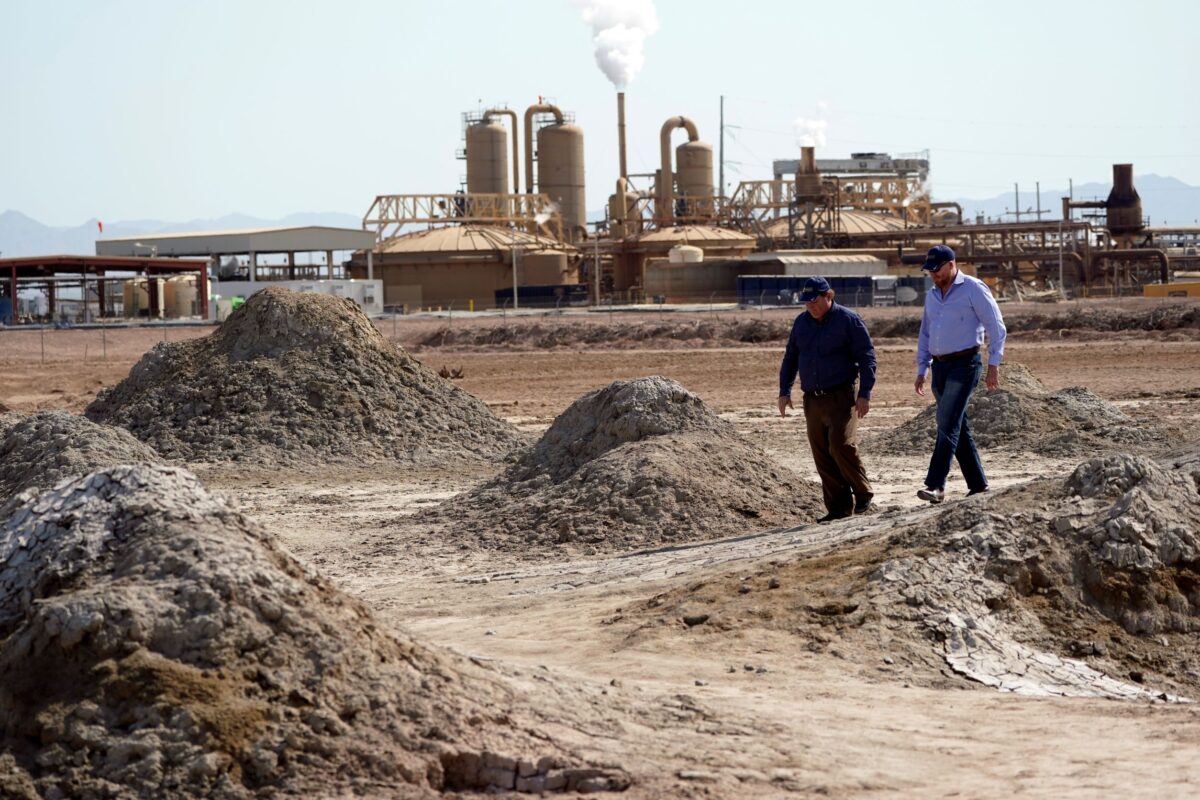
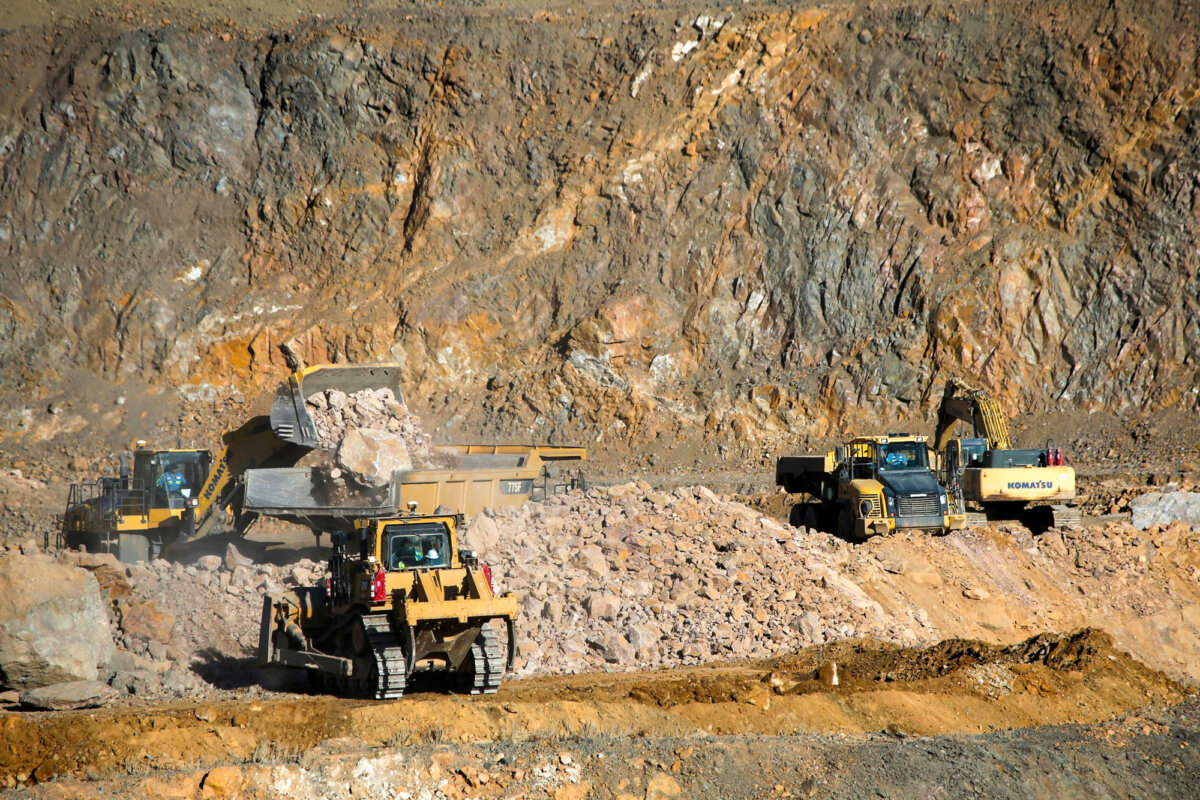
California’s Mountain Pass mine was the world’s largest rare-earths producer from the mid-1960s to the 1980s before China-based processors drove market prices down while regulatory pressures drove operating costs up. With its 2002 closure, there were no operating rare-earth mines in the United States.
The Obama-era creation of a defense department fund to subsidize Molycorp’s Mountain Pass reopening was a pivotal precursor in whole-of-government efforts by successive administrations, galvanized as an urgent priority with Trump’s 2025 return to the White House.
Yet, despite defense department subsidies, Molycorp went bankrupt in 2015. The mine languished until 2017, when MP Materials purchased it.
Sloustcher recalled that when MP Materials acquired Mountain Pass, “it was in care-and-maintenance under the supervision of a federal judge.”
“There was no accounting system, no corporate infrastructure, literally eight people,” he said. “The U.S. had zero mining, zero refining, and zero magnet manufacturing.”
Sloustcher said MP Materials faced two immediate challenges.
“In the early years of our business, we produced mineral concentrate at Mountain Pass that could only be sold into China, the sole market with refining capacity,” he said. “We reinvested profits to build refining capabilities at Mountain Pass but, as we prepared to launch, neodymium and praseodymium prices … collapsed to two levels below even China’s lowest production cost. That predatory pricing destroyed incentives to invest, and it kept capital scarce.”
The Trump administration’s 15 percent stake and $400 million stock purchase in MP Materials, held by the War Department, has fostered “burgeoning industry investment elsewhere,” Sloustcher said, such as “Apple following shortly thereafter with their own $500 million investment” in MP Materials’ battery magnet plant near Fort Worth, Texas.
The CCP is committed to shutting down Mountain Pass using “their playbook,” Krishnamoorthi stated. In 2024, it “slashed the price from roughly $170 per kilogram to about $49 per kilogram where it remains now” for NdPr (neodymium and praseodymium), “essential in permanent, super-hard magnets,” he said.
The federal subsidies and growing private investment demonstrate the United States has “significant resolve” to weather CCP manipulation and “in our case, [predatory pricing] has been effectively taken off the table,” Sloustcher said.
“Today, we have the second-largest rare-earth mine on Earth. We have the largest rare-earth refinery in the Western Hemisphere. We have metal production on a commercial basis, and we’re getting ready to do full-scale magnet production [in Texas],” he said.
The CCP is also trying to drive non-China-owned lithium operations out of business, Evans said, citing the Department of Energy’s 5 percent stake in Lithium Americas and 5 percent share in its Nevada mining project, and a $225 million grant for Standard Lithium’s Southwest Arkansas Lithium brine-extraction project, as vital.
“Both projects could have moved much, much faster if the Chinese hadn’t colluded over the last three years to depress lithium prices to an all-time low,” he said, adding that Lithium Americas “could have been in construction a year-and-a-half ago” if not for CCP manipulation.
China-based corporations control four of the world’s top five lithium mines and 70 percent of global processing capacity, according to the report, but Evans said that with efforts by the United States, Canada, Australia, Chile, and Bolivia, the CCP can be thwarted.
“Between Nevada and the Arkansas–Texas region, we have much better reserves than the Chinese do. We could be actually a world-class, sizable global supplier of lithium-refined chemicals in this country and usurp Chinese manipulation,” he said.
Innovations, Alternatives
“So the question is, what do we do about it?” Krishnamoorthi asked. “Mining and processing more rare earths is only part of the solution. We also need alternatives that potentially bypass rare earths entirely.”
Gimenez said: “Wouldn’t it be cheaper to go full blast on developing alternatives versus trying to catch the Chinese? I think the Chinese are so far ahead, it’s impossible for us to catch up.”
He suggested that the nation should be “more focused on investing in alternatives.”
“Are there alternatives to these rare earths … on the horizon?” Gimenez said.
Yes, Niron Magnetics’ Rowntree said, noting that his Minneapolis-based company is “pioneering the world’s first high-performance, rare earth-free permanent magnets” with iron and nitrogen, abundant materials that “no foreign power can monopolize or restrict.”
The Department of Energy has invested more than $52.2 million in grants and tax credits in Niron since its 2014 founding by Jian-Ping Wang, a University of Minnesota professor.
“We developed this new type of magnet technology over 12 years, the first new magnetic material commercialized in 30 years,” Rowntree said, noting that it eliminates “the need for rare-earth mining, chemical separation facilities, and complex metallurgical processing.”
Those foundational commitments have spurred “institutional investors, including GM, Stellantis, and Samsung,” to invest more than $300 million “in scaling the technology,” he said.
In October, Niron broke ground on a plant that will produce up to 1,500 tons of permanent magnets annually by 2027.
“We’re evaluating sites for a second, 10,000-ton-per-year facility,” Rowntree said.
He said the plants will serve “American automotive manufacturers, technology companies, defense contractors, and energy firms, creating hundreds of highly skilled jobs.”
Niron “was fortunate [to be] in the right place at the right time,” Rowntree said, and could serve as a model for similar public-private ventures in bringing innovation to market.
“There are other alternatives that need to be developed and invested in, but it’s not necessarily a quick solution,” he said. “We need to invest in these alternatives now.”
Krishnamoorthi agreed.
“If we want to break China’s stranglehold, we need an all-hands-on-deck approach. It also means funding research,” he said.
He asked whether Niron’s battery could keep the U.S. economy going if “the CCP cuts off rare-earth exports entirely to the U.S.”
Rowntree said it could.
“The United States already has everything needed to build a secure, resilient, and diversified magnet supply chain,” he said. “American industry and innovation have produced proven solutions. Federal policy must now align with strategic necessity.”
 Friends Read Free
Copy
Facebook
Tweet
Friends Read Free
Copy
Facebook
Tweet