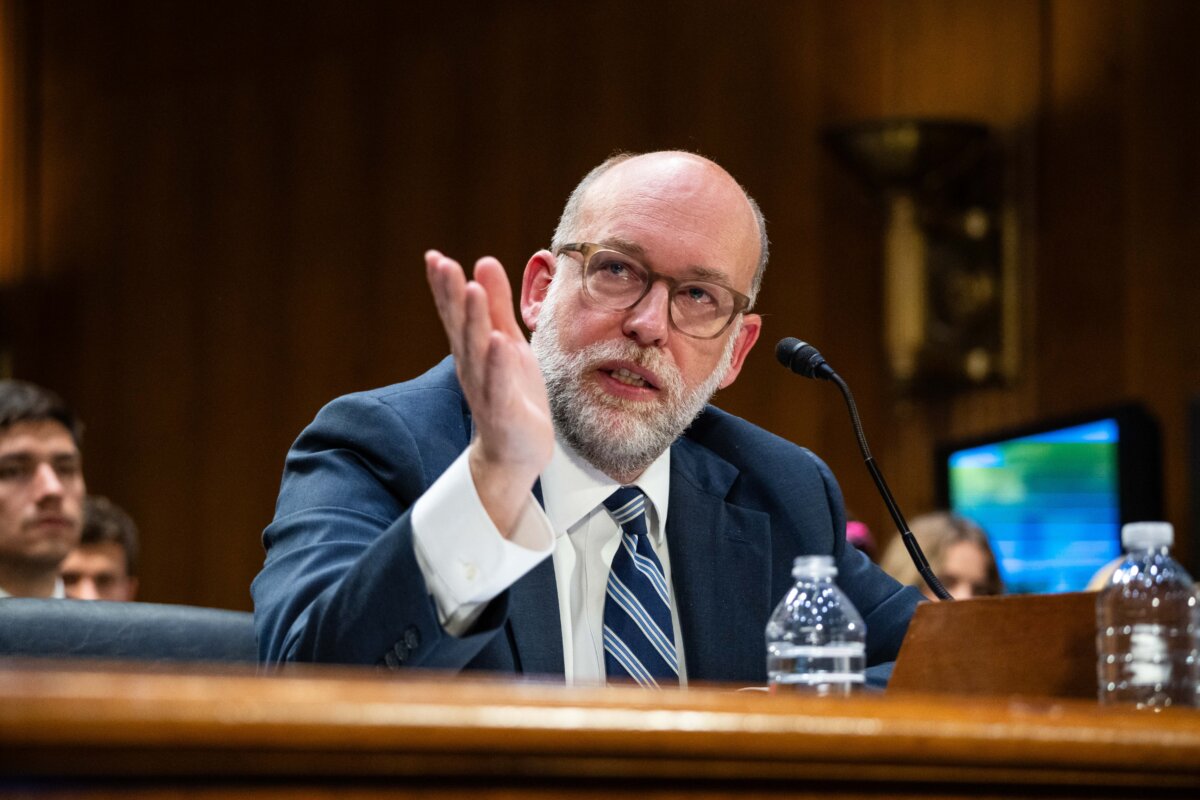

White House Office of Management and Budget Director Russ Vought on June 25 appeared before a skeptical Senate Appropriations Committee to make the administration’s pitch for a $9.4 billion rescissions package.
“This package reflects the Trump administration’s steadfast commitment to cutting wasteful federal spending antithetical to American interests in correcting our fiscal trajectory,” Vought told the panel.
The legislation, which passed the House of Representatives in a 214–212 vote on June 12, faces a difficult battle in the Senate, where some Republican senators, as well as their opposition Democrat colleagues, remain unconvinced by the package to implement possible cuts identified by the Department of Government Efficiency.
The bill was sponsored in the Senate by Sen. Eric Schmitt (R-Mo.).
Concerns about the budget cuts were on full display during the hearing as Vought urged lawmakers to move ahead with the cuts.
President Donald Trump’s rescissions package primarily targets funding for the U.S. Agency for International Development (USAID) and the Corporation for Public Broadcasting, which oversees the Public Broadcasting Service and National Public Radio. At $9.4 billion, the package would surpass all spending cuts since 1989 under the process laid out in the Impoundment Control Act—just shy of $6 billion.
The Impoundment Control Act gives Congress 45 days of continuous session to approve cuts offered by the president—the cuts cannot be resubmitted if Congress fails to do so.
In a sign of the political tensions around the package, Vought’s opening statement was initially interrupted by protestors who had to be escorted out of the hearing room by U.S. Capitol Police, leading Appropriations Committee Chair Susan Collins (R-Maine) to temporarily suspend the hearing until order was restored in the room.
As proceedings continued, many on the committee voiced at least one concern as they questioned Vought. These largely fell into two primary categories: funding for the President’s Emergency Plan for AIDS Relief (PEPFAR) and the effect that USAID cuts could have on the United States’ ability to project “soft power” internationally.
Historically, rescissions requests have fared better in the House than they have in the Senate.
HIV/AIDS Prevention Program
Collins raised concerns about the effect of the package on the PEPFAR program from the beginning of the hearing.
Collins was referencing proposed cuts totaling $400 million to the PEPFAR program, an international anti-AIDS program inaugurated by President George W. Bush in 2003. The program currently aims to end the HIV/AIDS pandemic internationally by 2030.
Collins noted that the United States is on track to be able to turn control of HIV/AIDS prevention programs to foreign countries by the turn of the decade.
“Cutting funding now, funding that is aimed at preventing disease transmission, would be extraordinarily ill-advised and short-sighted,” she said.
Vought countered that the $400 million in cuts targets waste and abuse within PEPFAR and not the project’s aims.
“Under the guise of so-called preventative care within [the] PEPFAR program, Americans have been funding the following,” Vought said. He then listed a string of specific programs that have been funded by PEPFAR: “$5.5 million to LGBTQ advocacy in Uganda; $800,000 for transgender people, sex workers, and their clients in Nepal; $3.6 million for LGBTQ activism … [and] dance focus groups for male prostitutes in Haiti.”
Sen. Lindsey Graham (R-S.C.)—who dubbed himself a longtime supporter of the PEPFAR program—announced that he would back the package during the hearing after expressing some skepticism about it. He referenced Vought’s explanation of the PEPFAR cuts.
“You know, I’m [a] vote for it, just as a statement that PEPFAR is important but it’s not beyond scrutiny, that the way you run the government has consequences,” Graham said.
Collins and other critics maintained their skepticism about the effect the cuts would have on related nutrition and medicine programs under the umbrella of preventative measures funded by PEPFAR.
“I certainly agree that the taxpayers of the United States should not be paying for things like ‘promoting vegan food in Zambia,’” she said. “However, these and other controversial and questionable projects were the product of misguided priorities of the Biden administration [in fiscal year 2025 funds].
“Unless the current administration plans to continue these controversial projects that it has identified, which I very much doubt, those projects alone cannot be used to justify the proposed rescissions. I am confident that the Trump administration would not allow this kind of wasteful spending.”
‘Soft Power’
Concerns about the effect that the cuts could have on U.S. “soft power” internationally were first raised during the hearing by Collins. Sen. Mitch McConnell (R-Ky.), majority leader in the last Congress, also devoted the bulk of his remarks to these concerns.
“Soft power” describes power using economic or cultural methods, such as foreign aid.
“Over my years in Senate, the biggest supporters of soft power I’ve run into have been the military generals, who are fully aware of how much more costly it is to have a war than to prevent one,” McConnell said.
“Soft power, at very little expense, goes a long way.”
Sen. Mike Rounds (R-S.D.) also expressed the importance of soft power, saying the alternative was allowing China and other U.S. adversaries to fill the vacuum.
His concerns were echoed by Sen. Brian Schatz (D-Hawaii), who noted that the proposed $1 billion in cuts to treaty dues and support for international organizations such as UNICEF risked the Chinese regime “increasing its funding to gain influence and re-write rules.”
Vought said the foreign aid cuts had been carefully chosen to solely target waste and abuse, telling the panel, “This is not a fade on soft power.”
“[Secretary of State Marco Rubio and I are] going line by line in each of these programs to articulate where we believe soft power could be effective, where we think that investment on the front end will keep us out of long-term, hard power conflicts of that nature,” he said.
Speaking to The Epoch Times after the hearing, Collins indicated that she remained unconvinced, saying PEPFAR was an important part of exerting U.S. soft power.
“We get benefits from this program,” she said.
Other Republican senators also have concerns.
Sen. Jerry Moran (R-Kan.) has spoken against some proposed USAID cuts.
Rounds, Collins, and Sen. Lisa Murkowski (R-Alaska) also expressed concerns about cuts to the Corporation for Public Broadcasting.
Correction: A previous version of this article misspelled the named of Office of Management and Budget Director Russ Vought and gave an incorrect state for Sen. Brian Schatz. The Epoch Times regrets the errors.
 Friends Read Free
Copy
Facebook
Tweet
Friends Read Free
Copy
Facebook
Tweet