
A massive effort is underway to evacuate global travelers in the Middle East amid the Iran war.
“Since February 28, over 17,500 American citizens have returned to the United States from the Middle East,” Assistant Secretary of State for Global Public Affairs Dylan Johnson said in a post on X on March 4.
The State Department has assisted nearly 6,500 Americans abroad with security guidance and travel assistance, but it’s not clear how many flights the U.S. government directly booked for travelers trying to exit the region.
“The administration is already rapidly chartering flights free of charge and booking commercial options, which we expect to become increasingly available as time goes on and the success of this mission further comes to fruition,” White House press secretary Karoline Leavitt said during a briefing on March 4.
Leavitt vowed that the Trump administration would not rest until every American is returned home safely.
Shanice Day, a Texas native stuck in the United Arab Emirates, told The Epoch Times she has not been able to leave Dubai since the conflict began.
“I feel like we’re all losing it here,” the Houston resident said.
Day arrived in Dubai on Feb. 24 to celebrate her 30th birthday.
After the conflict broke out on Feb. 28, she registered with the Smart Traveler Enrollment Program and was hoping to receive evacuation assistance from the U.S. government, but she said she is starting to lose faith that the Trump administration will quickly remove her from the region.
The Texan confirmed to The Epoch Times that she was able to independently book a flight from Dubai to London with a layover in Zurich, but she was not able to board because she didn’t have advance clearance to enter the UK.
The UK requires all U.S. travelers to be pre-approved using its electronic travel authorization system.
The flight she booked was ultimately canceled.
“Either way it goes, we will not make it home,” Day said of the flight predicament.
Day has not yet been refunded for her canceled flights and is relying on a GoFundMe page to pay for her unexpected extended stay in Dubai.
Other countries, such as the UK and France, began repatriation flights on March 4, but there have been delays.
Airports in the United Arab Emirates (UAE), which sit just south of Iran across the Persian Gulf, experienced hundreds of cancellations on March 4.
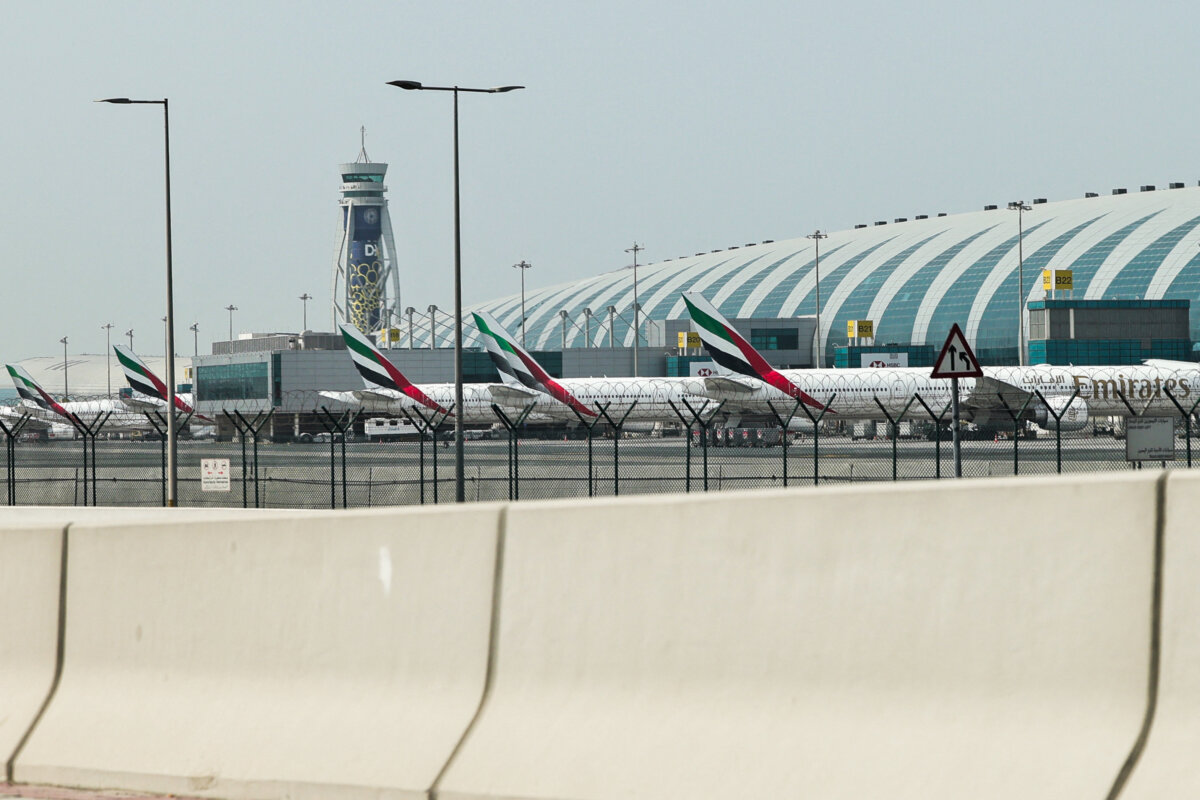
Dubai International Airport, located in the northern section of the UAE, had the most cancellations on March 4, affecting nearly 700 incoming and outgoing flights, according to flight tracking website FlightAware.
The airport confirmed that a small number of flights will take off from Dubai, the world’s busiest international airport, but it urged all flyers to stay away unless an airline contacts them to confirm a flight.
Abu Dhabi International Airport, also located in the UAE, just 77 miles southwest of Dubai, had nearly 300 cancellations on March 4.
In Qatar, south of Iran across the Persian Gulf, more than 250 flights were canceled at Hamad International Airport in Doha on March 4.
“Flight operations remain suspended at Hamad International Airport following the temporary closure of Qatari airspace, mandated by the Qatar Civil Aviation Authority,” Hamad International Airport stated.
The top airlines with flight cancellations included Emirates, Etihad Airways, Qatar Airways, and flydubai.
Hundreds of flights in the region scheduled for March 5 have been canceled.
 Friends Read Free
Copy
Facebook
Tweet
Friends Read Free
Copy
Facebook
Tweet