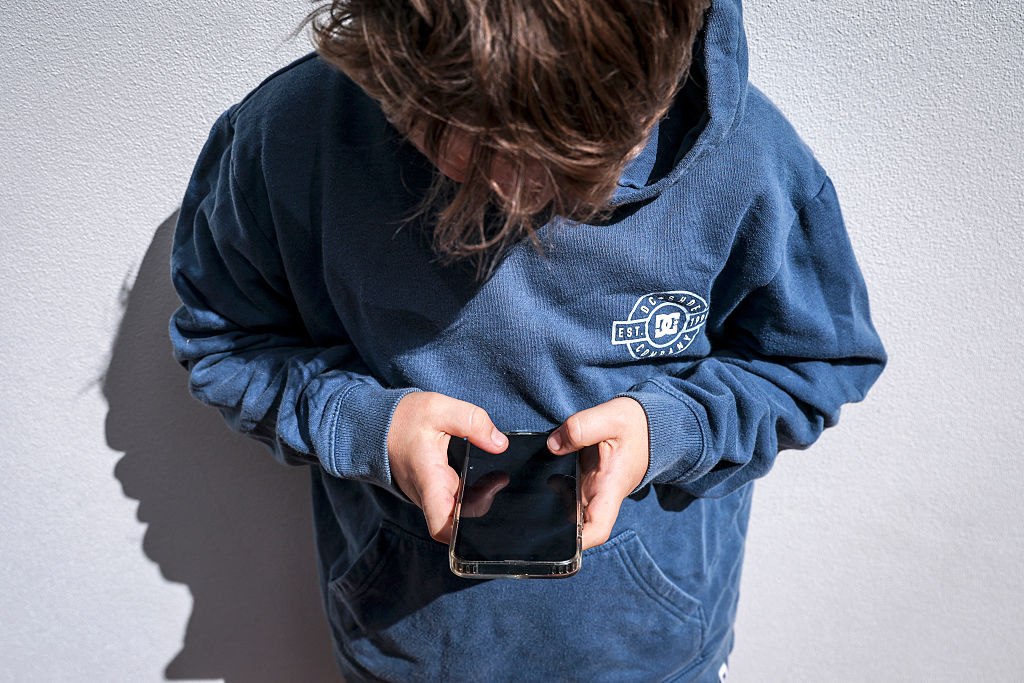

Two of Britain’s most senior police officers have urged the UK government to restrict the use of social media by under-16s to protect them from harm.
National Crime Agency (NCA) Director General Graeme Biggar and National Police Chiefs’ Council (NPCC) Chief Constable Gavin Stephens spoke at a briefing for journalists on May 21.
“Our assessment is clear: the online environment in its current form is not safe for children,” Biggar said.
The pair said social media apps, gaming platforms, and messaging apps all have design features that criminals are exploiting to target children.
‘Enough is Enough’
“The industry response has been too slow, while the problem has been getting worse. Enough is enough,” Biggar said.
“Either the tech companies must effectively stop children using those features or make them safe. If they do not, the government should ban them for under-16s.”
“In every other walk of everyday life, there are laws and safeguards in place to protect children, and yet the online space remains something of a wild west where legislation and regulation has failed to keep up with the pace of technology,” Stephens said.
Biggar and Stephens listed a number of features that were being exploited by criminals and sex offenders.
- Mass discoverability, which allows offenders to identify and target child victims at scale.
- Unrestricted contact with unknown adults, creating a danger of grooming and exploitation.
- Private or encrypted messaging, where abuse can escalate undetected.
- Algorithms that recommend and share harmful content or contacts.
- Nude image sharing or streaming, where children can be coerced into producing or sharing sexual content.
- Weak age restrictions that allow adults to misrepresent their ages, undermining all other safeguards.
Their intervention comes just days before the end of a consultation exercise—on May 26—being run by the Department for Science, Innovation, and Technology (DSIT) on how to improve children’s relationships with mobile phones and social media.
One option considered in the consultation is a total ban on social media for under-16s.
In January, a joint statement from 42 child protection charities and online safety groups said a ban on social media for under-16s could have “serious unintended consequences that could put children at greater risk.”
“For countless young people, social media can be a lifeline. A place where isolated teenagers find community,” Chris Sherwood, the CEO of one of those charities, the NSPCC, said in a blog posted on Jan. 21.
“Pulling the plug on those spaces overnight would take away these communities and limit teenagers’ worlds.”
The Australia Ban
Australia has already enacted a ban on under-16s using social media, and in January announced that 5 million social media accounts linked to children had been removed.
British Prime Minister Keir Starmer met with senior executives from Meta, Snap, TikTok, X, and Google—which owns YouTube—last month and urged them to “work with us to do better by British children.”
Britain passed the Online Safety Act in 2023, which introduced a series of safeguards, including age limits for content in four areas—pornography, suicide, self-harm, and eating disorders. They came into force in July 2025.
Biggar said the Online Safety Act was a “powerful piece of legislation,” but he said it had taken years to implement.
“Progress has been slow, it has been attritional, and it is insufficient,” he added.
In 2024, Scarlett Jenkinson and Eddie Ratcliffe were convicted of the murder of Brianna Ghey, a teenage boy who identified as a girl. Jenkinson and Ratcliffe were 15 at the time of the crime, and the trial heard they had both viewed inappropriate content, including scenes of extreme violence, online.
The victim’s mother, Esther Ghey, has campaigned for a ban on smartphones in schools and has written an open letter to Starmer urging him to implement it.
She told the BBC she was “deeply disappointed” Starmer had met with tech bosses before consulting with campaigners and activists such as herself.
The NCA’s 2026 national strategic assessment showed that online-facilitated child sexual abuse (CSA) accounts for at least 42 percent of recorded CSA offenses in England and Wales.
A British government spokesperson, in an email to The Epoch Times, said, “Tech companies have a legal duty to keep children safe online, including by tackling toxic algorithms, removing illegal content such as abhorrent child sexual abuse material, and preventing unknown adults from contacting children.”
“Ofcom [the UK communications regulator] has our full backing to act against those who fail to comply,” the spokesperson added, “We are going further—consulting on options from age limits and app curfews to outright bans.”
“We also remain committed to making it impossible for children in the UK to take, share or view nude images, and are working at pace to deliver this,” the spokesperson said.
 Friends Read Free
Copy
Facebook
Tweet
Friends Read Free
Copy
Facebook
Tweet