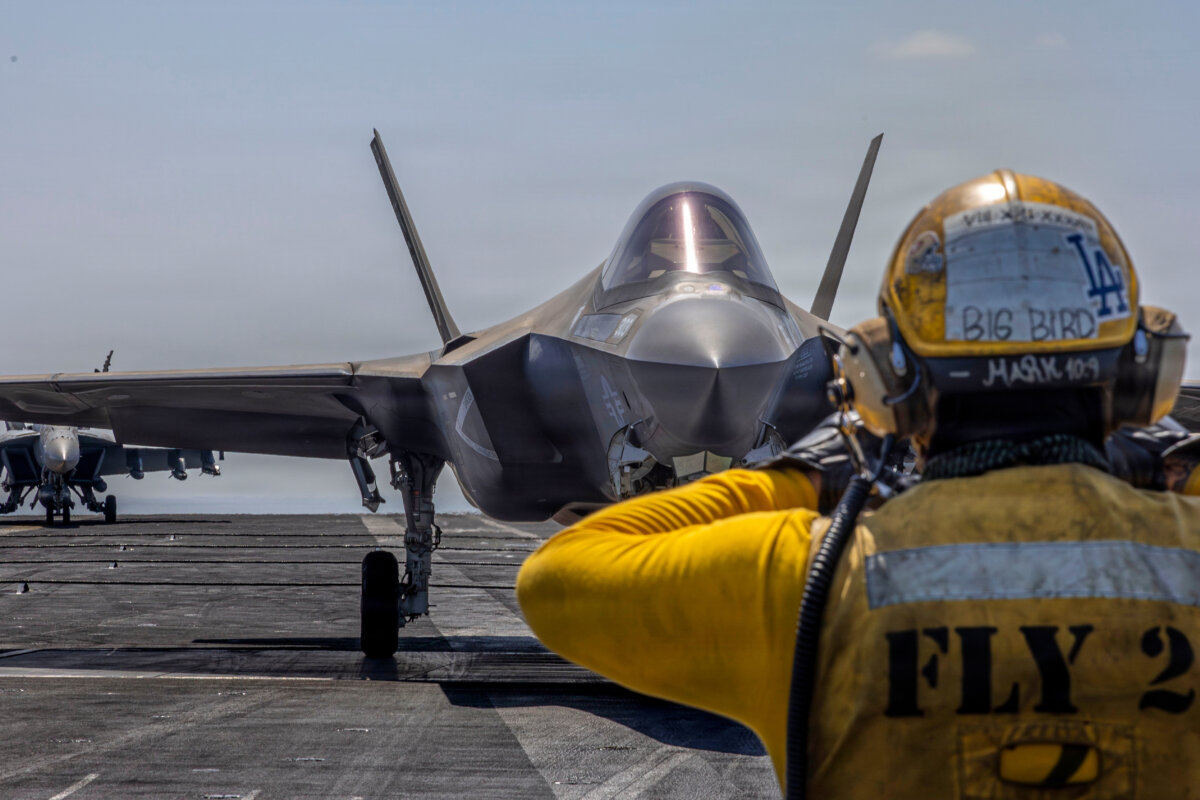

The U.S. military has deployed over 50,000 troops, 200 fighter jets, two aircraft carriers, and bombers as part of Operation Epic Fury against Iran, with more capabilities “on the way,” Adm. Brad Cooper, commander of the U.S. Central Command (CENTCOM), said in a March 3 video update on X.
“These forces bring a massive amount of firepower, representing the largest buildup by the U.S. in the Middle East in a generation,” Cooper said. “Now, we’re less than 100 hours into this operation, and we’ve already struck nearly 2,000 targets with more than 2,000 munitions. We have severely degraded Iran’s air defenses and destroyed hundreds of Iran’s ballistic missiles, launchers, and drones.”
“Our B-2 bombers and B-1 bombers have executed uncontested surgical strikes against multiple missile facilities deep inside Iran, and then just last night, a B-52 bomber force struck ballistic missile and command and control posts,” Cooper wrote, adding that U.S. forces had also sunk the entire Iranian Navy, a total of 17 ships, “including the most operational Iranian submarine, that now has a hole in its side.”
The Iranian regime, which has harassed international shipping for decades, now does not have a single ship in the Arabian Gulf, Strait of Hormuz, or the Gulf of Oman, Cooper said.
The admiral said U.S. forces will continue to hunt down Iran’s last remaining mobile ballistic missile launchers to remove the regime’s “lingering launch capability.”
According to Cooper, the Iranian regime has launched more than 500 ballistic missiles and over 2,000 drones in retaliatory attacks, with Tehran “indiscriminately targeting civilians.” However, the regime’s ability to hit the United States and its partners is declining.
U.S. and Israeli forces launched coordinated strikes against Iran on Feb. 28, with the conflict in its fourth day on Tuesday.
In a March 1 post on X, CENTCOM said the Iranian Islamic Revolutionary Guard Corps (IRGC) had killed more than 1,000 Americans over the past 47 years.
“Yesterday, a large-scale U.S. strike cut off the head of the snake. America has the most powerful military on earth, and the IRGC no longer has a headquarters,” CENTCOM said.
As of March 2, six U.S. service members have been killed in action. A CENTCOM spokesperson said 18 service members have been seriously wounded.
Meanwhile, Speaker of the House Mike Johnson (R-La.) expressed disapproval regarding an impending vote on the War Powers Act that threatens to restrict President Donald Trump’s ability to execute military operations in Iran.
“Iran’s increasing aggression and rapid ballistic missile development presented a clear and imminent threat that demanded decisive action,” Johnson said in a March 3 X post. “Efforts now to restrict the Commander in Chief from completing this limited but crucial mission would be both dangerous and irresponsible.”
Using Iranian Tech Against Them
Iran has launched hundreds of drones and missiles targeting Gulf nations in retaliation, with drones being the key offensive asset deployed by the regime.
By Sunday, the United Arab Emirates had shot down more than 500 drones, Kuwait nearly 300, and Jordan almost 50 drones. On Monday, the Saudi Ministry of Defense said the U.S. Embassy in Riyadh was struck by two drones.
In a March 3 post on X, CENTCOM shared a video of one of its attacks on Iranian drones. “The Iranian regime’s killer drones have been a menace in the Middle East for years. These drones are no longer a tolerable risk,” CENTCOM said.
In his video update, Copper said that for the first time, CENTCOM’s drone task force, Task Force Scorpion Strike, had launched one-way attack drones against Iran, achieving “massive effects.”
“I’d like to point out these drones were originally an Iranian design. We took them back to America, made them better, and fired them right back at Iran,” Cooper said.
“Our military objectives are crystal clear, and our people are executing an immensely complex and historic mission with relentless lethality, conviction, and professionalism. And we’ve just begun. But I have the utmost confidence that we, alongside our partners, will absolutely achieve our military objectives.”
Evacuating Citizens
The United States and other nations are in the process of evacuating their citizens from the Middle East.
On March 2, the U.S. Department of State urged Americans in the region to leave immediately, citing “serious safety risks.”
In a March 3 post on Truth Social, Trump said that over 9,000 Americans have returned safely to the United States from the Middle East since the launch of Operation Epic Fury.
Secretary of State Marco Rubio said in a Tuesday press conference that more U.S. citizens are attempting to leave the Middle East. In addition to charter and military flights, the federal government is working to secure expanded commercial flight options to ensure Americans can get back home.
The UK and European nations such as Italy, Poland, Lithuania, and Austria have begun or are planning the evacuation of their citizens from the Middle East. From Asia, Thailand and South Korea are engaged in evacuating their people.
On Monday, Trump said during a White House event that the military operation in Iran is expected to last four to five weeks, and was progressing ahead of schedule.
The UK had initially decided not to take part in U.S. strikes against Iran. But as Iran’s actions threatened British nationals and interests in the Middle East, Britain’s Prime Minister Keir Starmer said the country would allow the United States to use British bases for “limited defensive purpose.”
French President Emmanuel Macron said on March 3 that the country’s nuclear-powered aircraft carrier Charles de Gaulle had set sail for the Eastern Mediterranean, accompanied by air assets and frigate escort, to protect French assets in the Middle East.
 Friends Read Free
Copy
Facebook
Tweet
Friends Read Free
Copy
Facebook
Tweet