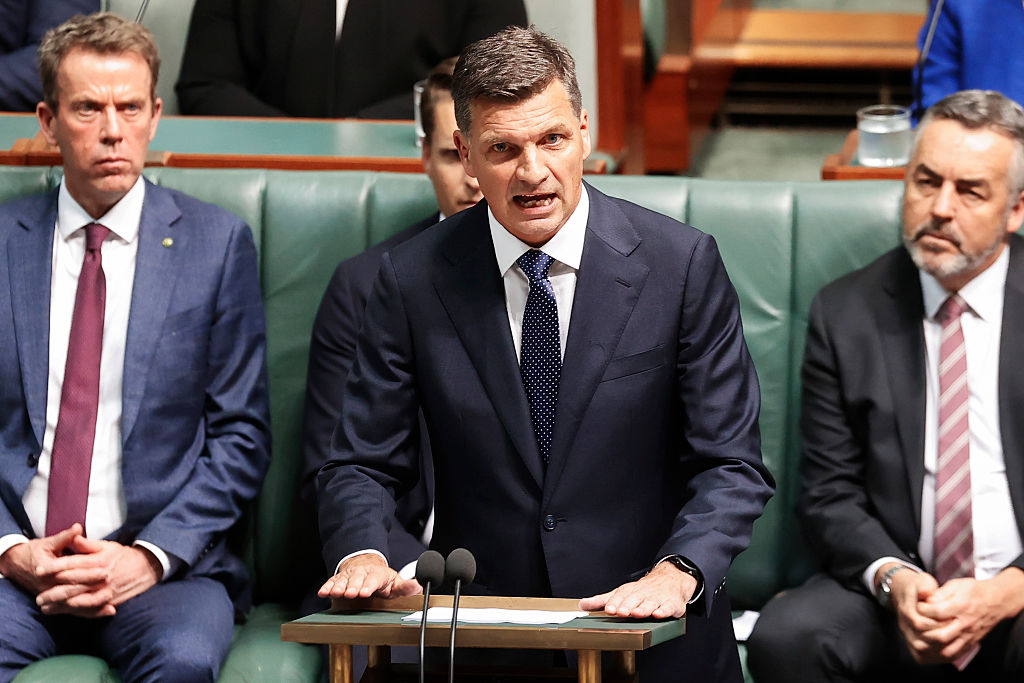

Opposition Leader Angus Taylor has used his official budget reply to outline his economic plan for the country while accusing the Albanese government weakening incentives to invest and build wealth.
On May 12, Labor handed down its first official budget after winning the May election last year.
It contained sweeping changes to how Australians previously could invest, preserve, and generate passive income.
Labor’s changes include removing the 50 percent capital gains tax (CGT) discount so that those selling investment assets like shares, crypto, and property will be liable for a higher tax.
Another is removing negative gearing from property investments, meaning investors can no longer deduct losses from their property against their taxable income, except for new builds.
While the third major change is a new flat 30 percent tax on income going into a discretionary trust, a legal vehicle often used by families and small business owners to help “split” income and reduce their own tax burden.
Taylor Calls Labor’s Budget ‘Intergenerational Fraud’
The opposition leader called Labor’s budget “intergenerational fraud” and pledged to repeal the government’s policies if elected.
“This prime minister is one of many Australians who has benefited from these opportunities. Now he’s pulling up the ladder of opportunity for the next generation, not only by whacking higher taxes on housing, but also on their savings, investments and small businesses,” Taylor told Parliament on May 14.
He described the changes as “an assault on Australian aspiration” and vowed the Coalition would fight to block them.
Stopping ‘Bracket Creep’
Taylor also pledged sweeping changes to the tax system to prevent “bracket creep,” which happens when workers move into higher tax brackets because of inflation.
Under the Coalition’s plan, the two lowest income tax thresholds—covering those earning between $18,201 to $135,000—will be indexed to inflation from 2028–29 so that Australians don’t inadvertently get swept into higher tax brackets.
Taylor said a worker earning $70,000 a year could lose all of their real wage gains if they are affected by bracket creep.
The highest tax brackets will be indexed to inflation from 2031–32.
Overall this will deliver tax relief of about $250 in the first year and more than $1,000 in the fourth, the Coalition forecasts, and will see the government take about $22 billion less tax from the people.
“This is generational tax reform. It’s fair, it’s simple, and it’s honest,” Taylor said.
‘Biggest Cuts to Immigration’
Taylor promised to remove benefits for non-citizens and reserve welfare and housing schemes for Australians citizens only.
He also pledged one of the “biggest cuts to immigration in Australian history,” saying migration levels would be tied to the number of homes built each year.
“Never again will a government be able to bring in more people than our housing can support.”
He said the Coalition would provide exact migration targets closer to the election.
The Coalition also reiterated an earlier pledge for stricter visa rules, mandatory English obligations for permanent visa holders, and deportation of those who no longer have a valid visa.
“We’ll enhance screening to stop radicals from entering our borders,” Taylor also pledged.
Scrapping Net Zero
Taylor pledged to abolish Labor’s climate agencies, EV tax breaks and parts of its renewable energy rollout, arguing the policies were costly and ineffective.
He said subsidies for electric vehicles largely benefited wealthier Australians.
“We will abolish Labor’s climate bureaucracy, its net zero agency, its power lines to nowhere, and its tax on the family car and you.”
The opposition leader said the Coalition would abolish Labor’s safeguard mechanism and other carbon-related policies, arguing they were driving up costs for households and industries.
Taylor pledged $800 million for new fuel storage, and pledged support for coal, gas, oil, biofuels, and nuclear energy development.
He also said Coalition would speed up approvals for major gas and oil projects, including the Browse Basin and the Toondoon oil project, by rewriting environmental laws and reducing barriers to development.
Taylor also pledged to strengthen Australia’s fuel security by doubling minimum reserves of petrol, diesel and jet fuel, taking national reserves closer to 90 days, the International Energy Agency standard.
Invest 80 Cents of Every Dollar from Resource Industry
Taylor accused Labor of wasting the windfall from high commodity prices instead of paying down debt and investing in infrastructure.
He proposed investing 80 cents of every dollar from the resource industry into a future fund to reduce debt and support nation-building projects.
“Instead of paying down debt and building our nation, Labor has squandered resource profits with its self indulgent spending.”
He said a quarter of the proposed future fund would be directed to regional Australia, particularly areas driving the nation’s mining industries.
Reducing the State’s Involvement in the Economy
Taylor argued inflation and interest rates could only be brought down by reducing government spending, which he said Labor had pushed to a 40-year high outside the pandemic period.
He pledged the Coalition would cut spending and make the National Disability Insurance Scheme more sustainable—currently a major employment driver in Australia.
Taylor said Australia needed to move away from what he described as a “government directed economy” and return to a freer market-driven system with lower government intervention.
To boost private investment, Taylor announced a permanent instant asset write-off worth $50,000 for smaller businesses turning over less than $10 million.
Cutting Thousands of Pages of Regulation
Taylor pledged to simplify the Tax Act, Corporations Act, National Construction Code, and Environment Protection and Biodiversity Conservation Act.
Pointing to the Construction Code, Taylor said Labor had expanded it by more than 2,000 pages.
“The Code’s 1,000s of rules add tens of thousands of dollars to new housing bills. We want the Code to be closer to 200 pages, and we will go further.”
He also argued regulators had become too large and interventionist under Labor.
“They’re regulating for regulations sake. They need to get out of the way.”
Taylor said a Coalition government would require regulators to encourage competition, investment, and wage growth.
He also pledged $5 billion for housing-related infrastructure such as roads, water and sewerage to unlock an estimated 400,000 homes.
Lifting Defence Spending to 3 Percent
Taylor said national security would become a bigger priority under a Coalition government, including a commitment to lift defence spending to at least 3 percent of GDP.
“That is what is needed to bolster our ranks of war fighters in this country, to harden our bases, to deliver AUKUS to build offensive and defensive drones and missiles at speed and scale in an age where such weapons are essential to deter a larger adversary,” he said.
He also pledged a new national security strategy and dedicated National Security Advisor.
 Friends Read Free
Copy
Facebook
Tweet
Friends Read Free
Copy
Facebook
Tweet