
News Analysis
There’s a new boss in Ottawa, and he thinks there’s a business case for boosting exports of liquefied natural gas (LNG), unlike his predecessor.
Prime Minister Mark Carney has multiplied efforts to diversify trade away from the United States, and LNG has surfaced as a valuable currency.
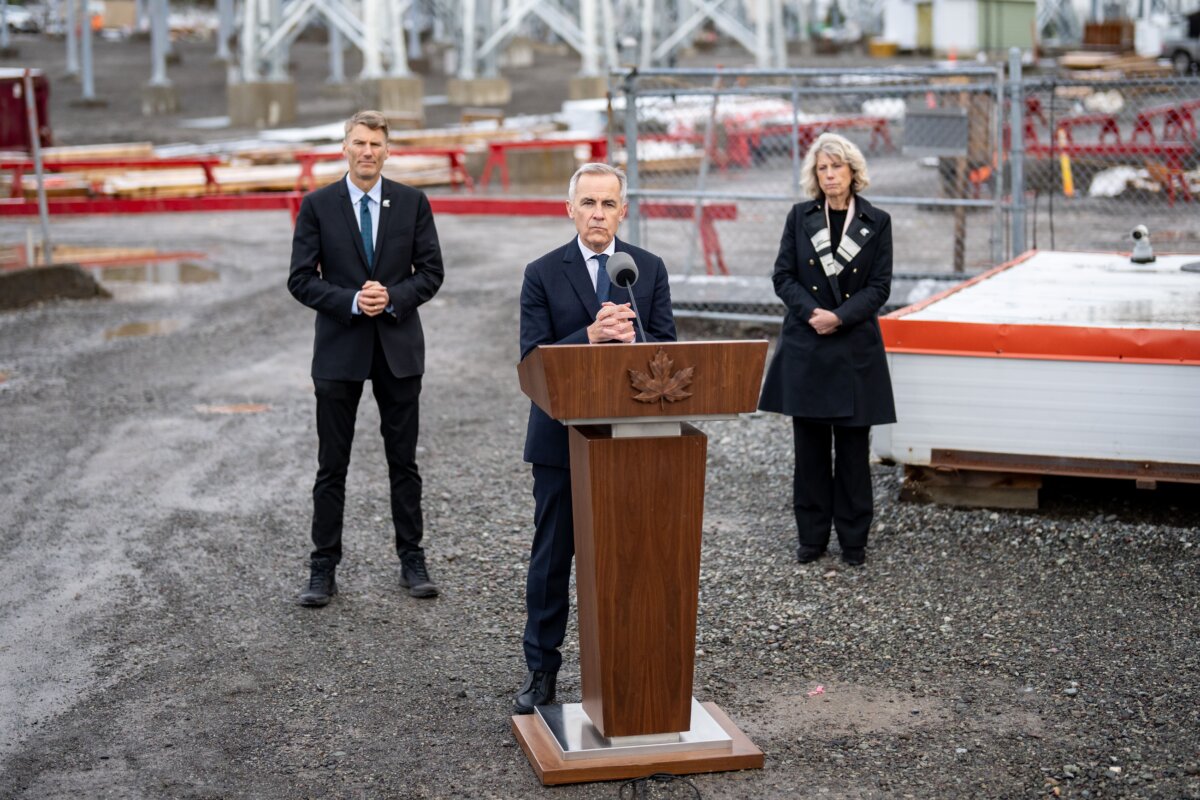
“LNG can help Canada build new trading relationships, especially in fast-growing markets in Asia,” Carney said on Nov. 13 when he announced a new tranche of major projects. The prime minister was fresh off his first trip to the Indo-Pacific earlier this month, which took him to Malaysia, Singapore, and South Korea.
While Carney has been a strong proponent of net-zero policies, he has also been touting Canada’s status as an energy “superpower” in both “clean and conventional” sources.
During his recent announcement, he labelled LNG as an “essential fuel for the energy transition.”
The idea is that increasing use of natural gas can reduce reliance on other fuels like coal and hence lower carbon emissions, with the ultimate goal to increasingly transition to renewables.
There’s currently a large appetite for LNG on the world stage, and countries and businesses are racing to seize the opportunity.
Canada will face stiff competition from major players like the United States and Qatar, and it remains to be seen if Ottawa’s strategy of designating a few projects for fast-tracking and financial support will rapidly improve Canada’s standing.
Ottawa’s pro-LNG stance has been reflected in the major projects identified in recent weeks. Two of the 11 projects referred to the Major Projects Office so far pertain to LNG export facilities on the West Coast.
Carney is not entirely revolutionizing the Liberals’ approach to exporting Canada’s wealth in natural gas, as most of the seven LNG projects in B.C. obtained their federal export licences under the previous Liberal government.
Under the previous Liberal government, however, several LNG export projects were dropped by proponents for a host of reasons, whether commercial, regulatory, or not wanting to deal with indigenous opposition. Those include Pacific Northwest LNG, Aurora LNG, Prince Rupert LNG, and WCC LNG.
Mood Change
The mood and intent have changed under the Carney government, with LNG being openly promoted and backed as a transformative strategy.
Former Prime Minister Justin Trudeau’s assertion in 2022 that there had “never been a strong business case” to ship LNG to Europe has become emblematic. This occurred shortly after Russia invaded Ukraine, causing an energy shock in Europe and throughout the world.
Trudeau was referring to the difficulty of linking the gas fields to shipping terminals, but German stakeholders brushed that concern aside when Energy Minister Tim Hodgson visited the country earlier this year.
“German companies today are looking at buying West Coast LNG and swapping it for deliveries into Europe so that they can take advantage of our production on the West Coast to supply German needs in the Atlantic,” Hodgson said in August.
He noted the Germans identify natural gas as a “transition fuel” and that they’ve realized in recent years they will need a lot more of it and for much longer than initially envisioned when they also began their energy transition.
This is one account among many from ministerial trips abroad in recent months that have reported a good dose of appetite for Canadian LNG from the foreign country.
It was the case again on Nov. 14 when International Trade Minister Maninder Sidhu spoke of his visit to India from Nov. 11 to 14.
“India is going to need 70 percent more energy by 2040 just because of their growth. They’re well positioned to receive more LNG from Canada,” Sidhu told reporters.
Major Projects
It’s in this context that alongside mines and electricity projects, two LNG projects on the West Coast have been identified by the Carney government as major projects worthy of special federal attention.
The latest announcement came last week, with Carney saying the Ksi Lisims LNG project in B.C. is being referred to the Major Projects Office for steering.
Carney’s office said Ksi Lisims will “transform Canada’s energy future” and more than double the country’s LNG production.
The project will be located on Nisga’a Nation land with involvement from Rockies LNG and Western LNG. Court documents show the project’s assets are to be constructed, owned, and operated by the Texas-based Western LNG and its subsidiaries.
Ksi Lisims LNG received provincial and federal approval in September, but two B.C. First Nations are challenging the decision in Federal Court. They allege that the federal environment minister ignored their concerns about the impacts of the project.
Ownership Structure and Opposition
Carney was asked by reporters about opposition from some First Nations and the ownership structure of the project during his Nov. 13 announcement.
The prime minister said there are different ownership structures for the project and all are necessary for it to move forward. He said there’s “significant indigenous ownership” and First Nations support, though it’s “not universal.”
“There are always also opportunities for adjustments for ownership structures, if that is appropriate, and the federal government stands ready to facilitate those,” he said.
Carney also noted Ottawa is offering “huge financing for indigenous equity ownership” to bring economic windfalls to indigenous communities.
The prime minister would not say whether the project will go forward with continued opposition from some First Nations. “There are many parties, and all of those parties have to be taken into account,” he said.
Conservatives and some members of the business community have criticized the Liberal government’s approach with its major projects.
The Tories say that instead of adding a layer of bureaucracy with the Major Projects Office, regulations that impede development should be repealed. They have also asked that Canada enable more exports to key markets including Japan and Germany.
Candace Laing, president of the Canadian Chamber of Commerce, said the process of identifying projects “feels like a raffle.”
“‘If you’re lucky, the government will pick you’ cannot be the long-term message we send to project proponents and investors,” Laing wrote in a Globe & Mail op-ed.
LNG Market
The referral of Ksi Lisims LNG to the Major Projects Office on Nov. 13 follows the September referral of LNG Canada Phase 2, also in B.C.
LNG Canada Phase 1 came online this past summer and started shipping the first cargoes of Canadian LNG to Asia. LNG Canada is a joint venture of major energy companies such as Shell, Malaysia’s state-owned Petronas, and China’s state-owned PetroChina.
LNG Canada hasn’t yet made a final investment decision on whether to build Phase 2. It did not respond to a request for comment by publication time.
This suggests the business case for LNG Canada might not be as clear-cut as seen by the Carney government.
One reason could be downward pressure on natural gas prices as global supply increases.
The International Energy Agency (IEA), in an October report forecasting the gas market, says an export capacity of around 300 billion cubic metres per year of LNG is expected to be added to global supplies by 2030.
“This wave of new LNG production capacity is set to profoundly transform global gas market dynamics,” says the agency. “A prolonged period of lower LNG prices could reduce the incentive for project developers to invest in LNG liquefaction projects and in upstream and midstream infrastructure.”
The IEA says the United States, Qatar, and Canada will be the main drivers behind this increase, while noting it expects around 70 percent will come from the United States and Qatar.
Canadian Capacity
In terms of capacity, LNG Canada Phase 1 is currently listed by Natural Resources Canada as having an export capacity of 1.84 billion cubic feet per day, which translates to 19 billion cubic metres per year. Phase 2 would add a similar capacity, and the Major Projects Office says Ksi Lisims would export up to 22.4 billion cubic metres per year.
Other Canadian LNG export projects with export licences, such as Woodfibre LNG, Tilbury LNG, and Cedar LNG, all have projected export capacities at roughly 15 to 21 percent of LNG Canada Phase 1 or 2.
Interest for LNG has also surged in the United States, with the IEA noting that the number of projects reaching final investment decisions in 2025 is the second highest historically.
The IEA says this “highlights the industry’s confidence that demand for LNG will continue to expand strongly, reflecting the supportive policy environment in the United States for natural gas projects.” It adds that this will make the United States the largest LNG exporter by the end of the decade.
The Canadian Press contributed to this report.
 Friends Read Free
Copy
Facebook
Tweet
Friends Read Free
Copy
Facebook
Tweet