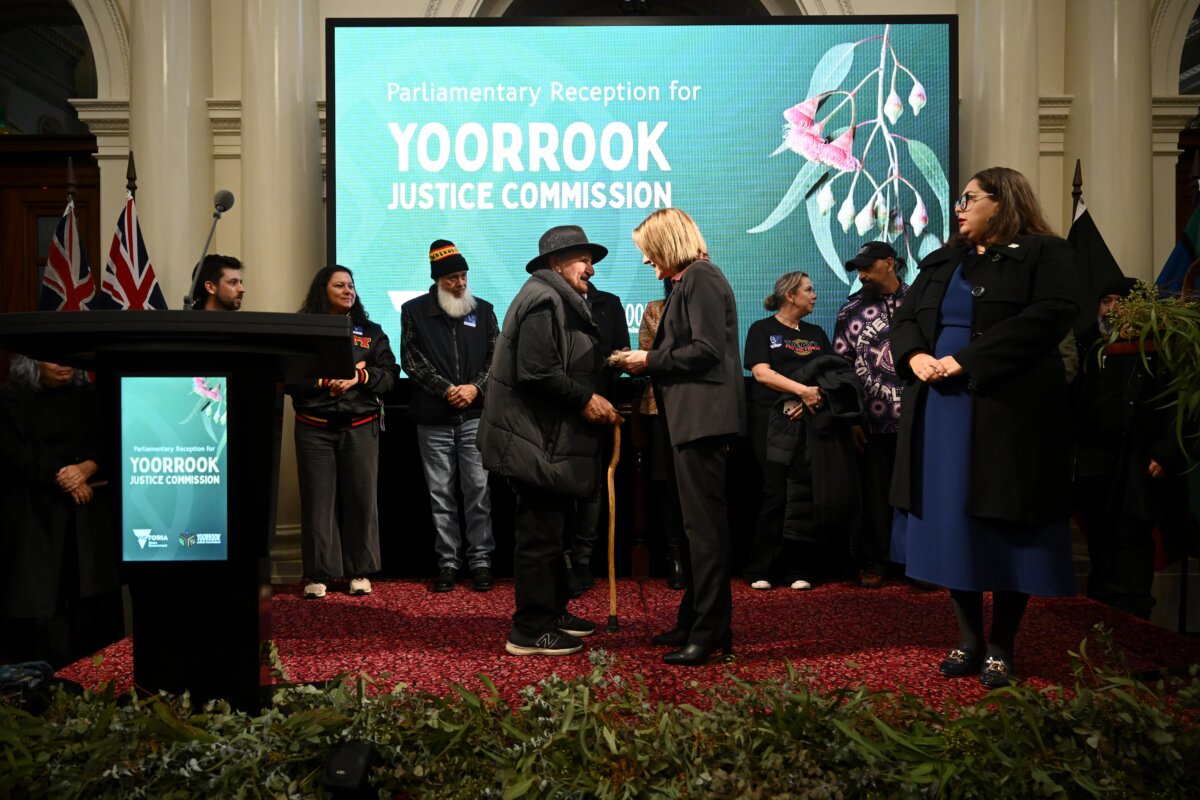

After receiving over 1,300 submissions and hearing directly from more than 9,000 Aboriginal people across Victoria over four years, the Yoorrook Justice Commission has released a report containing 100 recommendations for urgent change.
Between 1829 and 1860, the commission says, an estimated 978 Aboriginal people were killed in seven massacres by settlers or soldiers, as between 300 and 500 clan groups were violently dispossessed of their lands.
Subsequently, a lack of access to traditional food sources and the impact of disease reduced the pre-European native population from 60,000 to less than 15,000 by the time the colony of Victoria was founded in 1851.
That’s one of the findings of the commission, whose 230-page final report has been delivered to the Victorian State Parliament.
The killing of Indigenous people was, the report says, “enabled and justified by racist ideology with the explicit and complicit support of politicians, colonial authorities, and the State.”
The commission has found that the sovereignty of the Indigenous peoples of Victoria has never been ceded and that the initial occupation of their lands was illegal. The colonial laws and policies used to seize the land would amount to genocidal acts by today’s standards, it says.
That historical and continuing injustice requires redress, the commission says.
That would include compensation not just for economic loss, plus interest, but also for cultural loss. It could take the form of monetary compensation, tax relief, and the restitution of traditional lands, waters, and resources, but it recommends that the details should be worked out via a Treaty process.
No Redress to Date
Despite a 2024 commitment to reinstate Aboriginal land titles across 1,265,937 hectares of the 8.8 million owned by the state, just over 59,000 hectares have been returned to date.
The commission says they are also denied water rights, with less than 0.2 percent held by Aboriginal interests as of 2022.
The state received $83 billion in water-related revenue between 2010 and 2023, none of which has gone to traditional owners.
They also do not receive a share of the $1 billion in royalties for mineral, stone, and petroleum resources over the same period, or any of the $1.89 billion in revenue from grazing and government land licenses.
Other recommendations include transferring prison healthcare from the Department of Justice to the Department of Health and providing more funding to Aboriginal-led health services to ensure they are adequately resourced, regardless of their location.
The state Labor government is currently negotiating with the First Peoples Assembly of Victoria on a Treaty, and on the ongoing role of the Assembly itself, and expects to introduce legislation to give effect to the outcome later in 2025.
The government requires the support of up to six upper house crossbenchers for the bill to pass, as the Coalition is opposed to a treaty and a state-based voice to parliament.
Over its 67 days of public hearings, the commissioners heard evidence from elders, other Indigenous people, descendants of early colonisers, public servants, and politicians. They also heard 16 separate apologies from ministers and government officials.
Premier Jacinta Allan said the government would carefully consider the findings.
“Victoria’s truth-telling process is a historic opportunity to hear the stories of our past that have been buried—these are stories that all Victorians need to hear,” she said.
AAP contributed to this story.
 Friends Read Free
Copy
Facebook
Tweet
Friends Read Free
Copy
Facebook
Tweet