
The Alberta government has tabled legislation that, if passed, will limit the power of regulatory bodies to discipline members for off-duty comments and behaviour.
The legislation known as the Regulated Professions Neutrality Act, commonly referred to as the Peterson Law, is named after Canadian psychologist Jordan Peterson, who faced sanctions from the College of Psychologists of Ontario for comments he made on social media.
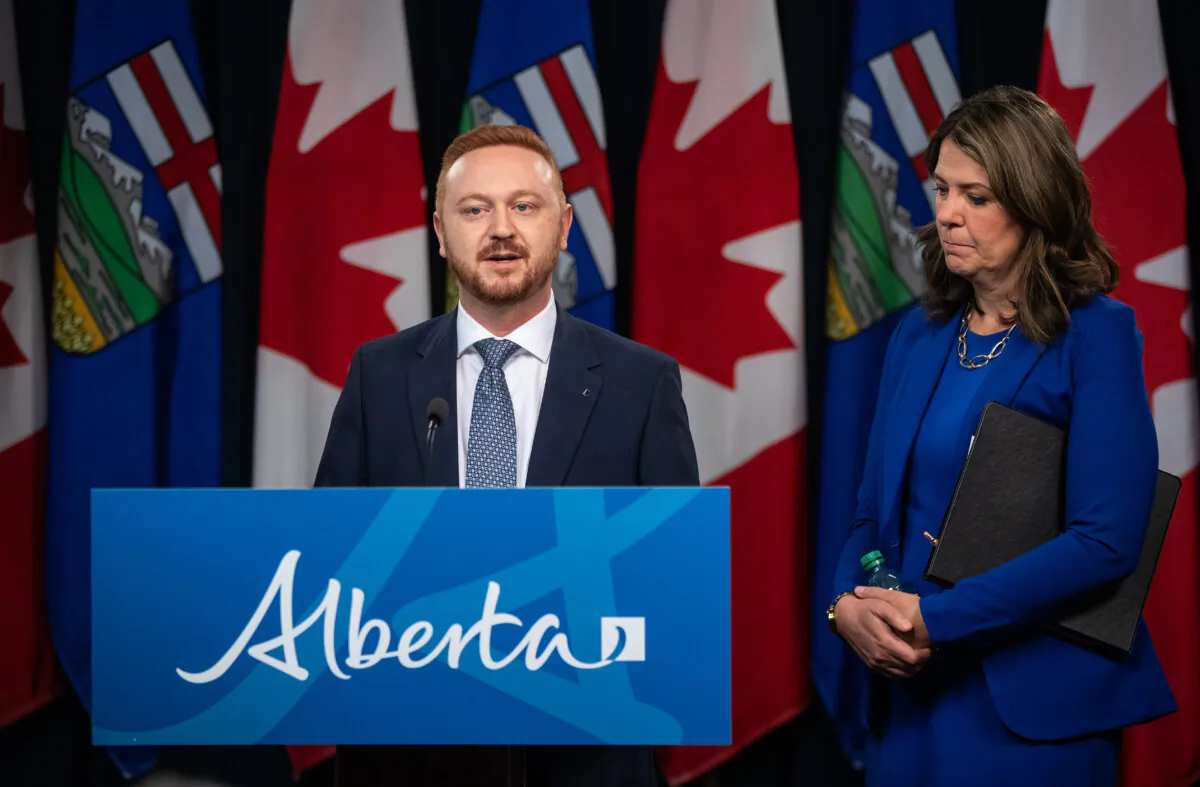
Premier Danielle Smith said the bill is meant to protect professionals from discipinary measures when it comes to “off-duty conduct.”
“No professional should fear losing their licence, their reputation or their livelihood because of a personal opinion, a social media post, an interview or open dialogue outside of working hours,” she told reporters during a Nov. 20 news conference.
Smith said regulatory bodies have a role in “safeguarding Albertans” but the role of regulators should stay in the workplace.
“When regulators begin disciplining people for simply speaking their mind on their own time, that’s overreach, and at its worst, it becomes an outright threat to free expression,” she said.
Justice Minister Mickey Amery said the legislation outlines a “clearly defined list” of misconduct that regulatory bodies have authority to discipline, including threats of violence, breaches of professional boundaries, or criminal convictions. He said it also established neutrality for professionals.
“This bill establishes neutrality principles that require regulators to treat everyone fairly, regardless of the personal beliefs that one might have,” he said during the news conference. “The intention is to ensure that regulators operate fairly and without bias.”
Amery said the bill would also limit mandatory training for professionals, noting that such training or education may only be mandated when it directly pertains to professional competence or ethical standards.
“Regulators will not be permitted to mandate training that attempts to prescribe particular political or social viewpoints,” he said, further noting that regulatory agencies cannot enforce education or training on matters of personal conscience.
Amery also said the bill would “strengthen” legal avenues for professionals to seek appeals and reviews of disciplinary decisions.
Public Engagement
Smith said input from professionals who were afraid to make their personal beliefs public was the inspiration for the current legislation.
“When we worked on Bill 9, we spoke to many professionals who were afraid to put their names in the public realm, not only due to the threat of public cancellation, but mainly due to fear of losing their professional status or their livelihood.”
Smith also said the bill would not prohibit professionals from speaking their mind about the government.
“I don’t think anybody is shy about criticizing our government,” she said in response to a reporter’s question about whether the province would backtrack on the bill if it was criticized.
“I think what we have heard, though, is that there are people who are concerned that they’re going to get punished by their professional college if they support our government.”
The Alberta government said it engaged more than 100 regulated professions in a 2024 review of regulatory bodies.
Reaction
The Law Society of Alberta said in a statement that it would “conduct a thorough review of the new legislation to fully understand what it means for the Law Society, the public and the legal profession in Alberta.” The Law Society regulates approximately 14,000 lawyers in the province.
The College of Physicians and Surgeons told The Epoch Times in a statement that it would “take the time to carefully review the details” of the bill. It said it was looking to understand any “potential implications” on how to fulfill its mandate to protect the public and ensure Albertans have “safe, high-quality health care.”
Alberta’s Opposition NDP justice critic Irfan Sabir called the bill political overreach, saying the government was interfering with self-regulated professions.
He told reporters the bill would remove training such as indigenous competency teaching for the legal profession.
“Essentially what it says is that people should be able to say all kinds of vile, inappropriate, incorrect things outside their professional work,” he said. “[Smith] is bringing in this legislation essentially signalling to her base… to say whatever wild inappropriate thing they want without any accountability.”
Sabir said the legislation would also prohibit mandatory training for members on diversity, equity and inclusion, cultural competence or unconscious bias.
Discipline Cases
Peterson faced discipline by the College of Psychologists and Behavioural Analysts of Ontario in 2022 for comments he made online and during a podcast interview. The college said it received complaints from the public about his comments. He was ordered to undergo social media training or risk losing his licence.
He filed for a judicial review of the decision, saying his free speech rights were being violated, but the Ontario Divisional Court dismissed his application in 2023. The Ontario appeal court dismissed his appeal and the Supreme Court declined to hear his case. Peterson then said he would take the imposed training, and make it public.
The Alberta government news release on Bill 13 quoted Amy Hamm, a B.C. nurse who was disciplined for comments she made about gender issues. She said the freedom to express ourselves and debate ideas is “critical” to progress and democracy.
“We all suffer when we live in a climate of fear and self-censorship,” Hamm said. “We want regulated professionals who think, speak and engage—rather than stew in silence and fear.”
Hamm was accused by the provincial nurses’ college of making “discriminatory and derogatory” statements regarding transgender people. She lost a disciplinary hearing earlier this year.
The panel said in its March 13 decision that Hamm’s comments amounted to “unprofessional conduct.”
It said Hamm’s statements were “untruthful and unfair as they challenge the existence of transgender women, argue for less constitutional protection for transgender women, and are designed, in part, to elicit fear, contempt and outrage against members of the transgender community.”
Meanwhile, the Law Society of Alberta recently faced a legal challenge for its mandatory training program, called PATH, that covers topics like diversity, equity, and inclusion.
Alberta lawyer Roger Song described the training as “woke” and said it promotes the need to “dismantle systemic inequalities and barriers” while imposing “politicized” requirements.
Song legally challenged the training in court in 2023, but the case was dismissed in a Sept. 12 decision where the Court of King’s bench said the training fell under the law society’s scope.
The decision also said the law society sees its professional development requirements as “necessary to achieve a greater societal good, and it was within their authority to do so.”
Carolina Avendano and The Canadian Press contributed to this article.
 Friends Read Free
Copy
Facebook
Tweet
Friends Read Free
Copy
Facebook
Tweet