
The Alberta government has used the notwithstanding clause of the Charter in a newly tabled bill in an attempt to order striking teachers back to work.
The bill, tabled Oct. 27, aims to put an end to the strike by 51,000 Alberta teachers that began Oct. 6 over unmet salary and class size demands.
The notwithstanding clause is a Canadian constitutional rule contained in Section 33 of the Charter of Rights and Freedoms that lets government override various rights and freedoms in the Charter if it’s deemed necessary by the province or the federal government. It shields legislation against court challenges for up to five years, and can be renewed.
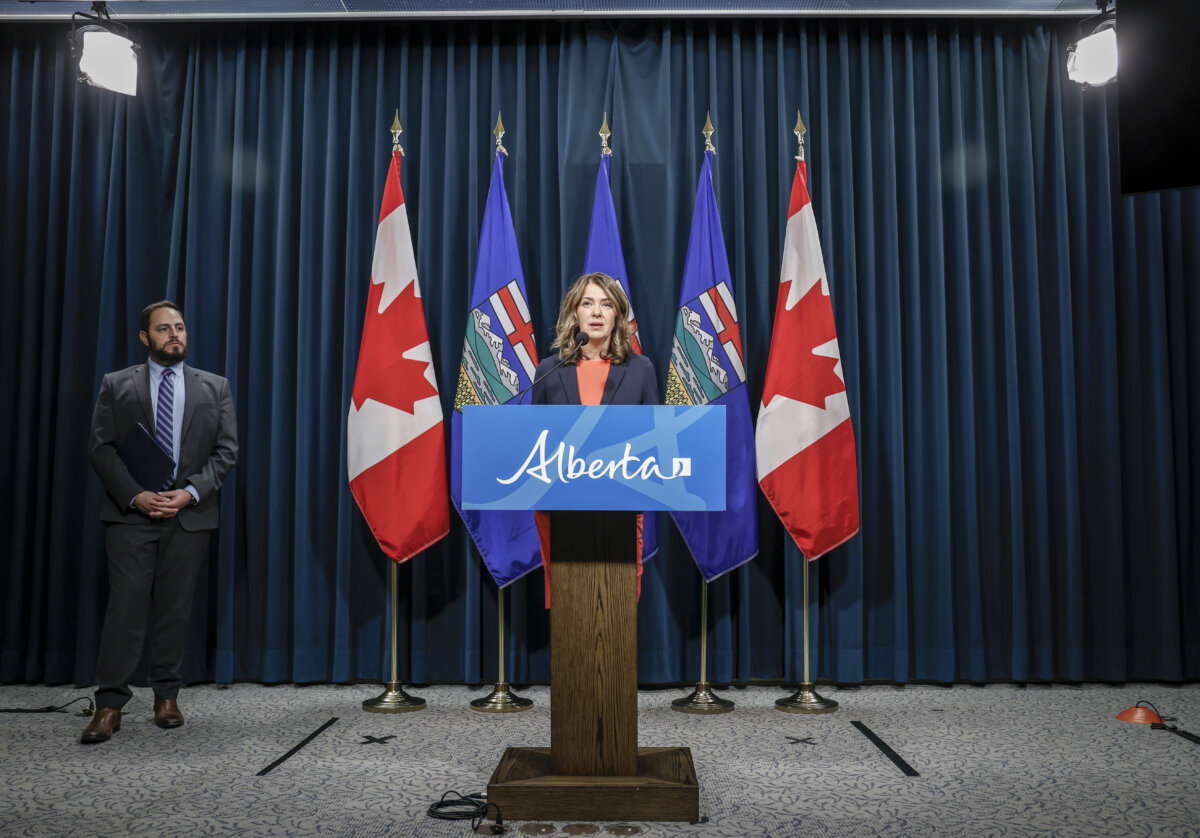
Bill 2, the Back to School Act, was described by Alberta Premier Danielle Smith as a “last resort” in a previous press conference, and she has vowed to fast-track its passage to end the biggest labour walkout in her province’s history. If it is given royal assent in the legislature, students could be back in class as soon as Oct. 29.
The bill imposes a collective bargaining agreement previously put forward by the province and the union, which was rejected by teachers in a vote. Under the imposed terms, teachers would receive a 12 percent salary increase over four years, and the province commits to hire 3,000 more teachers and 1,500 more educational assistants.
“This is a very unique situation we find ourselves in. This is a unique strike. We’ve never had 51,000 workers off the job at the same time,” Smith said on Oct. 27. “I do not think people should indicate any broader type of approach [using the notwithstanding clause] when it comes to labour action.”
Smith said the strike has already impacted more than 740,000 Alberta students who she said are unfairly being kept out of school and hindered from learning.
The Alberta Teachers’ Association (ATA) says the province’s offer is insufficient, and also wants the province to address the issue of class sizes.
“Over the last decade, teachers have received a total salary increase of less than six per cent, while being promised that they would be fairly compensated in their next collective agreement,” the union says.
Smith said the ATA’s offer would tack $2 billion in additional costs onto the province in addition to the $2.6 billion it has already committed to resolve the dispute.
If passed, the bill would apply to any noncompliant members of the ATA, with maximum fines of up to $500 per day and $500,000 per day for the union as a whole if it doesn’t comply with returning to work.
ATA president Jason Schilling condemned the province’s use of the notwithstanding clause, and said that union representatives will be meeting soon to determine the ATA’s next steps.
“This is a sad day for teachers. This is a sad day for Albertans to have a government that is willing to trample on your Charter rights for their own purposes,” Schilling told reporters.
“They will use it again on others.”
Strike
The strike occurred early this month when teachers from across the province walked out of work over stated concerns about salary levels as well as class size and having insufficient staff for students needing specialized care. Smith has said that teachers and the province will both have to collaborate in order to come up with a solution to these concerns, and she has pledged to gathering and publicly disclosing information on class sizes and ensuring students requiring specialized care get the help they need.
“We want to address the issues that came up during the strike. We want to just address them in a different way, a more nuanced way, in a more direct way,” Smith said, adding that she doesn’t agree with imposing a class size cap, which would be “arbitrary” in her view.
The bill pits Smith directly against the ATA and 350,000 employees who belong to 30 other unions across the province whose coalition Common Front has previously promised an “unprecedented response” if Alberta were to invoke the notwithstanding clause.
“If governments start using the notwithstanding clause as a tool in their dealings with workers and unions, it will make a mockery of the constitutionally protected right to strike,” Common Front said.
For his part, Finance Minister Nate Horner who introduced the bill said a broader walkout launched by Common Front would be illegal and lead to “severe consequences.”
“There’s severe consequences at the labour relations board for those actions,” Horner said.
Alberta’s Opposition NDP Leader Naheed Nenshi said the move is overrunning basic rights of Albertans and causing more instability.
“Albertans will be forgiven for asking themselves, ‘Who’s next? What rights does this premier want to defend and which ones is she willing to trample over and for whom?'” Nenshi said.
The Canadian Press contributed to this report.
 Friends Read Free
Copy
Facebook
Tweet
Friends Read Free
Copy
Facebook
Tweet