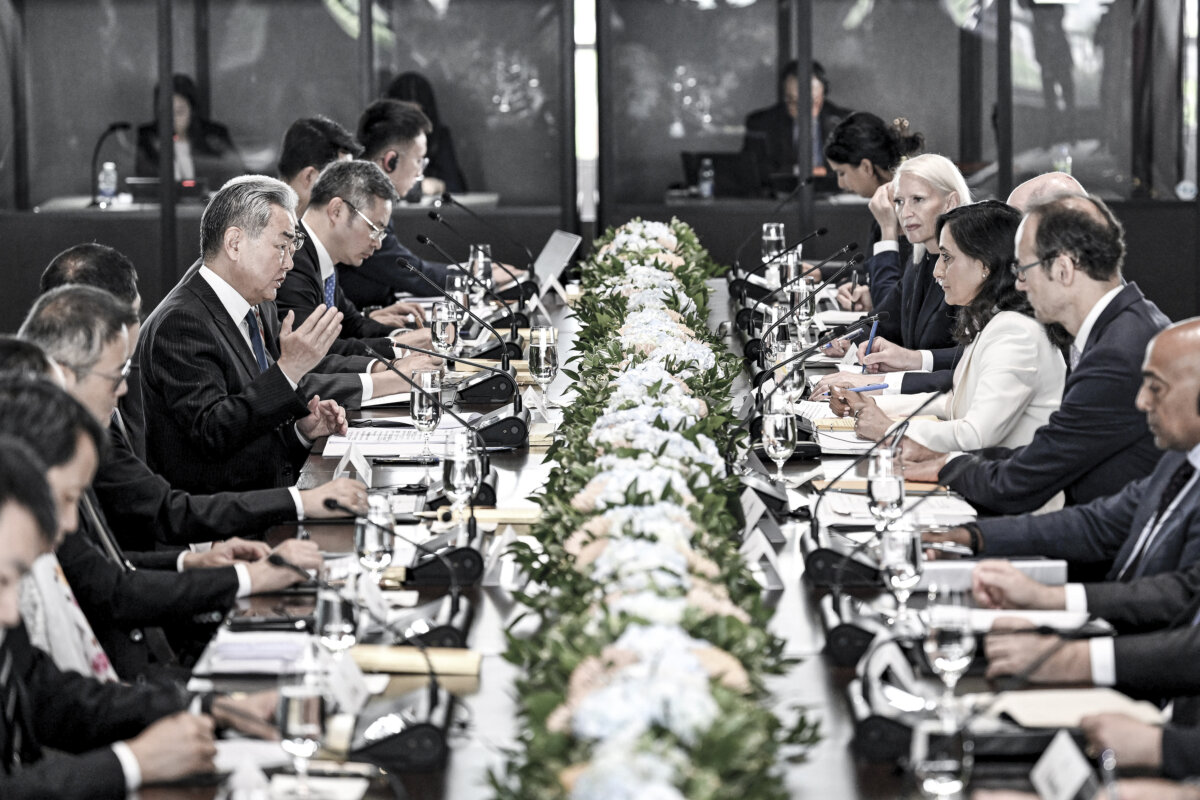
Foreign Affairs Minister Anita Anand met with her Chinese counterpart Wang Yi in Ottawa on May 29, and said both Canada and China have to address “critical issues” regarding people’s safety.
Anand made the public comments to Wang before the start of their meeting at the Global Affairs Canada headquarters. Wang also met with Carney after meeting Anand but neither offered public comments and media access was limited.
Wang is visiting Canada as Ottawa seeks to deepen ties with Beijing in a push to diversify its trading relationships. It’s the first visit by a Chinese foreign minister in 10 years.
Anand said Prime Minister Mark Carney and Chinese leader Xi Jinping have established an “ambitious vision” for a “recalibrated relationship” between Canada and China, including in the fields of trade, investment, and public security.
“At the same time, each of our countries must address critical issues and priorities to ensure the safety and security of our peoples,” Anand said, without elaborating.
Conservative MP and foreign affairs critic Michael Chong expressed concern about the government’s approach to relations with China, as well as the fact that the media were not given an opportunity to ask questions.
“Foreign interference from the PRC [People’s Republic of China] constitutes the greatest threat to Canada’s security—this is the assessment of CSIS, and the Prime Minister himself affirmed it one year ago,” Chong said on X on May 29, referring to comments made by Carney during the 2025 election campaign, when he described China as Canada’s foremost security threat.
“CSIS has advised the Liberal government that the best way to counter foreign interference is to adopt a policy ‘based on transparency and sunlight,’ so that this interference is ‘exposed to the public.’ Yet, the Liberal government appears instead to be yielding to the demands of an authoritarian state that wants Canada to discuss foreign interference only behind closed doors.”
A coalition of human rights groups urged Anand earlier this week to raise multiple issues in China with Wang, including the persecution of Falun Gong and Uyghurs, and concerns about ongoing transnational repression on Canadian soil.
Anand told Wang that Canada aims to grow its trading relationship “responsibly” and increase its exports to China by 50 percent by 2030. This will be done “while safeguarding Canada’s economic and national security interests and values,” she said.
Wang said engagement has dramatically increased between Ottawa and Beijing in recent months, adding that six meetings or calls between him and Anand marks a record for exchanges between foreign ministers.
Wang said this shows both sides are willing to improve relations, which he said have transformed and are “developing positively.”
Before Carney became prime minister, the Canada-China relationship had been effectively frozen since late 2018 due to the Meng Wanzhou affair. In apparent response to Canada executing a U.S. extradition warrant for the Huawei executive, who was wanted for fraud, China arbitrarily detained Canadians Michael Kovrig and Michael Spavor for over 1,000 days.
“The ups and downs of China-Canada relations over the years have brought us many important lessons, requiring us to adhere to mutual respect, seeking common ground while reserving differences, strategic autonomy, and mutually beneficial cooperation,” Wang said.
Wang also said he believes Canada can double its exports to China if the current momentum in relations is maintained and the related policies remain “stable and positive.”
Wang also said the prime minister has been invited to attend the Asia-Pacific Economic Cooperation summit in China in November. A visit to China in November would be Carney’s second in 2026, after his trip to Beijing in January.
During that trip, Carney announced a “new strategic partnership” with China. Ottawa agreed to lift the 100 percent surtax on an initial 49,000 Chinese electric vehicles in exchange for China removing or reducing its tariffs on some Canadian agricultural and seafood products for the rest of the year.
Memorandums of understanding were signed on different files, including energy and law enforcement cooperation.
Opposition MPs and human rights groups have urged the Carney government to release the terms of the law enforcement cooperation agreement, expressing concern about transnational repression. The Chinese regime has operated illegal Chinese police stations in Canada in recent years and conducted operations to repatriate wanted Chinese nationals.
On May 28, Conservatives gave notice of a motion in the House of Commons public safety committee to ask to see the MOU. Public Safety Minister Gary Anandasangaree, who was testifying before the committee, said there have been multiple security MOUs with China since 2010 and none have been publicly released.
Carney also rejected the call earlier this week to release the MOU, saying agreements with other governments are not released to protect operational security.
The Canadian Coalition on Human Rights in China earlier this week expressed “grave concern” with the police MOU given the state of repression in China and transnational repression in Canada.
“The MOU risks legitimizing the same coercive ‘Fox Hunt’ tactics Beijing has used globally to intimidate, threaten, and pressure targets into returning to China,” the group said in a May 28 letter to Anand. “Fox Hunt” refers to a Chinese operation to repatriate individuals wanted or targeted by the regime.
 Friends Read Free
Copy
Facebook
Tweet
Friends Read Free
Copy
Facebook
Tweet