
The government has announced two initial contracts for Australian-made next-generation counter‑drone systems.
It also comes alongside a doubling of the budget for procuring the technology and a boost to the Australian Defence Force (ADF) drone warfare.
The 2024 Defence Integrated Investment Program (IIP) allocated more than $13 billion to drone capability and $4 billion for counter-drones over the next decade. The 2026 version increases the overall spend to $30 billion and counter-drone spending to $7 billion.
Alongside the funding decision, the Minister for Defence Industry Pat Conroy also announced the awarding of contracts for two locally produced anti-drone platforms.
This technology is designed to detect, track, identify, and neutralise unauthorised or hostile drones. Detection uses various methods, including radar, radio-frequency analysers (which detect communications between the drone and its base), and cameras, which may include heat sensors.
Once an enemy drone is identified, it launches countermeasures such as jamming, spoofing, or physical capture. Spoofing refers to interfering with the drone’s navigation systems (for example, GPS) to take control or guide it away.
The initial orders were for $21.3 million from AIM Defence and $10.4 million from SYPAQ Systems.
Laser to Target Drones
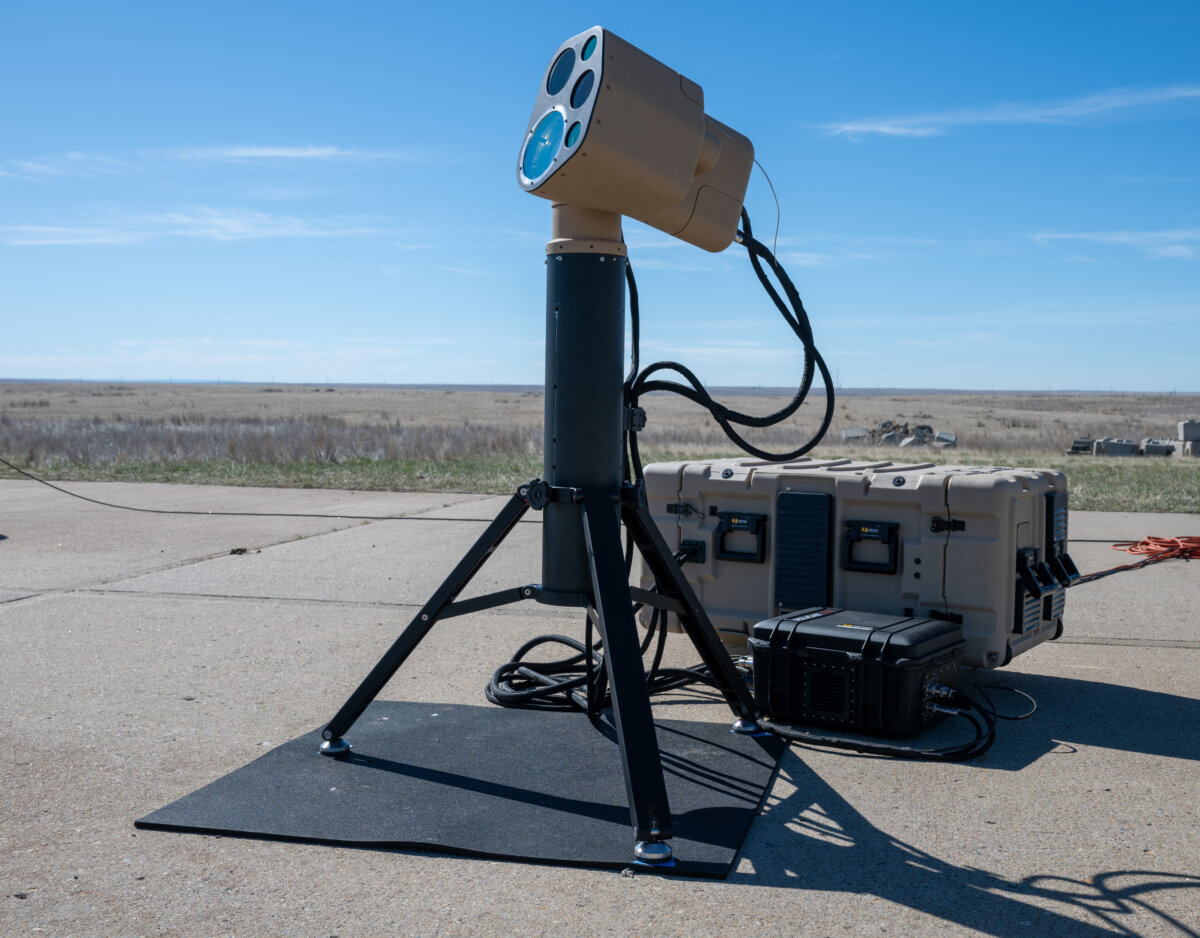
With the funding, AIM Defence will be able to further enhance the capability and combat readiness of its powerful counter-drone laser system, Fractl, which targets both individual drones and drone swarms. It is strong enough to burn through steel and can track objects as small as a 10-cent piece at over 100 kilometres per hour.
SYPAQ Systems will develop the Corvo Strike, an interceptor drone intended to track, target, and destroy larger drones currently frequently used on battlefields, building on its experience with low-cost, high-performance uncrewed air vehicles.
The government says the development of sovereign counter-drone solutions is crucial to ensuring the ADF can identify and respond to threats, as the war in Ukraine and conflicts in the Middle East demonstrate how uncrewed aerial systems are now a major part of conflict.
“While Australia’s unique geography has driven a focus on larger drones, the government’s efforts will accelerate the deployment of advanced capabilities designed to counter medium‑sized drones and swarms of small drones that our personnel could encounter in complex operational environments abroad or while protecting people and infrastructure domestically,” Conroy said.
“The government’s record investment in defence through the 2026 Integrated Investment Program includes record investment in drone and counter-drone capabilities, ensuring Australia can respond to threats to [its] security.”
Drones Can Still Evade Countermeasures
However, experts warn there is still no sure way to stop drone attacks.
Jamey Jacob, an aerospace engineer and director of the Counter-UAS Centre of Excellence at Oklahoma State University, cites the case of “Operation Spiderweb,” when Ukrainian forces deployed more than 100 “kamikaze” drones deep in Russian territory on Jun. 1, 2025.
That damaged a significant portion of Russia’s bomber fleet, demonstrating, he says, that “there is little stopping something like this from happening [elsewhere].”
Radio frequency systems won’t necessarily work if a drone is operating in “run silent” mode—not transmitting any information back to a remote operator.
Jamming surrounding GPS may confuse the drone, but it also blocks the navigational signals for other users. And drones can also navigate without GPS, using less accurate techniques such as following the terrain with cameras.
Meanwhile, the Modern War Institute at West Point warns that “directed energy (such as lasers) is no panacea. Lasers and microwaves come with trade-offs that create opportunities for adaptive tactics, techniques, and procedures.
“A significant weakness with both kinds of systems is that the effective range is generally short [which] might be fine for point defence of strategic targets, [but] the value may be limited for area defence.
“In addition, lasers typically require several seconds on target to create harm, and particulates in the air like rain or smoke can disrupt that.
“For example, American forces that tested a laser mounted on a Stryker found that the system struggled to function on a moving vehicle in tough conditions. To exploit these weaknesses, attackers might deploy drones during rainy or foggy weather, relying on the higher environmental hardiness of their drones.”
The Institute said the Office of Naval Research was now engaged in research aimed at countering directed-energy weapons, including material hardening.
 Friends Read Free
Copy
Facebook
Tweet
Friends Read Free
Copy
Facebook
Tweet