
Australia will introduce the world’s first strict national ban on social media for children under 16 from Dec. 10 amid broader concerns of mental health and cyber harms afflicting the nation’s youth.
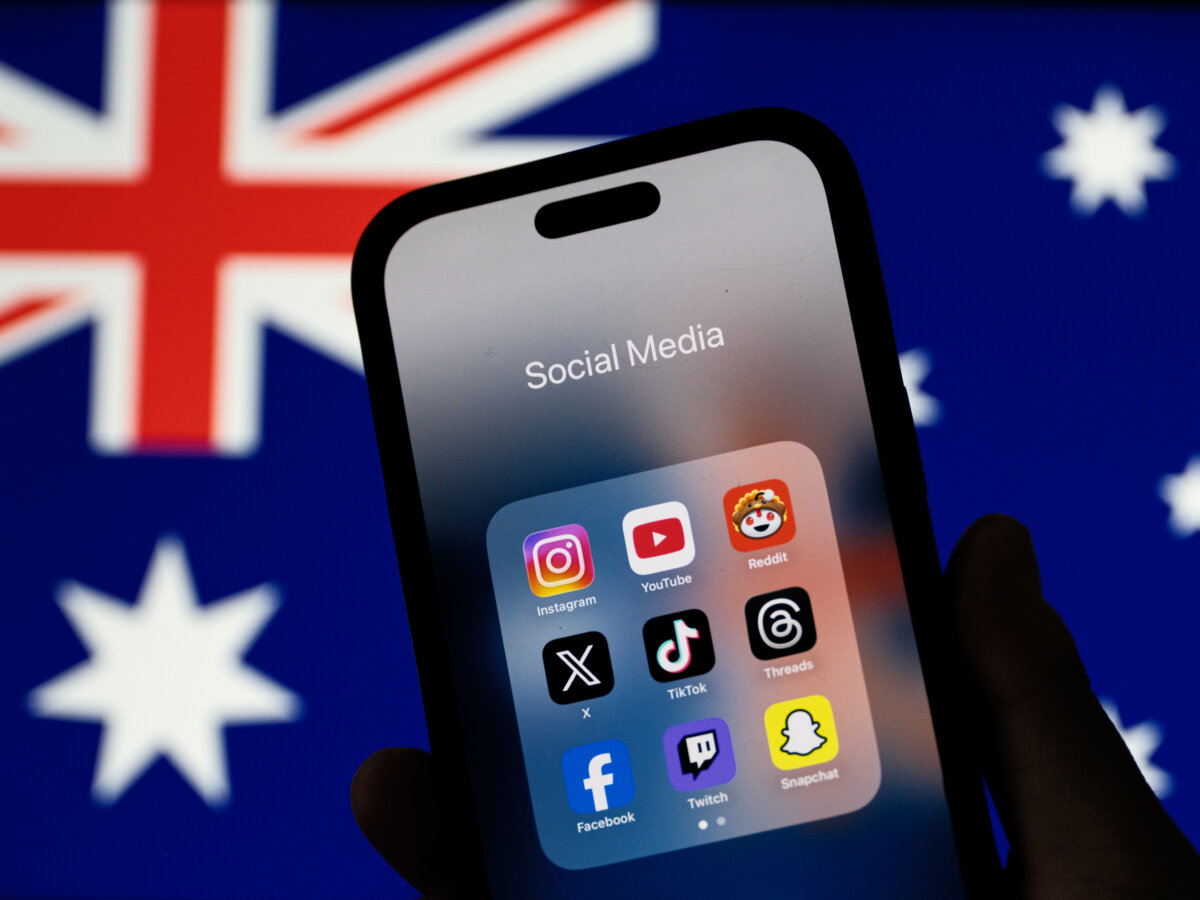
Big Tech firms like Meta (Facebook and Instagram), TikTok, X, Reddit, Snapchat, Twitch, Kick, Threads, and YouTube are obligated to take “reasonable steps” to stop young people from coming on their platforms, or face penalties of up to $49.5 million.
Here’s a breakdown of social media ban.
What Exactly Happens From Dec. 10?
Platforms must stop new under-16 Australians from signing up and begin phasing out existing accounts.
Young users can still browse public content, while messaging apps that do not rely on social media accounts will remain available.
How Will Big Tech Firms Know if Users Are Underage?
Platforms must move beyond checking birthdates and deploy tools that detect if under-16s are on their platform, while meeting privacy rules.
Methods can include AI tools, tracking behaviour signals, or verification with digital ID.
But each platform must explain what users need to do, what data is collected, and whether a third party is involved. They must also offer an option other than government ID.
As Communications Minister Anika Wells said, “You will not be forced to present government ID … the law states platforms must always offer a reasonable alternative,” noting Big Tech firms already have enough personal information to infer the age of users.
“They see that you’ve had an account since 2015 … and been talking to other adults,” she told the National Press Club.
Most platforms will likely start with inferring the age of users (by analysing behaviour or messaging) and, if unclear, shift to age estimation—deploy facial analysis via partners like Yoti or k-ID.
How Long Will It Take to Remove All Underage Users?
The government acknowledges that with almost 86 percent of Australian children between the ages of eight to fifteen using social media, it will take time to filter out current users and prevent new ones from joining.
What Should Users Do About Existing Posts, Photos, and Chats?
Platforms are expected to offer guidance so users on how they can save material before an account is restricted.
The eSafety Commissioner advises under-16s not to assume their content will remain accessible.
Children should download anything important—photos, videos, DMs, friends lists, group chats, contacts and posts—ahead of the cut-off date.
Some companies may allow a temporary deactivation option, letting young people reactivate accounts with the same data once they turn 16.
But eSafety stresses this cannot be guaranteed, and every platform will implement restrictions differently. Officials say the safest approach is to export or back up content manually before Dec. 10.
Why is the Government Doing This?
The eSafety Commissioner has determined that social media exposes young people to addictive design features that can have a deep impact on their psyche like disappearing posts, constant notifications, and algorithmic content recommendations.
These tools may disrupt sleep, increase anxiety, encourage jealousy and competition, or expose children to inappropriate material.
The government argues a delay until age 16 gives children more time to develop emotional, social and digital resilience.
Minister Wells explained, “That’s why this law matters to give Gen Alpha and the next generation a break from the persuasive and pervasive pull of social media … Themselves without being chased into predatory algorithms.”
Who Will Measure the Impact?
Australia’s eSafety Commissioner Julie Inman Grant has backed an academic advisory group led by Stanford University’s Social Media Lab, including 11 experts specialising in adolescent mental health, digital parenting, and psychiatric epidemiology.
The evaluation aims to measure sleep patterns, offline social interaction, school performance including NAPLAN, medication use and overall screen behaviour.
Quarterly updates begin three months after the law commences, and the legislation must undergo an independent review within two years.
Inman Grant said the team’s expertise spans children’s digital rights, and will deliver “independent, evidence-based guidance” throughout the study.
Members include six scholars from the Stanford Social Media Lab and representatives from Bath Spa University, the Mailman School of Public Health at Columbia University, the American Psychological Association, and Australian universities like the University of Melbourne.
Members will not be paid; instead, they will gain access to research data.
What Concerns Do Tech Firms Have?
At a parliamentary hearing in October, major platforms confirmed they will enforce Australia’s under-16 ban but questioned how effective the measure will be.
YouTube argued the move will cut out parental oversight because that function is dependent on a signed-in account.
TikTok public policy lead Ella Woods-Joyce said the app supports “evidence-based” regulation but warned a blanket age threshold could drive teenagers toward unregulated sites “where rules, safety tools and protections don’t exist.”
TikTok indicated it would follow the law but questioned whether the measure could backfire.
Meta said Australia’s rule will be hard to implement because the age 16 is a “globally novel” boundary and that current safety measures are adequate.
Regional policy director Mia Garlick highlighted Meta’s existing safeguards, including teen accounts, PG-13 filters, AI age-detection, and parental safety notifications.
Garlick also cautioned that letting every platform design its own verification process could create inconsistent standards and privacy problems, and suggested device-level checks—through operating systems or app stores—may be more reliable.
What Does the Rest of the World Think?
Governments in Denmark, Greece, Romania, France, New Zealand, Malaysia, and the European Commission have all expressed interest in minimum-age frameworks with some already implementing restrictions
Minister Wells pointed to remarks from European Union President Ursula von der Leyen that “parents, not algorithms, should be raising our children.”
Australia has also signed a Memorandum of Understanding with Ireland’s Coimisiún na Meán to coordinate regulation and platform accountability.
What about the US?
Wells has said that some U.S. states—including California and Utah—are already considering stronger age measures.
She noted the Governor of California Gavin Newsom was eyeing “even bigger moves.”
When asked whether U.S. President Donald Trump might oppose Australia’s approach in response to lobbying from Big Tech firms, Wells said the prime minister’s recent meeting with Trump did not reveal any concerns with the matter.
 Friends Read Free
Copy
Facebook
Tweet
Friends Read Free
Copy
Facebook
Tweet