

Commentary
The recent consumer price index (CPI) posted what seemed to be cooling numbers, granting a bit of relief to the fleeced masses. The release reported a monthly decrease of 0.4 percent in June after an increase of 0.5 percent in May. This decline in the all items index was the largest one-month decrease in six years.
That’s the good news. The driving factor was of course energy, a trend that has already reversed. Gas prices are rising again. The really bad news is that over the past 12 months, the all items index increased by 3.5 percent before seasonal adjustment. That is intolerably high, especially coming after a brutal five years in which between 28 and 40 percent of purchasing power has been knocked off the dollar.
Wages and salaries have not kept up in real-life experience. Going out to eat nearly always imposes shock. The old rules of thumb of what is expensive and what is affordable have shifted completely. What is and is not a good deal has become murky. Even the thrift stores and online sellers of used goods have experienced inflation.
To add another layer of trouble, the CPI numbers themselves are not reliable. The index is no longer constructed the way the textbook says it should be built, the same items over time with prices tracked according to weighted averages. A huge range of goods and services have been subjected to proxy measurements, quality adjustments, substitutions, consumption deflators, and other dramatic measurements.
You cannot build a house with measurements that are constantly changing, and you cannot build a reliable index with price indexes that are not comparing real-world prices across time. It becomes too subject to distortion.
Having followed this problem for decades, I have experienced genuine relief with a very clever attempt to repair the problem. The engineer is Tom Elliott, and he is the creator of the reality index. He has built his own index based on how the CPI used to be assembled, using actual prices of cars, insurance, housing, and the entire range of things we buy. His numbers are substantially different from what we are getting from the Bureau of Labor Statistics (BLS).
He is now attempting a monthly update, which gives us a window into what is happening in our own time. For example, he has created alternative numbers for June. He shows that prices rose by 4.38 percent in June 2026 compared with June 2025 (compares with CPI at 3.5 percent). That is 84 basis points higher than the CPI.
Doesn’t that fit better with what you intuit?
Year-over-year in June, transportation rose by 7.47 percent, priced with the reality index transaction composite. Gasoline (BLS average pump price) ran 26.7 percent higher year over year, used vehicles 2.1 percent at Manheim auction values, and new vehicles 1.2 percent at Kelley Blue Book transaction prices. Healthcare held its 5.56 percent from the KFF Employer Health Benefits Survey baseline. Housing rose by 4.43 percent, and utilities rose by 3.87 percent. Communications declined by 2.12 percent, the lone category below its level of a decade ago. The remaining categories—groceries (2.75 percent), dining out (3.37 percent), discretionary (2.83 percent), education (2.51 percent), and pets (2.70 percent)—printed in the single digits.
This has been a consistent pattern all of this year. In general, since 1980, there is a 31.8 percent gap between official numbers and the CPI. That gap remains for all of 2026, which means that the dollar in terms of its power to buy domestic goods and services is eroding at a much faster pace than is being reported.
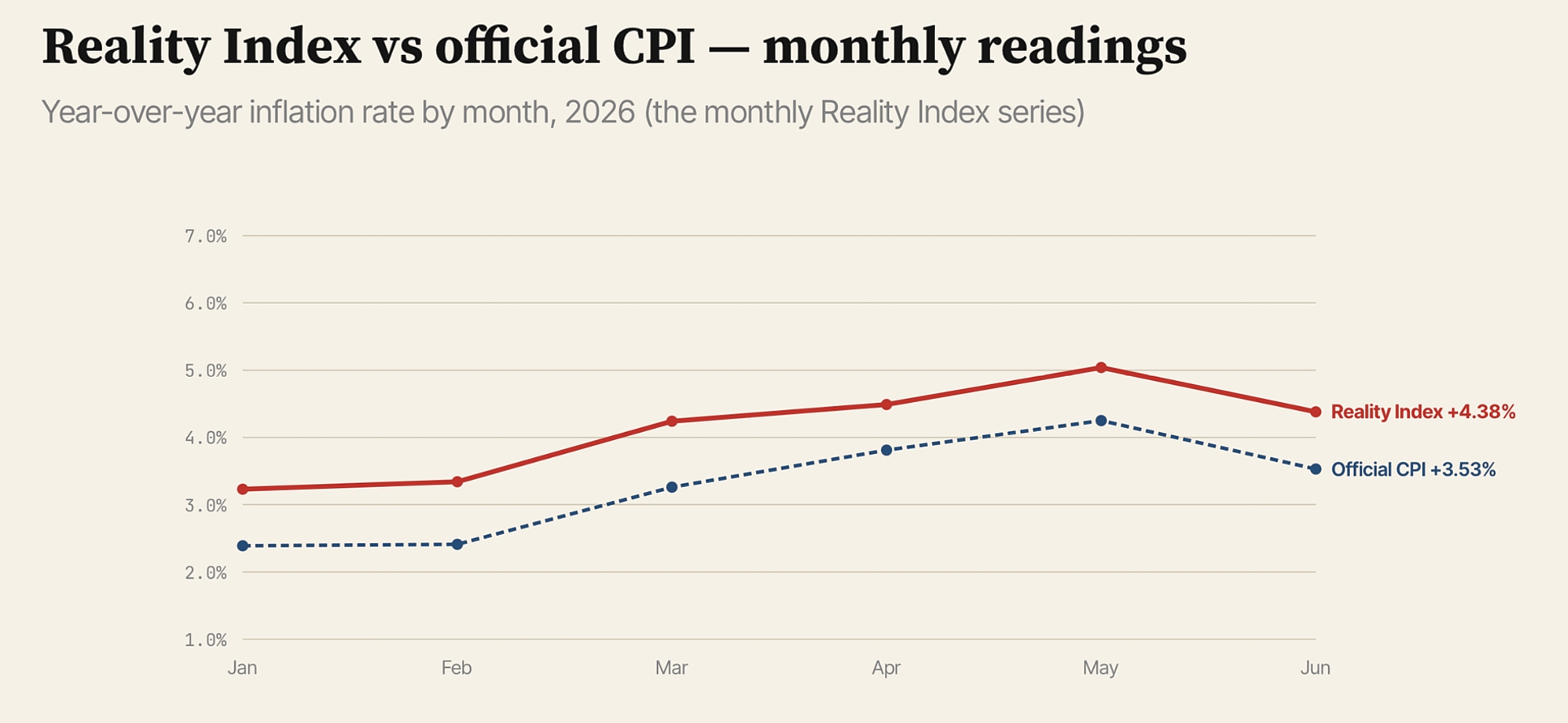
This gap accelerated tremendously since 2020 because inflation hit the very items in dispute—housing, rents, medical insurance, and cars—especially hard in times when inflation was raging more than at any time since the late 1970s.
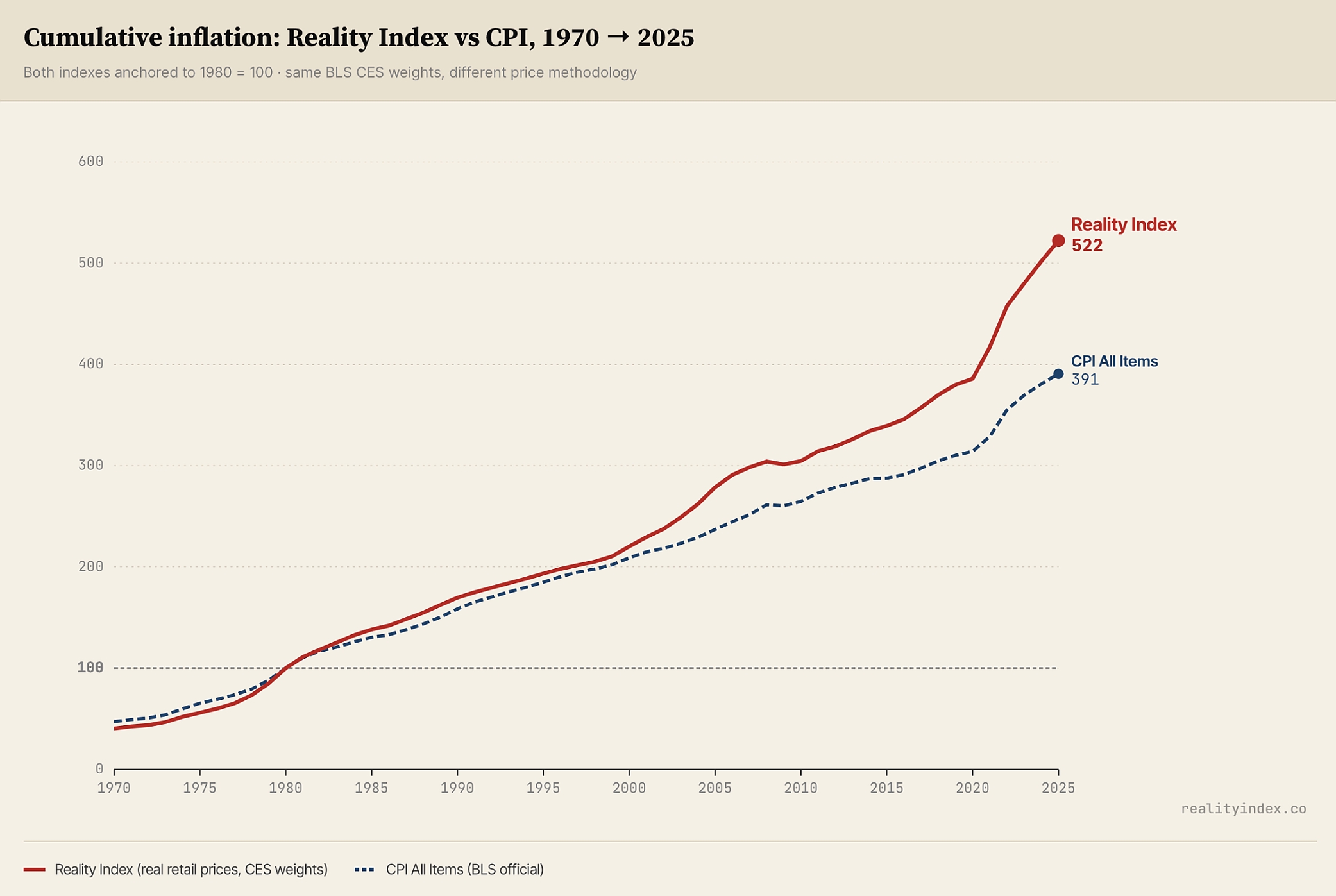
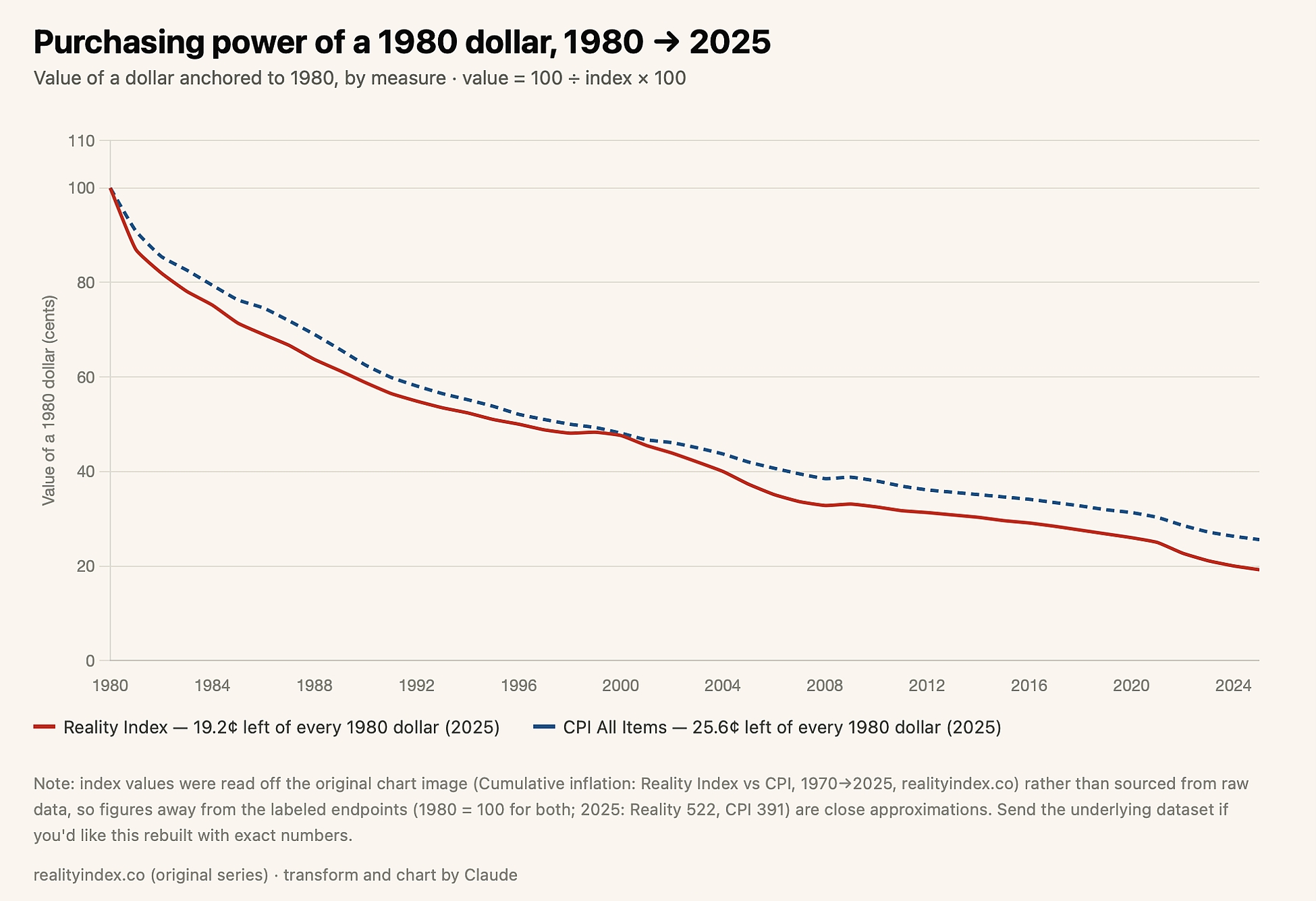
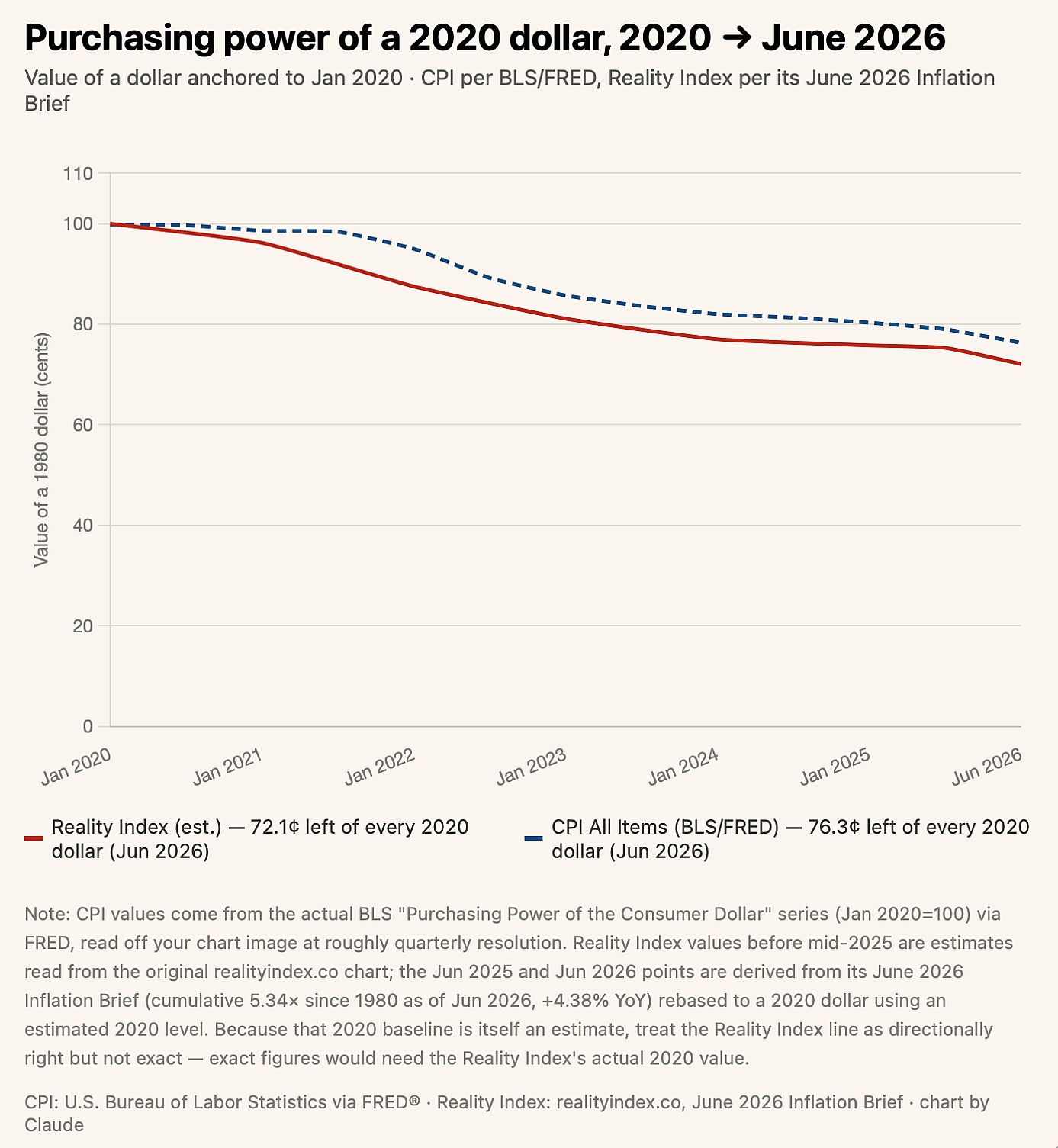
This also matters for calculations that go into tax rates and Social Security benefits. Tax rates have not been adjusted downward enough while benefits have not increased as much. So much in the way of government operations, raises, and calculations of all sorts is affected by the official inflation rate, which has consistently underreported inflation using statistical manipulations.
The manner in which the CPI is calculated has been hit eight separate times over the past 40 years. In each case, the rationale seemed to make sense. For example, if you paid $1,000 for a computer in 1990 and $1,000 today, you paid far less for memory and functioning because the machine improved so much. Why should that not be seen as the equivalent of a price decrease?
The reality index rejects this and other changes. Concerning hedonic adjustments: “This works reasonably well for technology goods. It works less well for food, where the same item specification can decline in quality over decades (smaller portions, lower meat content, more fillers) without the methodology adjusting prices downward to compensate.”
It’s the same with the tendency to adjust the index for substitutions; e.g., if people buy more chicken and less beef because of price, the CPI measures only what people actually buy. The reality index instead “tracks the price of the specified item year over year, regardless of whether consumer behavior has shifted.”
The rationale: “CPI measures the cost of maintaining a constant standard of living, where standard of living is itself adjusting to what consumers can afford. The Reality Index measures the cost of maintaining a constant material specification of consumption.”
Inflation is a scourge. It lowers living standards in surreptitious ways. It’s an insidious tax that undermines public confidence, discourages savings, and hits wealth creation in ways that are not always obvious. The new Fed chairman, Kevin Warsh, says he is determined to put an end to it. Let us hope he takes all necessary steps.
Views expressed in this article are the opinions of the author and do not necessarily reflect the views of The Epoch Times.
 Friends Read Free
Copy
Facebook
Tweet
Friends Read Free
Copy
Facebook
Tweet