



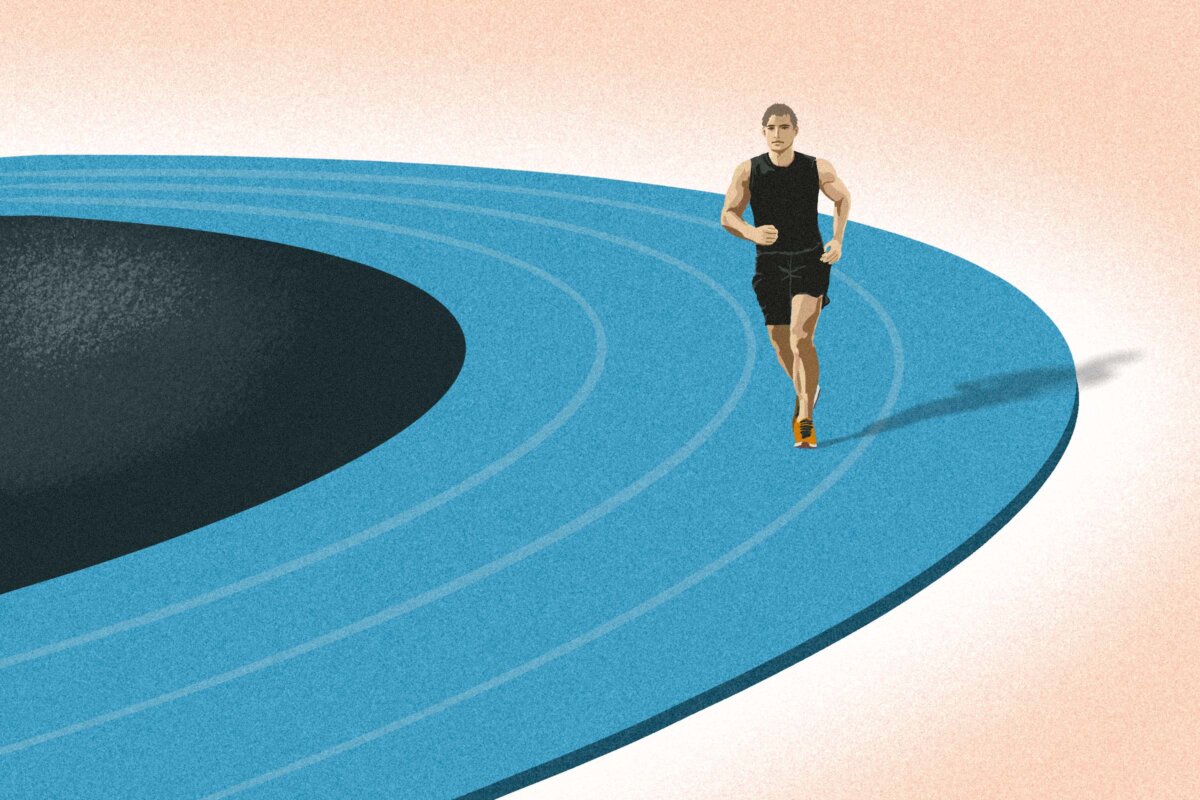
A few years ago, Dr. Mike Cymbor’s career and passion collided unexpectedly when he learned just how protective exercise is for some of the eye conditions he sees in his clinic every day.
An optometrist who specializes in glaucoma, Cymbor was at a work conference when three sessions on three different eye conditions—diabetic retinopathy, macular degeneration, and glaucoma—highlighted the protective role of exercise in disease development. Aroused by his own love for sports and exercise, he sat up straighter in his chair.
“It just hit me that there’s a thread running through all of this,” he told The Epoch Times. “And me being a glaucoma specialist who really never came across exercise [in my training], the light bulb went off, and I said, ‘Okay, there’s something here. Let me now try to connect all of the dots.’”
Today, Cymbor is a sought-after lecturer spreading the message that blood-pumping exercise does more than deliver oxygen and nutrients to muscles; it also improves your eyes.
Built for Blood Flow
The retina, which sits at the back of the eyeball but is part of the brain, detects light and sends information to the rest of the brain. It is also among the most energy-hungry tissues in the body. It requires blood to fuel neurons and photoreceptors, the light-sensing rods and cones that enable us to see through two distinct vascular systems.
One vascular system is responsible for delivering oxygen to photoreceptors behind the retina. The other system’s small branches supply oxygen to neurons responsible for visual processing.
Every heartbeat delivers oxygen, other nutrients, and immune cells to the retina, nourishing cells, removing waste, and keeping the tissue healthy. Good circulation helps control chronic, low-grade inflammation associated with many eye diseases.
Many Mechanisms Influence Different Eye Conditions
Exercise helps modulate a pressure system within blood vessels, Cymbor said, helping them expand and contract.
Expansion and contraction are a regulatory mechanism known as autoregulation. Autoregulation maintains proper oxygen flow to the eye and prevents damage to the capillaries, the body’s smallest blood vessels. Poor autoregulation can lead to eye diseases such as glaucoma.
Exercise may also improve the communication between the brain and the eyes. A single exercise session can release a neuromodulator called brain-derived neurotrophic factor, or BDNF.
“It also seems to go into the eye as well,” Cymbor said. “It gives the eye kind of like a shield of protection.”
BDNF improves communication between the retina and the brain and helps preserve certain cells that protect against diseases such as glaucoma. BDNF is also important in preventing macular degeneration, diabetic neuropathy (nerve damage), and cataracts because it helps neurons maintain connections, respond to stress, and survive injury.
Exercise additionally stimulates the release of more adult stem cells, powerhouse healing cells summoned from the bone marrow to repair microtears in muscles by releasing proteins that repair inflammatory damage. Researchers believe these stem cells are at work in our eyes.
“This is still very early on in the [research] process, but it makes sense that these adult stem cells are fixing things that need to be fixed,” Cymbor said of the hypothesis.
In a 2025 study published in Cell Stem Cell, stem cells injected into the eyes of six patients with age-related macular degeneration resulted in improvements in their vision, especially among those with the worst vision.
There’s an indirect way exercise helps vision as well: it can prevent and reverse obesity, Type 2 diabetes, and hypertension, all of which are risk factors for eye disease.
“I think all those things together contribute to this—it’s multiple things,” Dr. Pradeep Ramulu, a glaucoma specialist and the director of the Wilmer Eye Institute glaucoma division, told The Epoch Times.
Ramulu, who is a leading researcher on the relationship between vision and exercise, said more human studies are needed to understand exactly how exercise affects vision, though it appears to be multifactorial.
The Catch 22 of Vision and Exercise
While vision is affected by exercise, the reverse may also be true—poor vision was strongly correlated with low exercise levels, according to a study published in JAMA Ophthalmology. Poor vision was linked to low levels of exercise as much as, or even more than, systemic conditions including obesity, chronic obstructive pulmonary disease, arthritis, stroke, and congestive heart failure.
Participants with normal vision averaged nearly 10,000 steps per day over seven days of accelerometer-based tracking. Those with visual impairment took about 6,000 steps a day on average, with 9.3 minutes of moderate-to-vigorous physical activity—levels that were lower than those of people with the aforementioned severe diseases.
In many cases, their vision impairment was mild or moderate. For example, they would need to be 20 feet closer to a sign that someone with 20/20 vision could see from 40 feet.
Ramulu has found the same strong association between vision loss and activity level in his own research—a finding that confounds him.
“There’s something real here,” he said. “The fact that somebody with poor vision would restrict their activity even more than somebody who actually has a physical reason why they can’t walk, who gets tired, and just can’t do it. It was really rather striking.”
The authors of the JAMA Ophthalmology study speculated that it could be because people with weak vision had lower confidence in walking, balance issues resulting from their poor vision, past falls or a fear of falling, and limited driving ability that might keep them homebound rather than going to a gym or another place to exercise.
Part of the problem may be an educational one. Less than one-third of low-vision rehabilitation facilities or hospitals offered mobility training as of 2012, when the JAMA study was published.
[series_posts_list][/series_posts_list]
How to Exercise for Your Eyes
Given the connection between exercise and vision health, the logical question is what kinds of exercise, how much, and how often to exercise to help the eyes?
“Certain exercises may play a bigger role in some eye diseases and not others, and we’re still trying to tease that out,” Cymbor said.
For now, suggestions are vague or based on early studies on specific diseases.
In a meta-analysis published in BMC Ophthalmology, the study found a reduced risk of developing cataracts with higher levels of physical activity compared with lower levels. Risk was reduced by about 30 percent when participants ran or jogged about seven hours a week.
However, the exercise-related benefits for those with age-related macular degeneration were less clear in the study. The researchers found benefits for this group, but they were not statistically significant.
“There was a very limited number of studies that had looked at specific types of physical activity,” Dagfinn Aune, one of the authors and a professor at Imperial College London, told The Epoch Times in an email. “Much further research is needed on this before we can conclude with certainty.”
A study published in the Journal of Glaucoma examining the walking of 80 glaucoma patients found those who walked more experienced slower disease progression.
Based on the findings, Cymbor now emphasizes higher levels of aerobic activity for glaucoma patients, challenging them to increase their exercise progressively. For patients with diabetic retinopathy (diabetes that damages the small blood vessels in the retina), he tells them to move their bodies at whatever level they can. The message for most patients, he added, is to gradually increase physical activity, even if they’re starting from zero, and to do so sooner rather than later.
“People who are more active may actually be protected against losing vision,” Ramulu said. “If you have eye disease or are at risk of it, it is a smart thing to keep yourself active.”