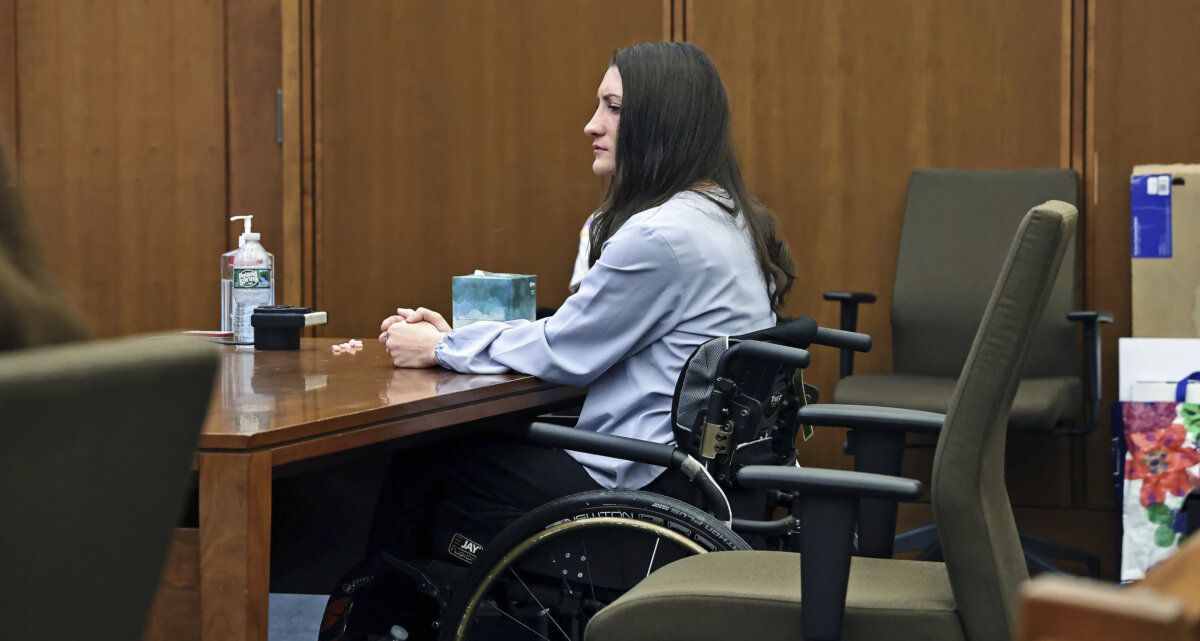


Jurors in the trial of Lindsay Clancy, charged with murdering her three children, were unable to reach a unanimous verdict, and the judge said he intends to declare a mistrial on Sep. 4.
Judge William Sullivan said he would stay his mistrial ruling for one hour to give Clancy’s defense attorneys an opportunity to file an emergency appeal.
The hung jury came not long after the jury entered its seventh day of deliberations following a five-week trial.
Clancy admitted to strangling her children with exercise bands in the basement of her Duxbury, Massachusetts, home on Jan. 24, 2023, while her then-husband was running errands. She then cut her wrists and neck and jumped out of a second-story window in a failed suicide attempt, leaving her paralyzed from the waist down.
Clancy was charged with three counts of first-degree murder.
Prosecutors said she intentionally planned and carried out the three deaths of her children, knowing it was wrong.
Clancy’s former husband, Patrick, was the prosecution’s first witness and testified that she shared having intrusive thoughts of harming their kids and taking her own life ahead of the killings. He said she even allegedly heard a voice encouraging her to kill.
“She heard a man’s voice telling her that if she didn’t do it now, she would lose her chance, or something like that,” Patrick Clancy testified.
Analysis of her phone data showed she made online searches for hallucinations, psychosis, and suicide in the weeks leading up to the killings.
A note on her phone revealed she had fears about how her kids would grow up.
“I’m terrified of something happening to my kids or doing something wrong to mess up their development,” Clancy’s note read. “Our generation is inundated with information about every aspect of parenting. … It’s insane. For the last five years, I’ve just filled my mind with all things parenting and it’s just unhealthy.”
Prosecutor Jennifer Sprague accused Clancy of planning the deaths by sending her then-husband to pick up food and adding a second errand—picking up medicine at a pharmacy—when she realized there wasn’t enough time to complete the killings during the first task.
A forensic psychologist who testified in the trial, Kirk Heilbrun, said Clancy did not have acute psychosis when she killed her three children. Acute psychosis is when someone has lost touch with reality and does not know what is real and what is not.
“The way she described this as happening is that she heard a voice that she’d never heard before, experienced a hallucination and she’s never experienced it since. But she only experienced it for the 18 minutes or so that it took to kill the children,” Heilbrun said. “To put it mildly, that would be a very, very unusual pattern or manifestation of how this kind of thing comes about. Very unusual.”
Heilbrun said he concluded that Clancy killed her children because she wanted to take her own life but didn’t want to leave them behind.
“One of the things that she said when I asked about what happened, is that in the course of strangling each child, she said, ‘Go to God, baby. Go to God,’” he said. “That was part of her expectation that she and the children would be together in heaven with God.”
Phillip Resnick, a forensic psychiatrist, testifed that Clancy was “clearly psychotic” on the day she killed her kids and was not in control of her actions.
“It was almost like she was a puppet and someone else was pulling the strings,” he said.
Defense attorney Kevin Reddington urged jurors to find Clancy not guilty by reason of insanity, insisting that his client’s “mind was gone” and the killings were part of postpartum psychosis.
“This young lady is not guilty of the killing of her children because she was suffering from a disease and defect, as his honor instructed you,” Reddington told jurors in closing arguments on Aug. 27. “And they’re not going to be able to prove otherwise.”
Reddington said Clancy sought medical help and spent five days at a hospital in January 2023, but the treatment was not effective.
During trial, including closing arguments, Reddington blamed Clancy’s actions on what he called “lousy medical care” and the effects of the medication Clancy was taking.
“My God!” he said. “What does she have to do? She was reaching out for help and she was not getting it.”
Clancy did not testify during the trial.
Allison Lespasio, a registered associate clinical social worker based in California, told The Epoch Times that the case has sparked a nationwide conversation on women’s mental health after childbirth and how the health system treats those issues.
Postpartum psychosis usually develops around two weeks after giving birth and can make a mother experience hallucinations, hearing or seeing things that are not there, delusions, changes in mood, and paranoia, said Lespasio, who is not associated with the case.
Reuters contributed to this report.
 Friends Read Free
Copy
Facebook
Tweet
Friends Read Free
Copy
Facebook
Tweet