
US Strikes Iran After Attempted Attacks on US Troops, Shipping

By Timothy Frudd
Timothy Frudd
Timothy Frudd
Timothy Frudd is a reporter for The Epoch Times. Timothy can be reached at timothy.frudd@epochtimes.com.
September 1, 2026Updated: September 2, 2026

The U.S. military launched new strikes against Iran on Sept. 1 following attempted attacks by the Islamic Revolutionary Guard Corps (IRGC).

U.S. Central Command (CENTCOM) said U.S. forces started striking IRGC targets in Iran at 12 p.m. ET on Tuesday.

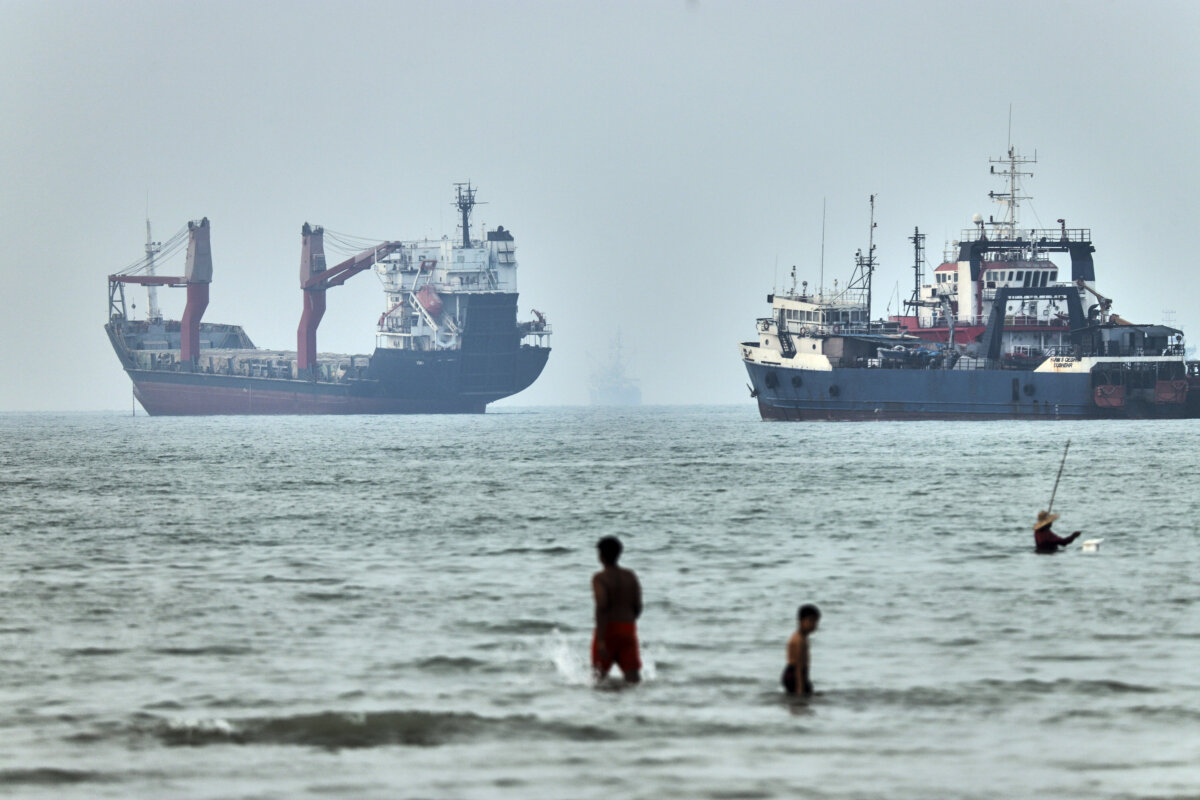
“The strikes follow recent attempted attacks by the IRGC against commercial shipping in the Strait of Hormuz and against American service members deployed to the region,” CENTCOM wrote in a statement on X.

The command later said in an update that the strikes successfully struck targets including air defense sites, radar systems, maritime assets and facilities, mine laying capabilities, and communications sites.

The U.S. military strikes came one day after President Donald Trump warned that the United States would resume attacks against Iran after the regime launched missiles at U.S. bases in Jordan.

“We’re going to hit them hard,” Trump told Fox News on Monday. “There will be a response.”

Trump addressed Tuesday’s strikes in a Truth Social statement shortly after CENTCOM announced the start of the new attacks.

“The United States is, as we speak, striking Iranian Targets near the Strait of Hormuz,” he said.

The president said the attacks were being carried out in response to Iran’s “failed attempt” at placing additional sea mines in the Strait of Hormuz and for shooting eight missiles at U.S. forces in Jordan.

Trump warned that if Iran retaliated for Tuesday’s “very justified attack,” the United States would hit the regime again “at a much harder and higher level.”

The president also warned Tehran that the “biggest attack of them all” was yet to come and that when it was over there would be “very little left” of Iran.

Trump reiterated his warning in comments to Fox News correspondent Trey Yingst on Tuesday. He told Yingst that the U.S. military’s strikes were a “very big hit” and that “if it goes a third time, they’re going to be totally wiped out as a country.

The president also told Yingst that Tuesday’s military strikes targeted radar that Iran was trying to rebuild in the southwestern part of Iran near the Strait of Hormuz. He said the United States was monitoring the reconstruction of the radar and launched the strikes just before the construction was completed.

Asked about a future peace agreement with Iran, Trump said, “I think an agreement with them isn’t worth the paper it’s written on.”

Fars and Tasnim, two semiofficial news agencies linked to the IRGC, reported that Iran started firing drones and missiles in response to the U.S. military strikes on Sept. 1.

The U.S. military said it carried out attacks on Aug. 30 targeting two Iranian rocket launchers loaded with sea mines on Larak Island in the Strait of Hormuz.

Iran condemned the strikes as an “act of aggression.” CENTCOM denied Iran’s claim in a statement on social media.

U.S. forces took “limited, precise action” against Iran’s minelaying forces, the command said, noting that the Iranian forces posed an imminent threat in the Strait of Hormuz.

“In essence, Iran created the threat, and the U.S. military eliminated it to protect civilian mariners, commercial shipping, and the free flow of global commerce,” CENTCOM stated.

In response to the U.S. military attacks on Aug. 30, Iran launched missiles targeting U.S. military bases in Jordan. The regime’s foreign ministry announced on Aug. 31 that its armed forces had conducted “defensive and crushing strikes” against the bases.

Trump later confirmed that all of the Iranian missiles were intercepted except one that was allowed to pass through without being intercepted because officials determined it would not hit anything significant.

Before the launch of additional U.S. military strikes on Tuesday, Iranian President Masoud Pezeshkian had offered to return to the peace deal outlined under the June 17 memorandum of understanding between the United States and Iran if Washington agreed to do the same.

“I am stating clearly that if the United States returns to its commitments under the Memorandum of Understanding, the Islamic Republic of Iran will immediately reciprocate,” Pezeshkian said during the Shanghai Cooperation Organization summit in Kyrgyzstan on Sept. 1.

The Aug. 30 strikes on Larak Island were the first military strikes U.S. forces had carried out against the regime since late July.

Washington and Tehran agreed to a ceasefire in April and a memorandum of understanding in June. The agreement established a 60-day window for the two countries to negotiate a permanent peace deal. 

However, the peace deal collapsed after Iran attacked multiple commercial vessels in the Strait of Hormuz, prompting the United States to launch strikes against Iranian targets for 13 consecutive days. Additional U.S. strikes had been paused by Trump to create space for negotiations, which ultimately stalled last month.