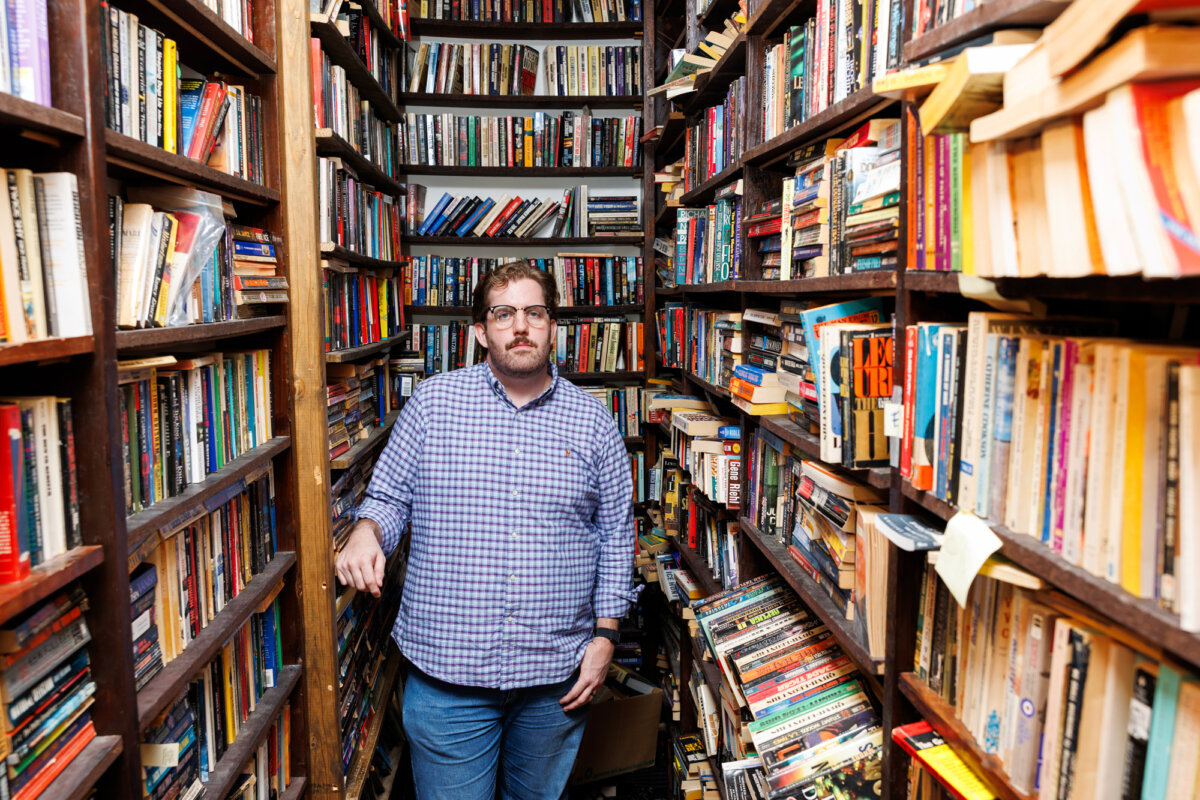

Charlie Becker’s family bookstore in Houston has been connecting people with literature for more than 30 years.
Becker said the family has “seen a lot of changes” since his dad opened the store for used and rare books in 1993.
When he was 12 years old, Becker said, his father made one of the store’s first large purchases. Another local business planned to get rid of its collection of books, but first called Becker’s dad.
“It was in their [company’s] last days, and they said my dad had to pick up the books. I went with him to the warehouse,” he said.
Becker grew up with that story of rescuing books bound for a landfill with his dad. Over the years, he has watched the entire industry of acquiring and selling books change with the rise of the internet, digital cataloging, and the emergence of major sellers such as Amazon.
For generations, booksellers have worked to preserve humanity’s writing. However, the recent revelation that millions of print books are being scanned to train artificial intelligence models and then destroyed presents an unprecedented challenge.
The practice of what has been dubbed AI “book shredding” came to public awareness after a 2025 court document revealed that AI tech giant Anthropic purchased millions of printed books, removed their bindings, then scanned each page into digital datasets. Afterward, Anthropic shredded and discarded the originals.
It was revealed that the project was part of an ongoing expansion of Anthropic’s central library, which has an aim to collect “all the books in the world” and retain them “forever.” The undertaking was called Project Panama.
The same document notes that Tom Turvey, former head of partnerships for Google’s own book scanning project, was hired to acquire material for the project. Turvey’s team emailed “major book distributors and retailers about bulk purchasing their print copies for Anthropic’s ‘research library.’”
Court filings from the Bartz v. Anthropic lawsuit, unsealed in January, name retailers such as Better World Books and World of Books as vendors from which Anthropic acquired thousands of books.
Anthropic did not respond to a request for comment.
“Sourcing books is a widely used approach for training large language models across the AI industry,” an Anthropic spokesman told technology website Tom’s Guide. “None of our data acquisition programs buy and destroy rare or antiquarian books.”
Although a federal judge ruled that the destructive scanning of legally purchased books qualified as transformative fair use, or the alteration of an original work for a new purpose, the practice is sparking concern among book dealers who say systematically shredding books means losing not only words, but also cultural artifacts.
Between the Lines
“What I’ve been hearing is alarming. People are right to raise a red flag about it,” Susan Benne, executive director of the Antiquarian Booksellers’ Association of America, told The Epoch Times.
The association has been a trusted source of rare and print books since 1949. Benne said the destruction of printed materials, even if they’re not rare or antiquarian, strikes at the heart of something sentimental in most people.
“Just the attachment to maybe something you read as a child or in college, I think it’s hard for a lot of us to see that kind of destruction,” Benne said. She compared AI book shredding to a flood, a museum fire, or a similar disastrous event that wipes out a repository of human knowledge and culture.
“It hits the same nerve.”
Becker said he thinks that the practice of destructive book shredding, particularly when done to train AI, triggers something “visceral” in people.
“I do think we lose something culturally when certain books are deemed as commodities or expendable,” he said.
However, Becker said it’s important to clarify that not all of the books being fed into the jaws of AI training were rare or out of print.
“A lot of people are upset because they have the idea that it’s all these rare books like priceless works,” he said. “But people need to keep in mind, a lot of times it can be stuff like an old GE refrigerator manual.”
Benne agreed. “Just because something is out of print doesn’t mean it’s rare. From what we’ve heard, many [of the books] were common items,” she said.
However, she added, “that’s not to say people shouldn’t be worried.”
Suspicious Orders
One of the greatest challenges to stopping this practice is a lack of transparency around who is buying the large volumes of books.
In July, a 404 Media report flagged the book database ISBNdb for promoting print book acquisition services that would keep buyer information confidential.
ISBNdb has since changed the landing page on its website titled “Printed Books Sourcing for Your AI [Large Language Models] Dataset Needs.” The website now states that the company was “exploring demand” and has “chosen to pivot away from that direction.”
When questioned about this practice, a representative from ISBNdb reiterated the statement on the company’s website, saying the database had never “purchased, scanned, or destroyed a book for AI training or anything else.”
“We have never bought or sold printed books for AI training: no orders, no purchases, no books,” the representative told The Epoch Times.
But even if it had, that’s just one aspect of the issue. Non-disclosure agreements can be involved when sellers are working with big buyers, Benne said.
“It’s not currently common practice to ask a seller, ‘What are you going to use this book for?’” she said.
The lack of available information is why Becker thinks that it’s important to know what books are being scanned for AI use and then destroyed.
“Literally no one knows; that’s part of the problem,” he said. “Somebody who cares about our literary heritage should be in that pipeline somewhere, but that’s not what’s happening.”
Back in April, Becker noticed a sudden spike in book sales—between double and triple his usual weekly sales tally.
By working in the warehouse for his family’s store, he said, “you kind of get a feel for what people order.”
The warehouse holds about 300,000 titles, and when the sales volume began picking up, he dug into the orders.
“That’s when I went online, and I saw a lot of people were talking about the same thing,” he said.
“This is crazy. I counted, I looked deeper: The last 100 book orders we’d received, 95 were from the same buyer. For all the book orders to come in that way, it was very strange.”
Andrea Klein, who operates the Ohio-based store The Bookseller Inc., also noticed strange orders in recent weeks.
For Klein, the bump in sales was enough to catch her eye. She also saw that whoever purchased the books wasn’t the final destination.
“I could tell they were buying it for somebody else,” Klein told The Epoch Times.
“I thought at the time they were buying it for somebody in Europe and consolidating an order to save on shipping. But once I heard about all this AI stuff, I thought that’s what it could have been.”
The Bookseller Inc. started in a basement in Cuyahoga Falls in 1948 and has been passed on between generations. Klein now runs the bookshop for used and rare volumes online. As a smaller retailer, she’s very attuned to anything out of the ordinary.
“Normally, I am selling one or two books to customers all over the place,” she said, noting that she had the suspicion that two recent buyers “might have been connected.”
“They would order five or six nice books. Instead of a $10 or $20 book, they would order $100 or so worth of books. And that happened maybe three, four, or five times.”
Benne said she’d also heard buzz about strange orders circulating throughout the print book community.
“Anecdotally, we heard murmurings about this two to three months ago, when there was a spate of orders going around,” she said.
The orders frequently involved older or obscure books and often books published pre-2022. Such books are valuable for training large language models because they’re sure to be free of AI-generated text.
Safeguarding Civilization
On the flip side, Benne highlighted some efforts to use AI more equitably when it comes to books. Companies and nonprofits such as Project Gutenberg digitize materials for preservation.
Benne believes that there’s a big difference between digital cataloging and conservation and just “taking information, revamping it, and then using it in a nonethical way.”
Becker shares this point of view.
“I do not have a flat problem with AI,” he said. “I think it’s a much more complex issue than something you can just be for or against.”
The discovery of AI book shredding has only strengthened Becker’s resolve to use AI in the service of literature. Alongside his cofounder, Adam Nelson-Archer, Becker is creating an AI-powered cataloging platform for used and rare booksellers.
“It’s the concept of safeguarding civilization,” he said.
Outcry over destructive book scanning has prompted some tech magnates such as Elon Musk to take similar steps toward preservation. Musk wrote on his X account in July that he had “asked the SpaceXAI team to preserve any rare books in a library and scan them the hard way [versus] just cutting off the spine and scanning.”
The disclosure of AI book shredding arrives at a time when American public trust in the technology’s use is plummeting. A recent Bentley University–Gallup survey observed that an increasing number of U.S. adults believe that AI does more harm than good, while an overwhelming 73 percent of Americans don’t trust companies to use AI responsibly.
 Friends Read Free
Copy
Facebook
Tweet
Friends Read Free
Copy
Facebook
Tweet