



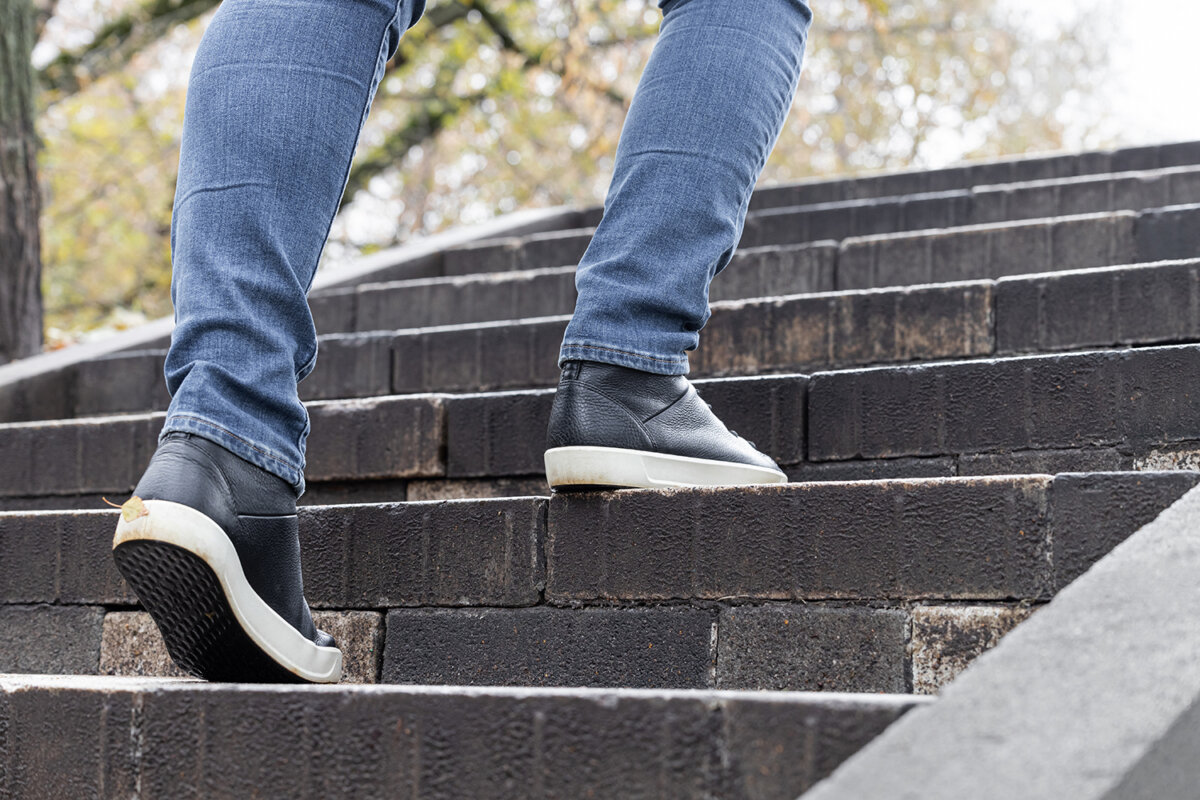
Who knew that a simple trip up the stairs could be a way to reduce your heart disease risk?
People who regularly climb stairs are 39 percent less likely to die from cardiovascular disease and 24 percent less likely to die from any cause, according to a recent analysis of nearly half a million people.
The findings, published in the American Journal of Cardiovascular Drugs, come from a systematic review and meta-analysis of nine studies covering 480,479 people, with an average follow-up of 14 years. The pooled data spanned adults aged 35 to 84, just over half of whom were women.
“Taking the stairs is a practical and often overlooked way to build physical activity into daily life,” study author Vassilios Vassiliou, a professor at the University of East Anglia’s Norwich Medical School, said in a press statement.
Reduced Risk of Death From All Causes
Compared with people who rarely took the stairs, regular stair climbers were 39 percent less likely to die from cardiovascular disease and 24 percent less likely to die from any cause. The study also showed that stair climbers were less likely to develop major heart conditions such as heart attack, stroke, and heart failure.
Moving vertically requires roughly 9.6 times the energy expenditure of sitting. These short, high-intensity bursts condition the heart muscle, increase stroke volume, and lower resting heart rate over time.
“For people who are able to do so safely, taking the stairs is a simple and cheap way to incorporate more physical activity into everyday life,” Vassiliou told The Epoch Times.
The pattern was consistent: going from little or no stair climbing to some stair climbing was linked to a meaningful drop in risk. Some studies suggested that climbing more offered additional benefit, though not without limit.
One large study in the analysis pointed to around six flights per day as the point of greatest benefit—but more research is needed before turning that into a formal recommendation.
Vassiliou said that the studies he analyzed measured stair climbing in different ways, making it difficult to define an optimal “dose” based on the analysis alone.
Heart Disease Has Doubled Since 1990
Heart disease is the leading cause of death worldwide, and cases nearly doubled between 1990 and 2019.
Existing evidence shows that incorporating short intervals of stair climbing three days a week over six weeks can significantly improve cardiorespiratory fitness.
Similarly, another study included in the analysis showed that two- to 10-minute intervals of stair climbing five days a week reduced low-density lipoprotein cholesterol by 7.7 percent in previously sedentary young women.
Adapt Exercises to Your Needs
Stair climbing works the glutes, quads, hamstrings, and calves while raising the heart rate quickly, Denise Chakoian, a Rhode Island-certified fitness trainer and owner of Core Cycle and Fitness LaGree, who was not involved in the study, told The Epoch Times, making it useful for both cardiovascular fitness and strength.
“Stair climbing is generally safe and actually healthy for you, but it’s important to build up gradually, especially if you’re not used to it,” she said.
Her guidance includes the following:
-
Start Small: Build up gradually with a few flights rather than attempting a long stair workout right away, especially if you’re not used to the activity.
-
Wear Supportive Shoes: Choose shoes with good traction to reduce the risk of slipping.
-
Use the Handrail: Use it if you need extra stability, and pay attention to your footing.
-
Stop if Something Feels Wrong: Stop if you experience dizziness, unusual shortness of breath, or sharp pain rather than pushing through.
-
Let Your Body Recover: Allow time for recovery because, like any workout, overuse without rest can lead to injury.
You can also make it more challenging by increasing your pace, adding more flights, or simply climbing for longer, Chakoian advised.
For people with joint pain or limited mobility, going up stairs is often better tolerated than repeatedly going down, since descending places more strain on the knees, she said.
Lower-impact alternatives—walking on flat ground, swimming, water aerobics, stationary cycling, or seated strength exercises—can offer similar benefits without the joint stress.
“The goal is to find movement that challenges your muscles and heart without aggravating your joints or putting you at risk of falling.”