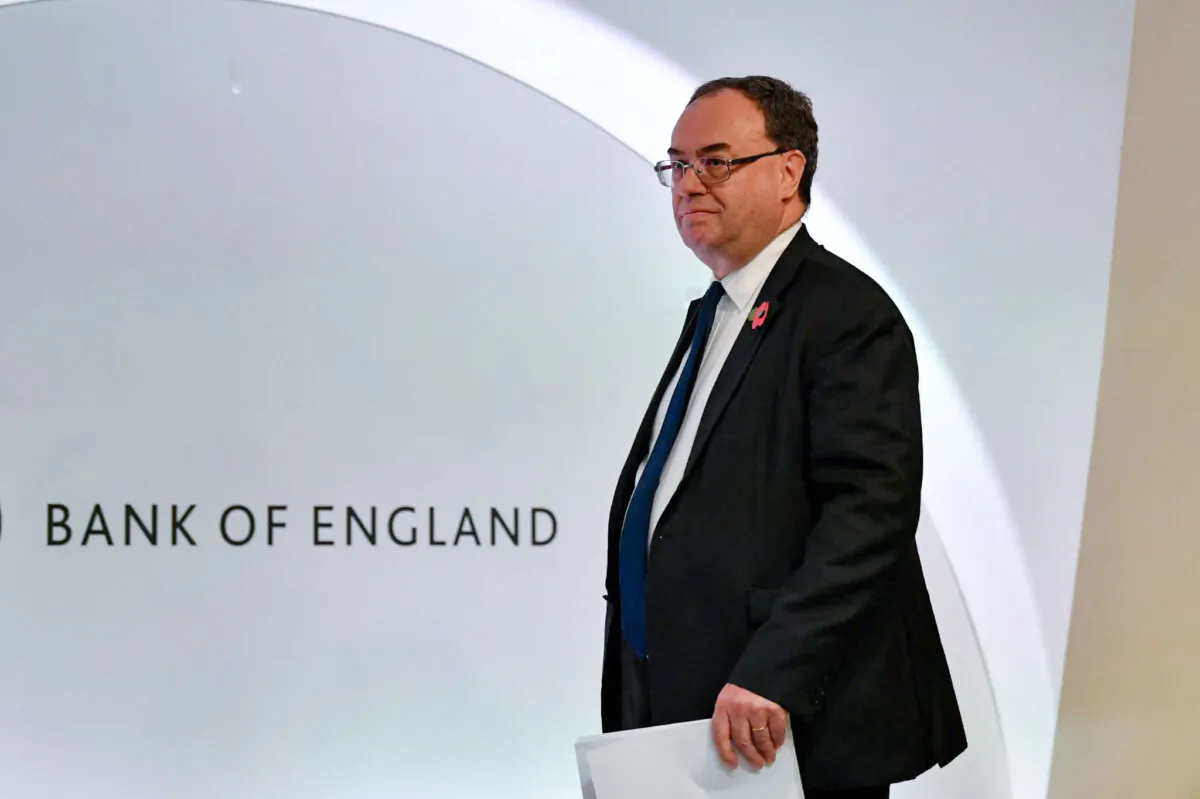

The Bank of England (BoE) kept its benchmark interest rate unchanged at 3.75 percent on Feb. 5, saying inflation is falling faster than expected but warning that risks to the outlook remain as the economy slows and unemployment rises.
The decision to maintain the rate, announced by the central bank’s Monetary Policy Committee, was made in a 5–4 vote.
The bank said it was keeping rates steady to ensure inflation returns to its 2 percent target and stays there. UK consumer price inflation rose to 3.4 percent in the year to December 2025, up from 3.2 percent in November, but eased after a summer peak.
BoE Gov. Andrew Bailey said during a press conference on Feb. 5 that inflation was “a little lower” than the bank’s expectations in November.
The BoE expects inflation to decline to about 3 percent in the first three months of 2026, before reaching a level close to the 2 percent target from April, he said.
A key factor behind the improved outlook is falling energy costs. Bailey said that a drop in utility prices will account for about one-third of the expected decline in inflation in the first half of the year.
He said that energy measures announced in November 2025, designed to reduce household energy bills from April 2026 onward, combined with lower wholesale gas prices, are expected to lower the Ofgem price cap in April.
The Bank also expects slower wage growth and fading effects from last year’s increase in national insurance contributions for employers to ease price pressures.
Economy Slows, Unemployment Rises
The BoE said the British economy is estimated to have grown by 1.4 percent in 2025, slightly below its previous forecast of 1.5 percent for the year.
It also lowered its outlook for the next two years. Gross domestic product is now projected to expand by 0.9 percent in 2026, down from a prior estimate of 1.2 percent, and by 1.5 percent in 2027, compared with an earlier forecast of 1.6 percent.
The BoE also revised its unemployment projections upward. In November 2025, policymakers expected the jobless rate to peak at 5.1 percent. On Feb. 5, however, it said unemployment is now forecast to rise as high as 5.3 percent.
The rate is then expected to ease gradually, falling to 5.2 percent in 2027 and 5.1 percent in 2028. That compares with previous forecasts of 5 percent for 2027 and 4.8 percent for 2028.
Scope for Further Easing, Growth Outlook
Bailey said that recent progress has allowed the BoE to make policy less restrictive.
“As inflation has fallen, we’ve been able to ease our foot off the brake, making monetary policy less restrictive by cutting bank rates six times, including at the meeting we held in December,” he said.
He stressed, however, that the job is not complete.
“We need to ensure that inflation falls all the way back to the 2 percent target and stays there,” Bailey said.
Looking ahead, he signaled that further rate cuts are possible if conditions evolve as expected.
Despite some improvement in inflation, the broader economic outlook remains cautious, Bailey said. The BoE projects gross domestic product growth to strengthen gradually to nearly 2 percent a year by 2028, supported by recovering consumption and a stronger housing market. Still, Bailey warned that consumption growth could disappoint.
“Despite past reductions in bank rate, the household saving rate remains above historical levels,” he said.
PA Media contributed to this report.
 Friends Read Free
Copy
Facebook
Tweet
Friends Read Free
Copy
Facebook
Tweet