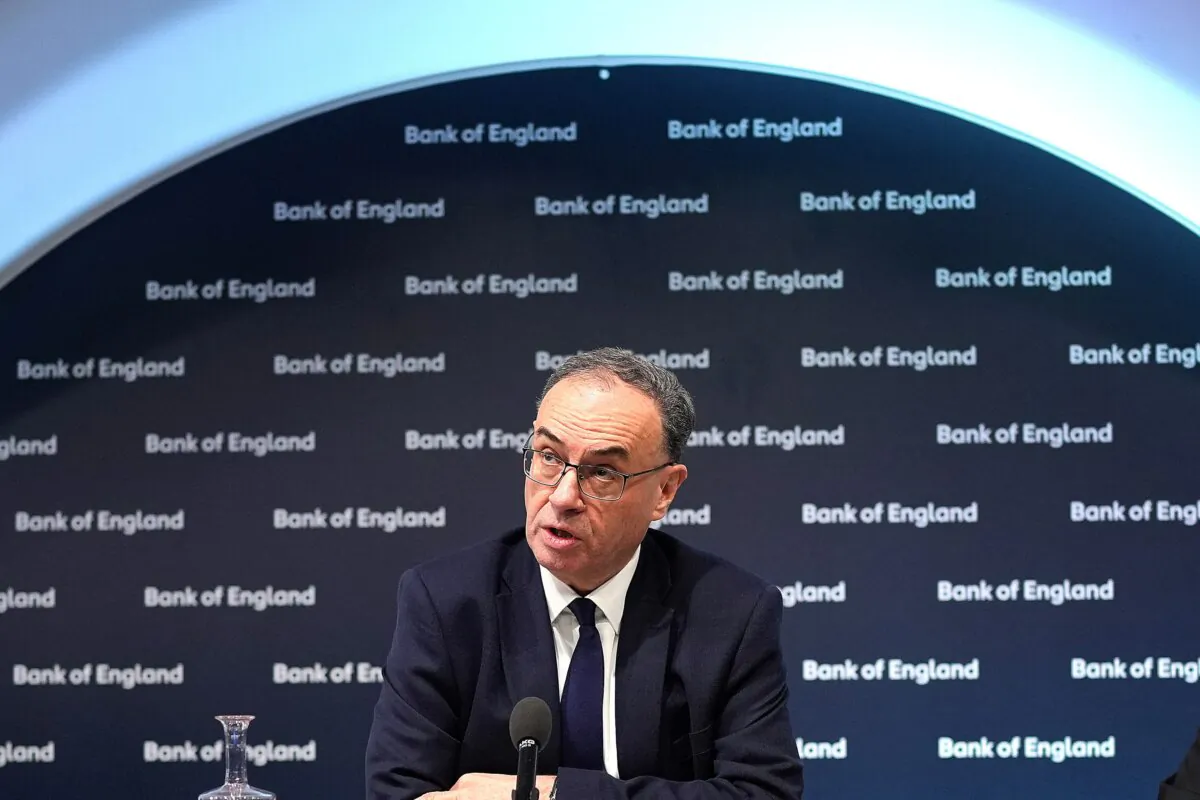

The Bank of England (BoE) on April 30 held its key interest rate steady at 3.75 percent, after weighing rising inflation against signs of a weakening economy and warning of the global energy market volatility.
The bank said it assessed how rising energy prices in the aftermath of the conflict in the Middle East may affect UK inflation and economic activity.
“War in the Middle East is disrupting the transportation and supply of energy, raising its price and pushing up households’ motor fuel costs; we expect utility bills to increase as well,” the bank’s Monetary Policy Committee (MPC) said.
The MPC voted 8–1 to keep rates unchanged, with one member calling for an increase to 4 percent.
UK inflation rose to 3.3 percent in March from 3 percent in February, higher than expected earlier this year.
The MPC said inflation is likely to increase further in the coming months due to higher energy costs.
“The conflict in the Middle East means that prospects for global energy prices are highly uncertain,” the bank said. “Monetary policy cannot influence energy prices but will be set to ensure that the economic adjustment to them occurs in a way that achieves the 2% inflation target sustainably.”
The BoE Governor Andrew Bailey described the rise in energy prices as a “supply shock” and said it differs from 2022, when energy prices surged following the onset of the war in Ukraine.
“The increase in energy prices has been smaller, monetary policy started more restrictive and the labour market is weaker,” Bailey said.
One committee member, Huw Pill, voted to raise interest rates, citing concerns that higher energy prices could lead to more persistent inflation.
“Events in the Gulf have left the outlook for global energy prices elevated and more uncertain,” Pill said April 29.
He added that higher energy costs “represent an inflationary shock to the UK economy” and warned that second-round effects in wages and pricing could push inflation higher over time.
BoE Scenarios
The Bank of England said the trajectory of inflation will depend largely on how energy prices evolve and how long they remain elevated. It also outlined a range of forecasts.
Across all scenarios, inflation is expected to be higher in the near term due to rising energy prices.
In a milder case, inflation rises to around 3.6 percent in 2026 before falling below the 2 percent target by 2027 as the economy weakens and energy prices ease. In a middle scenario, inflation peaks at about 3.7 percent and declines more slowly, staying near the 2 percent target over time.
In a worst-case scenario, inflation could rise as high as 6.2 percent and remain above target for longer due to persistent energy shocks and stronger wage pressures.
“At the moment, I place most weight on Scenario B, albeit with slightly reduced second-round effects,” Bailey said. “I place some weight on Scenario C, which would require a stronger monetary policy response.”
The BoE’s decision aligns with other major central banks facing similar uncertainty.
The U.S. Federal Reserve on April 29 held rates steady at 3.5–3.75 percent, while the Bank of Japan kept its short-term policy rate steady at 0.75 percent a day earlier.
The European Central Bank is expected to follow a similar path as policymakers assess the global impact of energy market disruptions.
The Bank of England said it will continue to monitor developments in the Middle East and stands ready to act if needed to ensure inflation returns to its 2 percent target over the medium term.
“We are monitoring the situation very closely; whatever happens, we’ll make sure that inflation gets back to the target,” the bank said.
 Friends Read Free
Copy
Facebook
Tweet
Friends Read Free
Copy
Facebook
Tweet