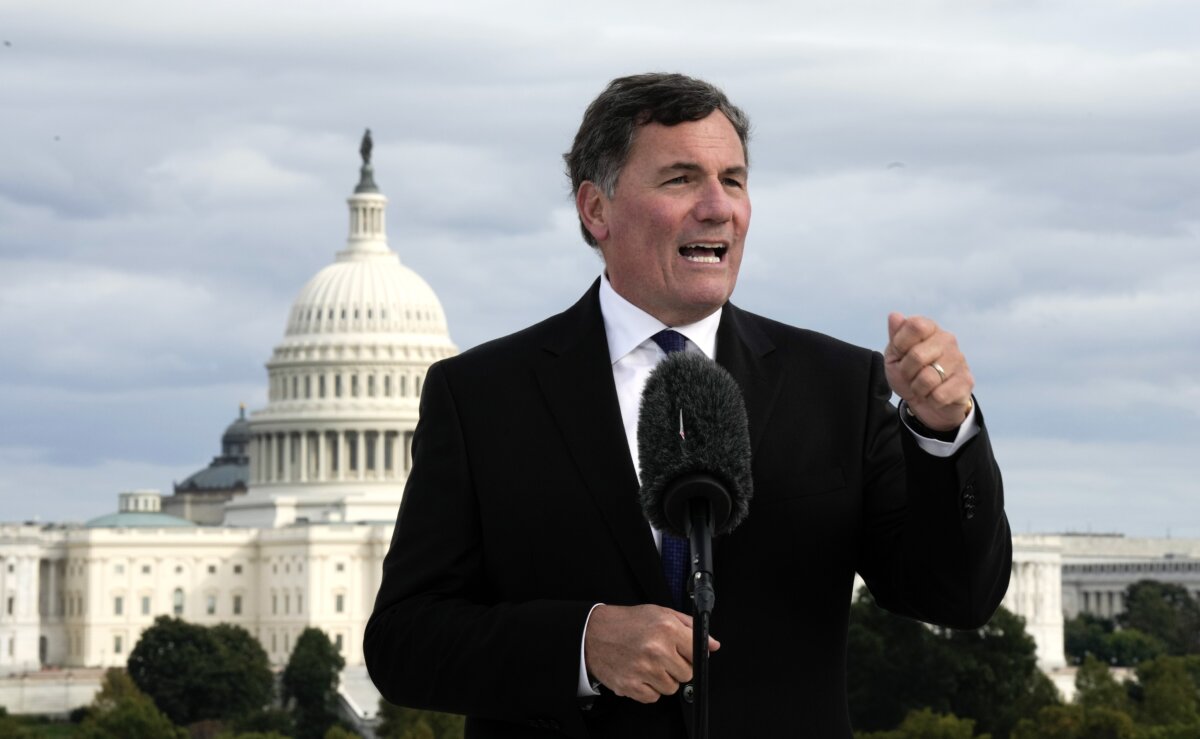

Canada-U.S. Trade Minister Dominic LeBlanc says relations between Ottawa and Washington have not been impacted by their differing stances on the Iran war.
U.S. President Donald Trump in recent days has publicly criticized some allied countries for not facilitating U.S. military operations or for not playing a role in helping restore freedom of navigation in the Strait of Hormuz.
LeBlanc told reporters in Ottawa on March 30 he would not comment on that specific matter, while adding that Canada’s stance has “not been an impediment at all” during talks with U.S. officials.
LeBlanc said the top Canadian officials managing the relationship with the United States, such as chief trade negotiator Janice Charette and Ambassador to the U.S. Mark Wiseman, have not relayed any concerns from U.S. officials regarding Canada’s stance.
At the onset of the conflict, Prime Minister Mark Carney issued a statement backing the attack on Iran, noting the failure of diplomatic efforts to curb Iran’s nuclear program or its support for regional terrorist proxy groups. Days later, Carney said the attacks on Iran appeared to be “inconsistent” with international law and called for de-escalation.
As the war against Iran enters its second month, and the energy crisis grows due to major disruptions in the Strait of Hormuz, Trump is railing against NATO allies for not providing help.
Trump said on March 31 that countries like the United Kingdom, which did not get involved in the “decapitation of Iran” and can’t get jet fuel, should now buy fuel from the United States. He said they should gather “delayed courage” to restore navigation in the Strait of Hormuz. “Go get your own oil!” he said on Truth Social.
The same day, the U.S. president accused France of not letting planes carrying military supplies to Israel to fly over its airspace. Sources confirmed the matter to Reuters while France had not issued an immediate response by publication time.
The spat comes after foreign ministers of the G7, which includes Canada, the United States, France, and the United Kingdom, issued a joint statement on Iran on March 27. The statement called for the cessation of attacks against civilians and noted the “absolute necessity” to restore freedom of navigation in the Strait of Hormuz.
Carney said last week that Canada and some NATO allies have held ongoing talks on ensuring the free transit of vessels in the strait once a ceasefire is achieved. The virtual closure of the strait, through which roughly 20 percent of the world’s oil supply normally transits, has sent oil prices rocketing.
‘In Due Course’
Besides commenting on the impact of the Iran war on Canada-U.S. relations, LeBlanc addressed the state of bilateral trade discussions.
The review of the United States-Mexico-Canada Agreement (USMCA) on free trade will begin in July and engagement between parties is underway.
U.S. Trade Representative Jamieson Greer said on March 18 that Canada is lagging behind Mexico in that process, with formal talks between the United States and Mexico having already begun.
No such formal talks with Canada have been launched or announced by the Office of the U.S. Trade Representative.
LeBlanc said no announcement has to be made about when talks will begin because trade discussions with Greer are “already underway.” The minister referred to his visit to Washington to meet Greer in early March, along with the ongoing conversations between U.S. officials and chief negotiator Charette and Ambassador Wiseman.
When pressed by reporters on when formal talks would be launched, LeBlanc said, “I expect that process to start in due course.”
“Who is ahead at what particular moment in time isn’t as interesting as ensuring that Canada gets to the conclusion in a way that’s important for Canadian workers, because a lot is at stake,” said the minister.
LeBlanc said his meeting with Greer in early March marked the resumption of trade talks after Trump cancelled them in late October. The president suspended the talks after the Ontario government ran an anti-tariff TV ad campaign in the United States.
At the time, Ottawa and Washington were making progress on a deal to address the U.S. sectoral tariffs impacting Canada. The deal related to the sectors of steel, aluminum, and energy.
LeBlanc said that discussions around that issue have been ongoing. Greer told CBC News in late February that Canada was still interested in “some kind of alternative deal right now,” while adding the White House is “quite focused on re-shoring supply chains related to automotive, steel, aluminum.”
 Friends Read Free
Copy
Facebook
Tweet
Friends Read Free
Copy
Facebook
Tweet