
Ottawa has announced more than $1.2 billion in additional support for the softwood lumber industry after Washington increased tariffs on the sector.
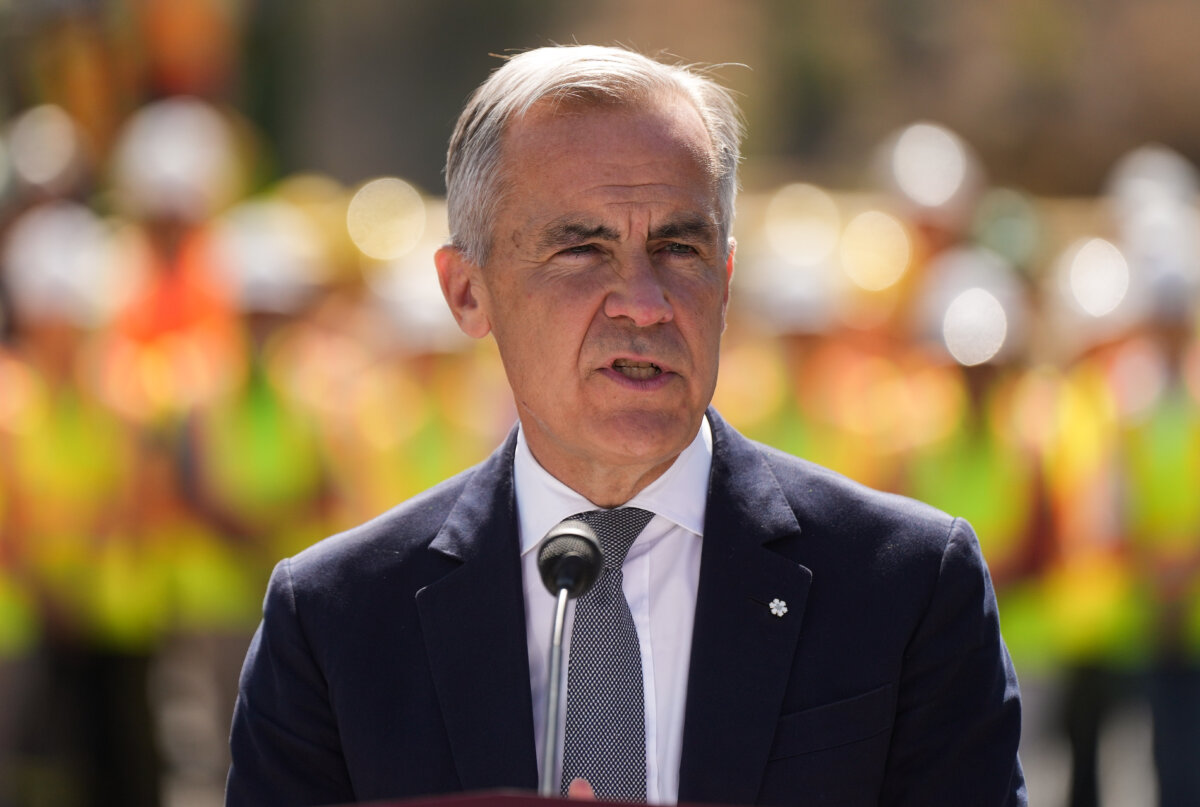
Prime Minister Mark Carney is promising an aid package for the industry that includes $700 million in loan guarantees and $500 million for long-term support to aid companies in diversifying their export markets and advancing their product development. The funding announced by Carney following a visit to Gorman Brothers Lumber in Kelowna, B.C., on Aug. 5 also includes $50 million for up-skilling and re-skilling lumber workers.
“The forest industry is a pillar of the Canadian economy,” Carney said. “It supports 200,000 jobs across the country and contributes more than $20 billion directly to our GDP. It’s the economic backbone of nearly 300 rural, indigenous, and northern communities, many of them right here in British Columbia.”
The funding is being introduced against the backdrop of increasing trade tensions with the United States over softwood lumber, a long-standing source of tension in the Canada-U.S. trade relationship. In July, Washington raised duties on Canadian lumber to 20.56 percent from the previous 14.5 percent, and Canadian officials say the rate would further increase to around 35 percent once higher countervailing charges are announced.
Carney said that although trade negotiations with the United States will continue, Canada “cannot count or fully rely on” the United States as a trading partner and is pivoting to focus “on building our strength at home and finding new opportunities for Canadian companies and workers abroad.”
The $700 million in loan guarantees is aimed at allowing all sizes of forestry companies to get competitive financing to restructure and reform how they operate during what Carney called “a period of profound transformation,” while the $500 million is focused on lending support for product innovation and market diversification including products like “low-carbon wood fibre” and “reinforced timber.”
Carney also said Canada will be its own best customer by relying on more Canadian timber as it works to double the pace of new home building to almost 500,000 homes annually over the next 10 years.
“That alone could double the use of Canadian softwood lumber in new residential construction, an increase of almost 2 billion board feet, and double the demand for structural panels, an increase of nearly 1 billion square feet,” he said.
Carney also said the government will launch a Build Canada Homes program this fall that gets “the government back in the business of building deeply affordable homes and in the process, catalyze the new housing industry using Canadian technology.”
The initiative will provide up to $25 billion in financing, Carney said, to get more affordable homes built and hike up the demand for Canadian softwood and Canadian labour.
Ongoing Dispute
Although trade tensions with the United States have escalated in recent months due to tariffs levied by U.S. President Donald Trump, softwood lumber has long been a bone of contention between the two countries.
The Canada-U.S. softwood lumber dispute began in the early 1980s after the American lumber industry said Canada’s low stumpage fees for harvesting timber on Crown land was a form of unfair subsidization and constituted “dumping.” The industry said this practice undermined U.S. domestic lumber producers by offering lower prices.
Various back-and-forth negotiations and softwood lumber agreements led to litigation and an expired deal in 2015, followed by the first Trump administration putting new duties on Canadian softwood lumber and accusing Canada of dumping in 2017. The duties were kept in place by President Joe Biden’s administration, and were jacked up from 7 to 14.5 percent to 20.56 percent in late July, with some Canadian lumber companies soon facing up to around 35 percent tariffs.
Trump raised tariffs on Canadian goods from 25 percent to 35 percent on Aug. 1, allowing trade of goods covered by the United States-Mexico-Canada Agreement to be exempted. Canada continues to face steeper sectoral tariffs on various goods, including a 50 percent U.S. tariff on aluminum, steel, and copper, as well as 25 percent on automobile parts.
Trump requested a Section 232 study in March of this year on dangers to the U.S. economic health posed by softwood lumber imports to be submitted within 270 days, but hasn’t yet imposed universal related tariffs on the matter.
Canada tacked 25 percent counter-tariffs on $30 billion of U.S. imports on March 4, along with $29.8 billion in duties announced a bit more than a week later. When hiking tariffs on Canada to 35 percent on July 31, Trump cited Canada’s counter-tariffs as one of the reasons.
Carney said Aug. 5 that Canada is looking for opportunities to drop counter-tariffs on the United States and hasn’t placed new retaliatory tariffs since the Aug. 1 U.S. tariff hike. He has said hikes are not in the interest of Canadian industry because the majority of Canada-U.S. trade continues to be tariff-free under USMCA.
Carney said on Aug. 5 that he is still negotiating to achieve the best possible deal for Canada with the United States and seeking out win-win agreements, adding that “Canada is in a strong position,” is the second largest foreign investor in the United States, and also has numerous companies that are “essential” to the complex U.S. supply chain.
The Canadian Press and Reuters contributed to this report.
 Friends Read Free
Copy
Facebook
Tweet
Friends Read Free
Copy
Facebook
Tweet