Prime Minister Mark Carney says he has learned a great deal from U.S. President Donald Trump, including the effectiveness of initiating a flurry of political activity.
Carney discussed his rise to power as well as his relationship with Trump during an interview with Bloomberg’s Mishal Husain.
“I’ve learned lots of things from President Trump,” Carney said in the interview released on Oct. 16.
When asked to clarify, he said: “I don’t fully subscribe to this, but I see the effectiveness, the value of ‘flooding the zone,’ of doing multiple things at the same time. I think that [Trump] has a very effective way, in his own almost unique manner, of framing issues and of dominating the agenda.”
Trump issued a raft of presidential actions immediately after taking power in January, making drastic policy changes from the previous administration. The tempo has not let up, whether with rapidly shifting trade policies or major international moves to resolve conflicts.
Carney did not expand on the concept of “flooding the zone,” a strategy which is thought to be coined by Trump’s first-term adviser Steven Bannon. The idea of the strategy is to overwhelm the opposition and the media with concurrent political activities and announcements, leading them to focus on a particular issue. Meanwhile, the administration can push forward other priorities unencumbered while the opposition is still fighting the previous battle.
Carney was asked by the interviewer whether one of the things he learned from Trump was being more performative in signing orders in front of the cameras.
Shortly after being sworn-in as prime minister in March, Carney had set the consumer carbon tax rate to zero. Before the formal order-in-council was adopted to make the change effective, he released a video of himself signing a document contained in a red folder, saying he had cancelled the carbon tax.
“I wouldn’t have ascribed it to him, per se,” he said about his decision to sign the document on camera, much like Trump does when signing executive orders. “I just think that in a time when people are under a lot of pressure and there’s a lot of uncertainty, there is a value of being very clear.”
Carney added that during crises one should not only act decisively, but also “be seen to act decisively, and that’s what we were doing.”
Trump’s Impact
The impact Trump has on Canada and on Carney was a key topic broached in the Bloomberg interview. Carney was asked if he was elected because of Trump. He replied that the question should be posed to voters, but noted the trade war had intensified when he was running for the Liberal leadership.
“So certainly, yes, it helped that people made a judgment that I was best placed to deal with it,” he said.
Carney was also asked to comment on his actions and change of tone since his election campaign, where he promised to stand up to Trump. He replied that Canada was the only country, along with China, to respond to Trump with counter-tariffs.
Carney lifted most counter-tariffs on Sept. 1, saying it was a bid to restart stalled trade talks. He also defended the pledge to repeal the Digital Services Tax at Trump’s request, again a move he said was needed to unlock trade discussions.
“We made a decision, in the context. What happened after we took that digital service tax off? Within weeks, the president confirmed, in an executive order, tariff-free status for the vast majority of our trade,” he said.
“I reckon my responsibility is to get the best possible deal for Canada,” he said when asked how he reconciles his changing stance.
Carney told reporters on Oct. 16 that now is the time to hold talks with the United States and not to impose retaliatory trade measures, as some have called for, including Ontario Premier Doug Ford.
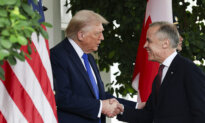
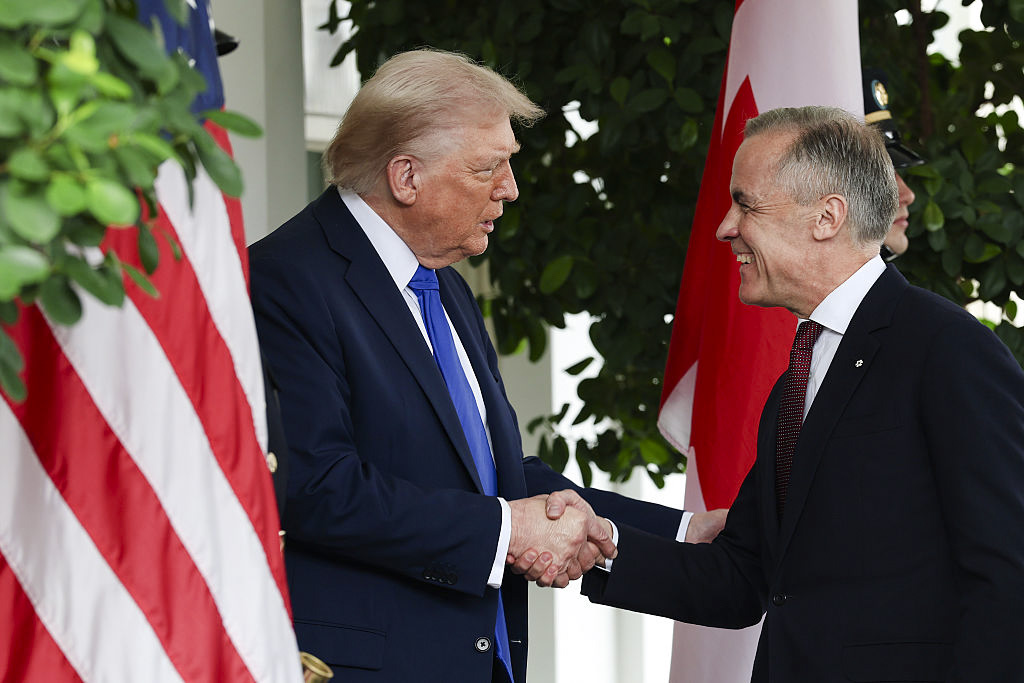
Carney spoke with Bloomberg as he was visiting the United Kingdom in late September. This was before his second meeting with Trump at the White House on Oct. 7. No trade deal was announced after the meeting, but Ottawa expressed optimism about the possibility of reaching deals on sectoral tariffs. Canada-U.S. Trade Minister Dominic LeBlanc is in Washington this week to continue negotiations.
The metal, automobile, and lumber industries have been hit particularly hard by Trump’s sectoral tariffs.
‘Same’ on Climate
The topic of net-zero emissions policies was also broached in the interview. Carney was asked whether he has changed his values on the topic, given he nixed the consumer carbon tax. Carney has been a strong advocate of net-zero policies, including in his capacity as U.N. special envoy on climate finance.
“I’m the same,” Carney said, adding his government will address reducing emissions by other means, including through its home-building strategy.
Carney said he’s not concerned about his reputation as a net-zero advocate being damaged with his government policies. “My role as prime minister is not about my reputation. My role as prime minister is about what’s in the best interest of Canada,” he said.
Carney was pressed on whether he has plans to scrap the oil and gas emissions cap. He did not respond directly, but said, “What makes emissions go down in the oil and gas sector will be carbon capture and storage, [and] other efficiencies.”
The major foreign policy decision to unilaterally recognize Palestinian statehood, going against Israel and the United States, was also broached during the interview. Carney said the move was justified because the actions of the Israeli government were “explicitly designed to end any possibility of a state of Palestine, in violation of the UN charter and going against Canadian government policy since 1947.”
Carney also said Ottawa would abide by the warrants of the International Criminal Court (ICC) against Israeli Prime Minister Benjamin Netanyahu if he came to Canada, a similar position taken by his predecessor Justin Trudeau.
Netanyahu is wanted for alleged war crimes and crimes against humanity in the Gaza Strip. He has called the court’s decision an “anti-Semitic step” seeking to prevent Israel from defending itself against “enemies who try to destroy us.”
Carney was in Egypt earlier this week to mark the implementation of Trump’s peace plan to bring an end to the conflict between Israel and Hamas. Carney has praised the U.S. president for his efforts in leading this endeavour.
 Friends Read Free
Copy
Facebook
Tweet
Friends Read Free
Copy
Facebook
Tweet