
TAMPA, Fla.—Ballistic missile attacks from Iran’s Islamic regime have decreased by 90 percent since Operation Epic Fury began six days ago.
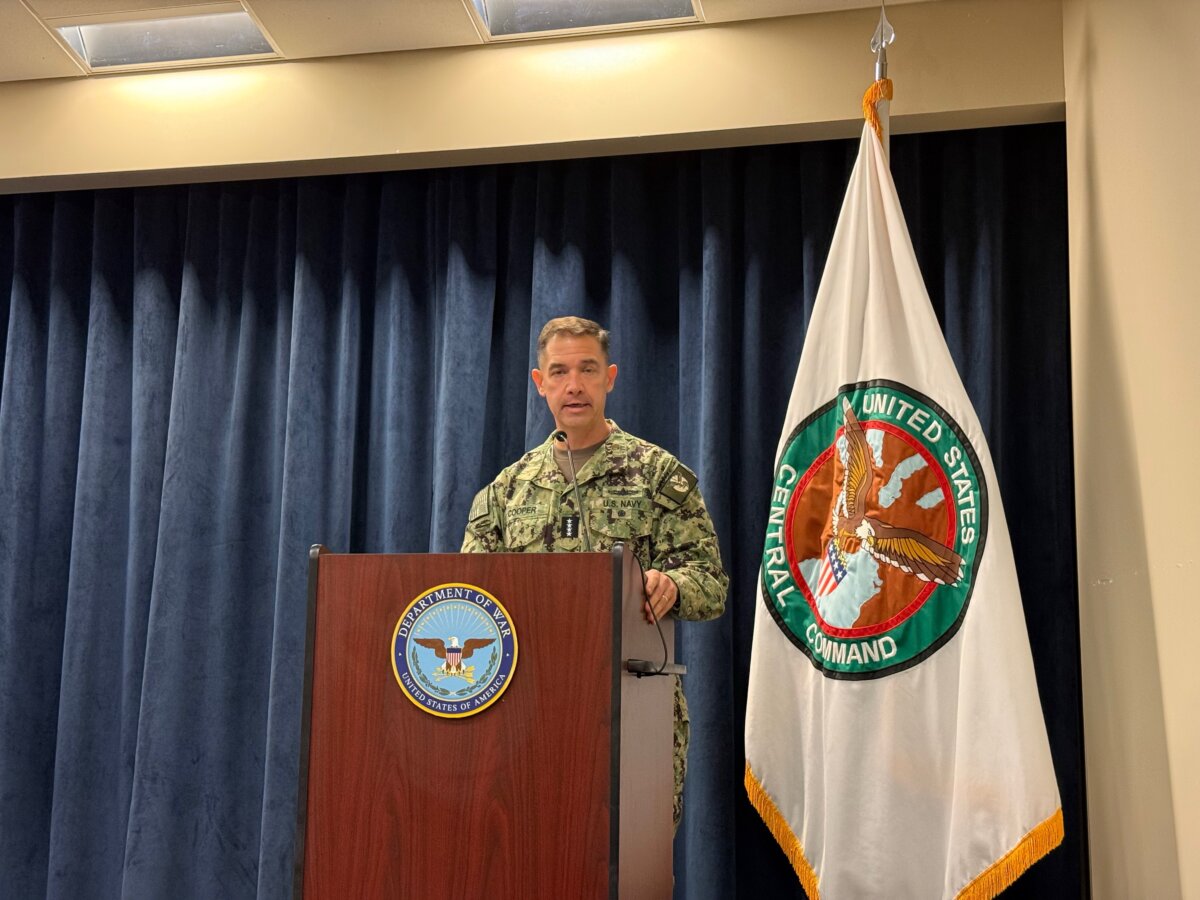
Adm. Brad Cooper made that announcement to members of the press on March 5 at U.S. Central Command (CENTCOM) at MacDill Air Force Base in Tampa, Florida. He also reported that drone attacks have decreased by 83 percent, and more than 30 of Iran’s naval vessels have been destroyed.
Specifically in the past 72 hours, the admiral noted that nearly 200 targets around Tehran and elsewhere deep inside Iran were struck by U.S. bombers, with two U.S. B-2 bombers dropping dozens of 2,000-pound “penetrator bombs” on buried ballistic missile launchers within the last hour before the press conference. A drone carrier ship was also struck.
“In just the last few hours, we hit an Iranian drone carrier ship roughly the size of a World War II aircraft carrier, and as we speak, it’s on fire,” Cooper said.
Iran’s equivalent to U.S. Space Command was also struck.
That being said, CENTCOM’s commander emphasized that U.S. forces were remaining vigilant and were not letting up. He was joined in Tampa by Secretary of War Pete Hegseth to say that things were just getting started.
They would follow through with the task assigned by President Donald Trump to level Iran’s ballistic missile industrial base.
“We’re not just hitting what they have,” Cooper said. “We’re destroying their ability to rebuild. And so as we transition to the next phase of this operation, we will systemically dismantle Iran’s missile production capability for the future, and that’s absolutely in progress.”
Iran’s Islamic Revolutionary Guard Corps has still been able to get its retaliatory shots off, first targeting U.S. assets and Israel, then launching indiscriminate attacks on a dozen other countries with territory and assets within the greater region. The United Arab Emirates alone has detected and intercepted more than 1,000 of Iran’s drones since the conflict began.
Several fatalities have been confirmed, including six U.S. service members who were killed during Iran’s initial retaliatory strike.
Iran has also been able to shut down commercial shipping traffic—particularly the movement of oil—through the Strait of Hormuz, though Trump has signaled that the U.S. Navy would begin providing escorts to commercial ships.
However, Hegseth said that Iran’s retaliations have only brought Iran’s neighboring nations closer to the United States.
“If anything, what Iran is doing by targeting allied countries that would otherwise want to stay out of this, it actually pulled them into the American orbit,” the war secretary said. “So now you’ve got UAE and Qatar and Bahrain and Saudi and Kuwait and others saying, ‘Hey, we’re with you. Here, we’ll shoot with you. We’ll fly with you. We’ll defend with you. We’ll allow you more bases.”
It has also strengthened American resolve to finish its mission of ensuring Iran never gets a nuclear weapon and destroying its ballistic missile arsenal, he said.
The admiral added that the next phase of the operation to dismantle Iran’s missile production would take some time, and neither he nor the war secretary gave a concrete timeline during the 20-minute press conference. But they both stressed that the name of the game at this point was endurance, and the United States was going to win out.
“CENTCOM’s authorities through the president and myself are maxed out,” Hegseth said. “Our capabilities are overwhelming and gathering still, as are those of our Israeli partners. Our munitions are full up, and our will is iron-clad, which means our timeline is ours and ours alone to control as long as it takes to ensure the United States of America achieves these objectives.”
Hegseth also touted the U.S. ability to coordinate and operate fully in multiple theaters around the world, specifically citing the U.S. Indo-Pacific Command (INDOPACOM) for sinking an Iranian naval vessel in the Indian Ocean.
“Combat power is building as Iranian combat power declines; our air dominance allows us to hit Iran’s center of gravity with overwhelming power and reach,” Cooper said.
Meanwhile, just outside MacDill Air Force Base, demonstrators gathered, waving American and pre-Islamic Iranian flags, raising chants of thanks to Trump, and calling for Crown Prince Reza Pahlavi to be seen as an alternative for Iran. However, who that new leader will be has yet to be decided.
 Friends Read Free
Copy
Facebook
Tweet
Friends Read Free
Copy
Facebook
Tweet