
JOHANNESBURG—In a significant riposte to the tariffs President Donald Trump imposed on African goods and products entering the United States, Beijing has announced it will scrap taxes on nearly all imports from the 53 African countries with which it has diplomatic ties.
The Chinese regime’s latest strategy to entrench itself in a region expected to play a growing role in shaping the world’s future was announced at the Forum on China–Africa Cooperation in the Chinese city of Changsha, the capital of Hunan Province, on June 11.
It builds on commitments Beijing made during last year’s summit when it granted 33 lower-income African countries limited tariff-free access to its market.
The new plan encompasses the continent’s largest economies, including South Africa, Nigeria, Egypt, Algeria, Kenya, and Angola.
This latest carrot offered by the Chinese communist party follows a recent stick. https://cmsapi.theepochtimes.com/world/china-pressuring-african-nations-over-us-trade-deals-5852225
Senior members of African governments, including those of South Africa, Egypt, Kenya, and Nigeria, recently told The Epoch Times that Beijing has warned them it will retaliate against countries that sign trade agreements with the United States “at China’s expense.”
U.S. trade partners, including many from Africa, are currently negotiating with President Donald Trump’s administration following his global tariff announcement on April 2.
They’re trying to work out deals that could see the tariffs scrapped or lowered, depending on what they’re able to offer the White House.
Trump imposed some of the highest duties on African imports, ranging in some cases between 30 and 50 percent. He said these are necessary to correct trade imbalances that take advantage of the United States.
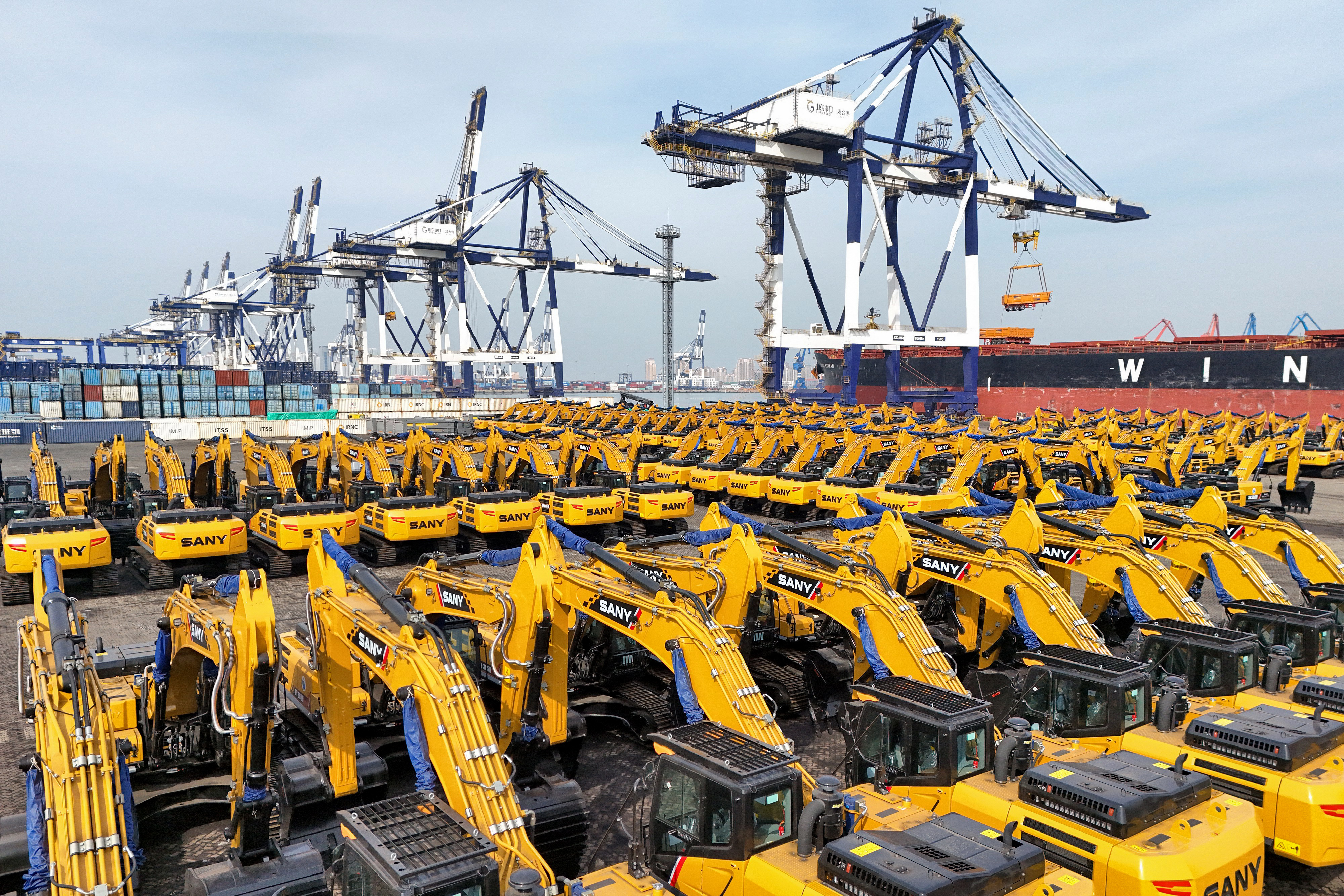 Excavators to be exported to Africa are seen waiting to be loaded on a cargo ship at a port in Yantai, in eastern Shandong Province, China, on March 7, 2025. (Stringer STRINGER/AFP via Getty Images)
He said the reciprocal tariffs will increase America’s competitive edge, protect its sovereignty, and strengthen its national and economic security.
Ahmed Moustafa, director of the Asia Center for Studies and Translation in Egypt, told The Epoch Times that “global trade alliances are changing and China wants to control this change.”
“It is keeping a big eye on U.S. moves and obviously sees the U.S. as its main rival as the biggest player when it comes to investing in African industrialization,” he said.
China wants to stay ahead in the battle for African business and the continent’s resources, he said, by taking advantage of any “difficulties” in U.S.–Africa trade relations.
“China began upping its trade game in Africa in January, in fact,” Moustafa noted.
China–Africa trade increased by 12.4 percent in the first five months of 2025, reaching a record 963 billion yuan ($134 billion), according to data from China’s General Administration of Customs.
“This is what the U.S. must try to counter, but there’s a feeling in Beijing that the Trump administration isn’t serious when it says it sees Africa as a priority, and it wants to exploit American slip-ups,” Moustafa said.
Charles Adams, economics lecturer at the University of Western Cape in South Africa, described China’s move to cancel tariffs on African goods and products as Beijing’s answer to Washington’s African Growth and Opportunity Act (AGOA).
AGOA, established in 2000, has been the primary vehicle for U.S.–Africa trade and economic policy and offers 32 sub-Saharan African nations tariff-free access to the U.S. market for more than 1,800 goods and products.
But AGOA expires in September, with China “waiting in the wings” to replace it, Adams noted.
“My bet now is that the Trump administration will remodel AGOA, and not scrap it, and this decision will in part be attributable to China’s decision to end tariffs on African goods,” he said.
China and its African trading partners did almost $300 billion in bilateral trade in 2024, Chinese Foreign Minister Wang Yi said in his speech at the June 11 China–Africa forum.
U.S.–Africa bilateral trade amounted to $71.6 billion last year, according to the Office of the United States Trade Representative.
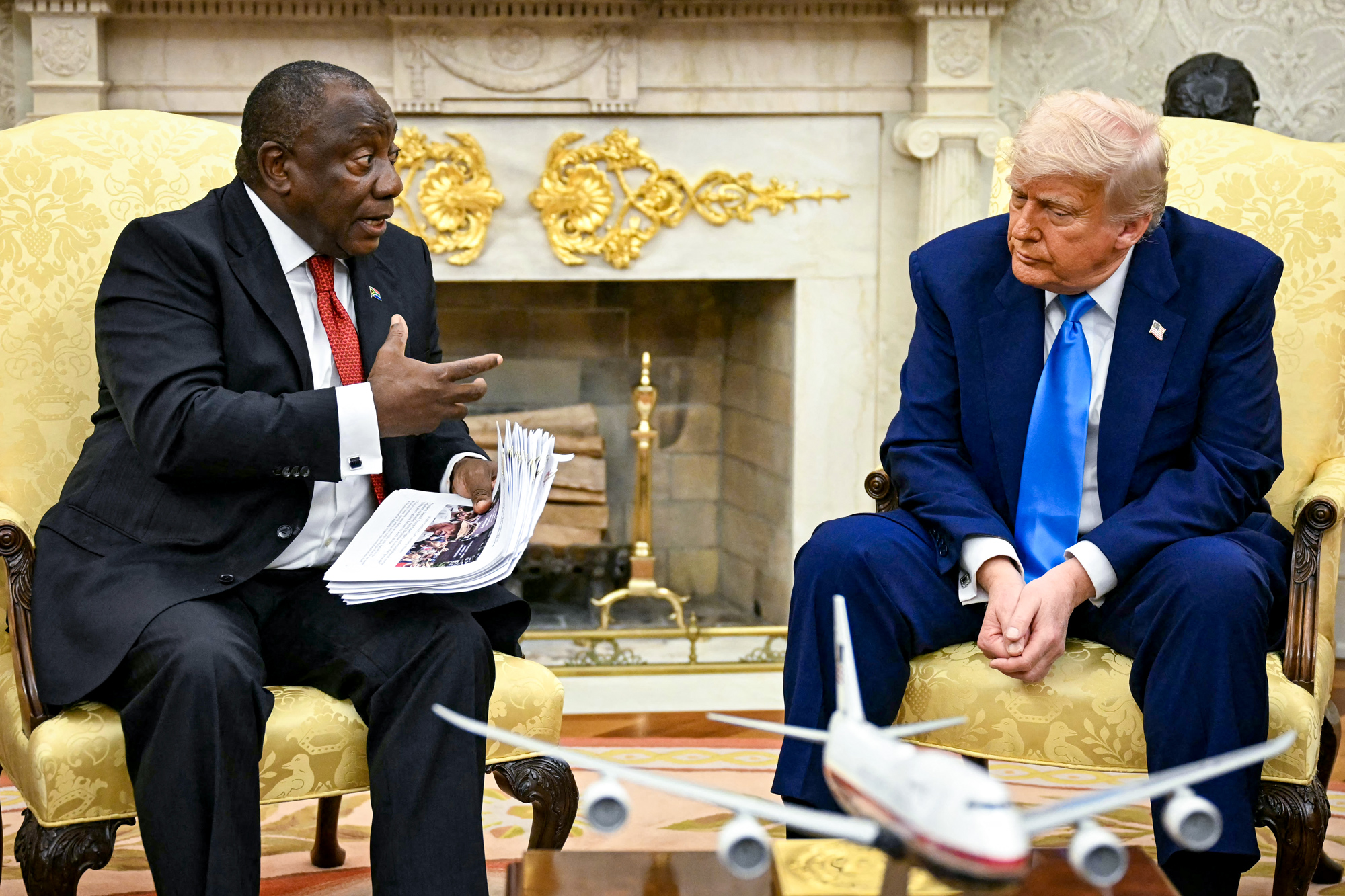 President Donald Trump hands papers to South African President Cyril Ramaphosa during a meeting in the Oval Office of the White House on May 21, 2025. (Jim Watson/AFP via Getty Images)
Research from the Center for Strategic Studies in Washington has shown that U.S. trade with sub-Saharan Africa consistently represents less than 1 percent of all U.S. trade in goods. That figure “has remained virtually unchanged for more than two decades,” according to the U.S. State Department.
Several studies show that Africa constitutes less than 5 percent of China’s global trade.
The Chinese regime has built a lot of infrastructure in Africa under its Belt and Road Initiative and loaned billions of dollars to the continent, leading many African nations to become heavily indebted to Beijing.
China is also heavily invested in African extractive industries, allowing it to dominate global supplies of the critical minerals that are increasingly driving economic growth in some parts of the world.
Africa is the most mineral-rich continent, possessing vast amounts of the resources that the world has come to rely on for use in a wide array of products, from electronics such as cell phones to renewable energy systems and military equipment.
Karuti Kanyinga, research professor of development studies at the Institute for Development Studies, University of Nairobi, said Beijing’s “apparently bulletproof position” in Africa allowed it to be “arrogant” at the China–Africa forum in Changsha.
“Just about everything [Chinese Foreign Minister] Wang Yi said was crafted for the ears of the United States of America,” he told The Epoch Times. “He showed contempt for Trump’s tariffs on Africa and Washington’s new ‘trade not aid’ approach to economic relations.”
Those facing the steepest reciprocal tariffs in Africa are Lesotho (50 percent), Madagascar (47 percent), Mauritius (40 percent), Botswana (37 percent), Angola (32 percent), Libya (31 percent), and Algeria and South Africa (both 30 percent).
The measures are expected to kick in on July 8, with many African countries currently negotiating new trade deals with Washington to reduce negative impacts on their fragile economies.
“If these new U.S.–Africa agreements are damp squibs and don’t result in significant wins for Africa, China will be the real big winner, as China’s place at the head of the trade table on the continent will be cemented further,” said George Awuah, an economist at the African Center for Economic Transformation in Ghana.
South African independent economic analyst Bonke Dumisa said Beijing’s decision to stop tariffs on imports from Africa is an “entirely predictable response” to Trump’s recent actions.
Dumisa told the Epoch Times that Beijing is trying to turn recent U.S. policy shifts to its advantage. “It wants to use this to alienate America, to separate it from Africa in particular.”
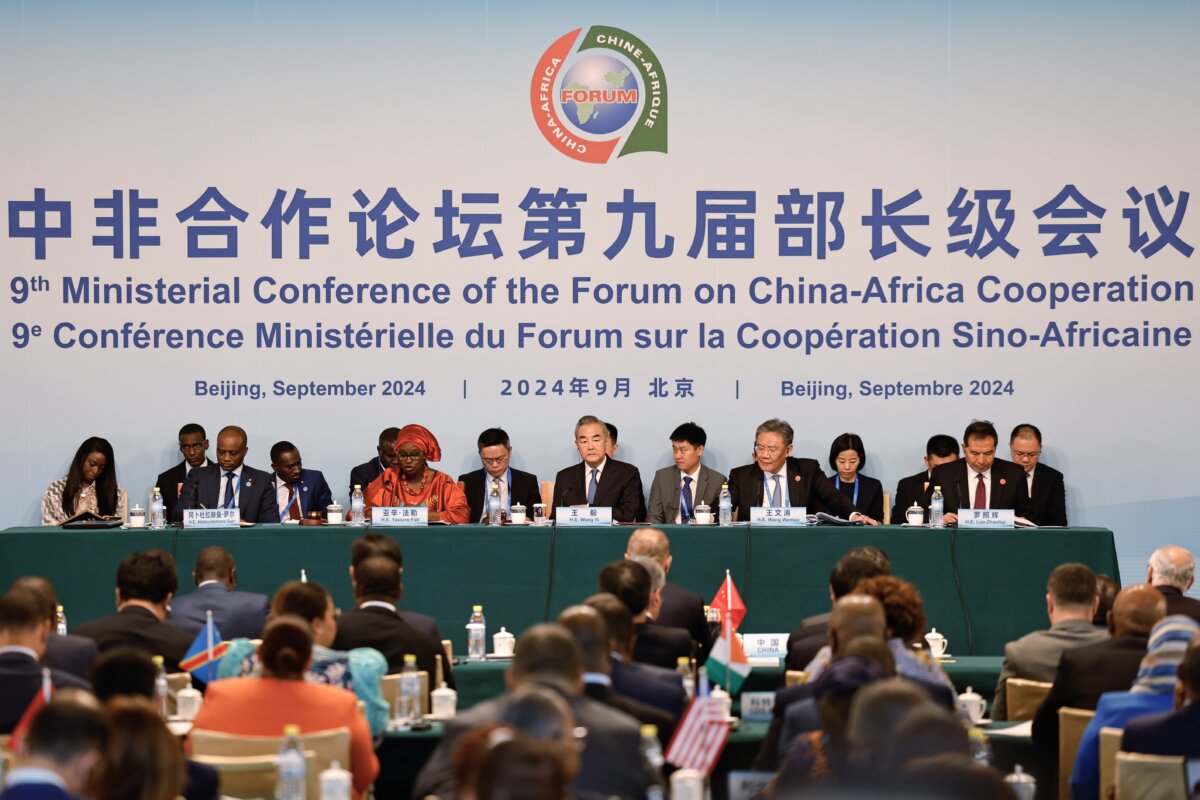 The ministerial conference of the 2024 Summit of the Forum on China-Africa Cooperation (FOCAC) in Beijing, China, on Sept. 3, 2024. (Tingshu Wang-Pool/Getty Images)
Dumisa pointed to the U.S. president’s tariffs and the “hollowing out” of institutions, including the Millennium Challenge Corporation (MCC) and the U.S. Agency for International Development (USAID), saying the policies provided “more rich fodder” for Beijing.
“These organizations, especially the MCC, played big roles in promoting and facilitating trade in Africa, and they leave a gap that will be hard to fill,” Dumisa said.
“The U.S. government is promising to replace aid with trade in Africa, and to scale up investments, and to build infrastructure to support those investments. But right now, to many Africans, these are just vague promises.”
On the other hand, he said, Beijing can pitch China’s cancellation of tariffs as being a concrete action that “puts money directly into African bank accounts at a time when Africa’s relations with the U.S. are shaky.”
The United States needs to counter this with longer-term benefits, says Dion George, an economist and a member of Parliament in South Africa for the country’s second-largest political party, the Democratic Alliance.
He said the future of U.S.–Africa economic relations will be set on the outcome of ongoing U.S. trade negotiations with Africans.
“The Trump administration has to make a few changes to its tariff policy pertaining to Africa if it doesn’t want to lose further ground to China,” he told The Epoch Times.
“China’s ending of tariffs on African products is an immediate win for Africa, whereas the U.S.’s new trade strategy in Africa focuses on potential long-term benefits,” he continued. “These are all fine and well, but the Trump administration must now fight back against China with deals that immediately put dollars in African pockets.
“The U.S. dollar is the most powerful instrument Trump can use to shake China’s standing in Africa.”
 Friends Read Free
Copy
Facebook
Tweet
Friends Read Free
Copy
Facebook
Tweet