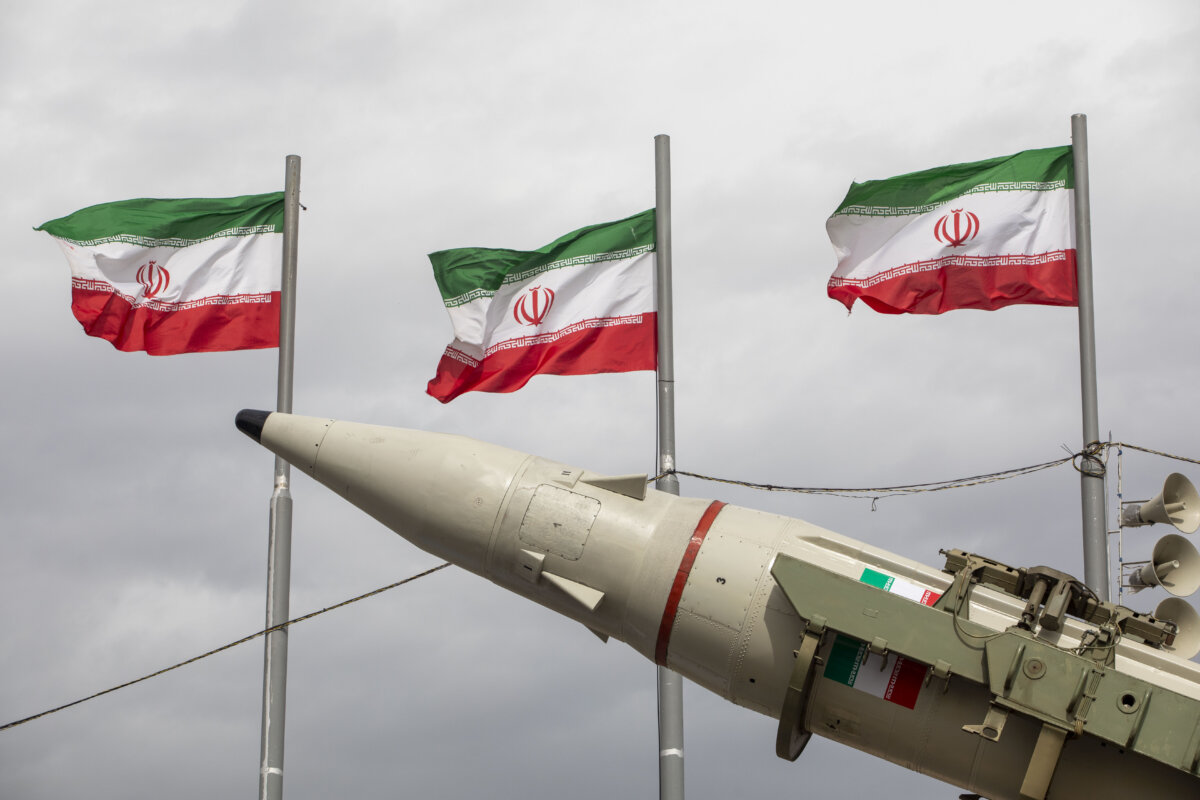

Israeli Prime Minister Benjamin Netanyahu said China has provided Iran with some military support—including components for missile manufacturing—adding new weight to long-running U.S. and Israeli concerns that Beijing-linked entities are supporting Tehran’s warfighting capabilities through dual-use technologies, industrial materials, satellite services, and covert procurement networks.
In a May 10 interview with CBS’s “60 Minutes,” Netanyahu said China had provided Iran with “a certain amount of support” and “particular components of missile manufacturing” when asked whether Beijing was providing “materially valuable military support” to Iran.
“But I can’t say more than that,” Netanyahu said.
The remarks came days after the U.S. State Department sanctioned several China-based entities accused of supplying satellite imagery that enabled Iranian strikes against U.S. forces during Operation Epic Fury.
Earlier, the U.S. Treasury Department imposed sanctions on Chinese companies and individuals for their roles in helping Iran’s Islamic Revolutionary Guard Corps procure ballistic missile propellant ingredients.
Together, the comments and sanctions are drawing renewed attention to what analysts describe as a broader strategy of the Chinese Communist Party (CCP): avoiding overt military alignment with Iran while quietly helping sustain Tehran’s military-industrial base.
“The design of Iran’s entire network of underground tunnels was executed by the military engineering division of the CCP’s military,” Yuan Hongbing, a Chinese legal scholar and political writer living in exile in Australia, told The Epoch Times.
“Furthermore, the critical high-tech components for Iran’s missiles and drones were all supplied by the CCP.”
Yuan said that Beijing has sought to play a behind-the-scenes role while outwardly portraying itself as a “champion of peace.”
Netanyahu Raises Concerns Over CCP Support
In the CBS interview, Netanyahu suggested that Beijing should reconsider whether strengthening Tehran truly serves its interests.
“Does it really want to have Iran controlling the waterways that supply the energy that China needs?” he said. “Would it not prefer to have open waterways that are not subjected to this kind of violent blackmail?”
China depends heavily on Middle Eastern energy imports, much of which transits through the Strait of Hormuz.
Netanyahu also warned against empowering what he described as “a fanatic regime with nuclear weapons” committed to exporting Islamist revolution.
His comments follow earlier remarks by U.S. President Donald Trump, who hinted in April that Beijing might be helping Iran replenish military supplies during a ceasefire.
“We caught a ship yesterday that had some things on it, which wasn’t very nice—a gift from China, perhaps,” Trump told CNBC on April 21.
He said that Iran had “done a little bit of restocking” during the pause in hostilities.
Although Trump did not specify the cargo, former U.S. Ambassador to the United Nations Nikki Haley linked the vessel to “chemical shipments for missiles.”
Haley, now with conservative think tank Hudson Institute, said the shipment was another reminder that China helps “prop up Iran’s regime.”
China denied involvement. Chinese Foreign Ministry spokesman Guo Jiakun rejected what he called “false association and speculation” surrounding the intercepted Iranian-flagged vessel.
Satellite Imagery and Intelligence Support
Last week, the State Department sanctioned four entities, including three China-based companies, over allegations that they supported Iranian military operations.
The department stated that one sanctioned company, MizarVision, published details of U.S. military activity during Operation Epic Fury, while another, Chang Guang Satellite Technology Co., collected imagery of U.S. and allied military facilities to support Iranian requests.
“The United States will continue to take action to hold China-based entities accountable for their support to Iran,” the State Department said.
Analysts say intelligence, satellite navigation, and electronic warfare support may be among the most important forms of support China can provide Iran without openly transferring weapons.
James Gorrie, author of “The China Crisis,” wrote in a recent Epoch Times commentary that Beijing’s role appears designed to maximize strategic effect while maintaining deniability.
“It’s not Cold War-style arms dumping, but something subtler and arguably more effective,” Gorrie wrote.
“Perhaps the most consequential support China can provide is not physical at all.”
He cited satellite intelligence, BeiDou navigation support, and electronic warfare capabilities to back up the claim.
A March fact sheet from the U.S.–China Economic and Security Review Commission states that China granted Iran full military access to its BeiDou satellite navigation system in 2021, although it states that the extent of Iran’s reliance on the system remains unclear.
Missile Inputs and Solid-Fuel Production
Some concerns center on China’s role in supplying industrial materials and technologies essential to Iran’s missile production.
Israeli security officials told Epoch Magazine Israel that Iran resumed purchases of planetary mixers from China after Israel destroyed much of Tehran’s solid-fuel missile production infrastructure during the 12-day war in June 2025.
The large industrial mixers, used to blend compounds for solid rocket fuel, are a key bottleneck in Iran’s missile manufacturing chain because they are difficult to replace, the sources said.
Solid-fuel missiles are a central part of Iran’s arsenal because they can be launched quickly without pre-launch fueling, reducing the time launchers are exposed before firing. Israeli officials have viewed the Chinese-supplied mixers as strategically important enough to repeatedly target in operations against Iran’s precision-missile program.
The U.S.–China commission also reported that Chinese components—including sensors, semiconductors, and voltage converters—have been found in Iranian drones used by Tehran’s regional proxies.
While China was a major supplier of conventional weapons to Iran in the 1980s, bilateral cooperation has shifted in recent years toward “dual-use technology sales and transfers of defense-related technologies,” including those relevant to missile and drone development, the commission stated.
The commission also reported that two Iranian vessels departed a Chinese port in March carrying sodium perchlorate, a key precursor used in solid rocket fuel for missiles. It cited a similar shipment in January involving roughly 1,000 tons of sodium perchlorate loaded onto Iranian-linked ships in China.
“This type of support reflects a broader strategic pattern in China’s supply line to Iran,” Gorrie wrote.
“It enables Iran’s military capacity at the margins, where deniability is highest, and the impact remains strategically significant.”
The Trump administration has increasingly targeted the chemical and industrial supply chains underpinning Iran’s missile program.
In April 2025, the U.S. Treasury Department sanctioned six entities and six individuals in Iran and China accused of procuring missile propellant ingredients for the Islamic Revolutionary Guard Corps, including sodium perchlorate and dioctyl sebacate, another substance used in solid-fuel rockets.
U.S. Treasury Secretary Scott Bessent said at the time that Iran’s missile development “imperils the safety” of the United States and its partners.
Alex Wu and Dorothy Li contributed to this report.
 Friends Read Free
Copy
Facebook
Tweet
Friends Read Free
Copy
Facebook
Tweet