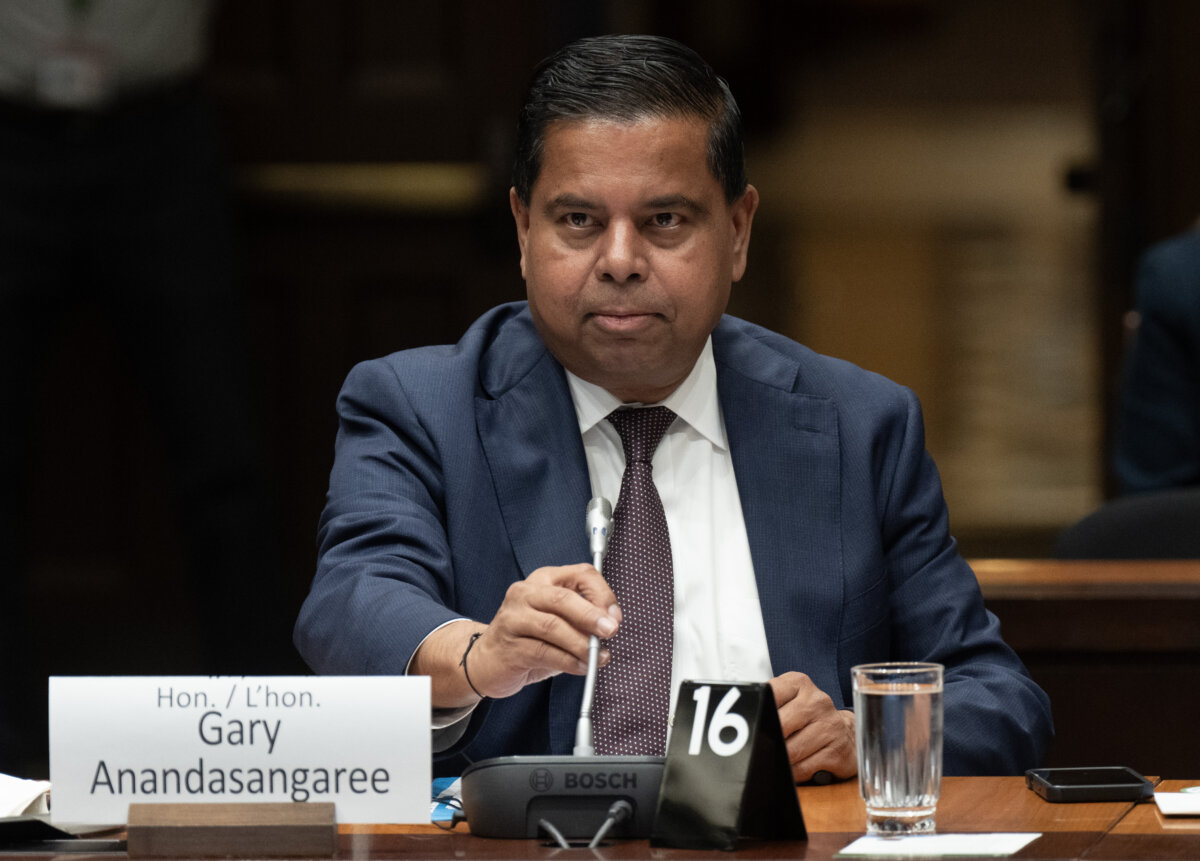

Public Safety Minister Gary Anandasangaree says his government will not split its lawful access bill into two parts after the Conservatives filed a motion to divide the bill, arguing the most controversial provisions need greater scrutiny.
Anandasangaree told reporters on June 3 that the Liberals are “very comfortable” with the balance between the two sections of Bill C-22, also known as the Lawful Access Act, and will not be splitting it.
His comments came after Conservative MP Rhonda Kirkland tabled a motion during a House of Commons public safety committee meeting on June 2 to recommend to the House that the committee be granted the power to divide the bill into Bill C-22A and Bill C-22B.
The Conservatives were willing to support the first part of the bill and have it potentially become law before the House adjourned for the summer, Kirkland said, adding that the second part raises “serious concerns” of government overreach and requires further study.
“When legislation touches Canadians’ private communications and personal data, our responsibility is to slow down, to examine it carefully, and fully understand the consequences before proceeding,” she said.
The committee meeting concluded before MPs could debate the motion. Public Safety Minister Gary Anandasangaree has said he wants the bill to become law before Parliament breaks for the summer on June 19.
Bill C-22, which passed second reading in the House of Commons in April and is under study by the committee, would expand law enforcement’s authority to access digital information and subscriber information.
It would allow law enforcement to ask an electronic service provider whether it offers services to a specific individual, based on a “reasonable suspicion” that a crime has been or will be committed. With the information provided, police could then seek judicial authorization for a production order to obtain a range of data on the subscriber.
This part of the bill would become Bill C-22A under the Conservative motion.
The second part of the bill, which would become Bill C-22B, would require digital service providers to retain metadata about user activities for up to a year, and compel telecommunications and online service providers to grant authorities access to user data.
This part of the bill has received the most criticism, including from tech giants and VPN companies, who say the legislation would require them to modify their systems in ways that could compromise the privacy and security of their customers.
“There’s major government overreach, significant expansion of government authority, and I truly believe this bill needs further study if the committee is going to fix this,” Kirkland said.
The government has said the bill aims to give security agencies tools to better tackle modern crime in a digital environment.
Privacy Concerns
Udbhav Tiwari, Signal’s vice-president of strategy and global affairs, testified before the committee on June 2 and told MPs that Signal, an encrypted messaging app, will not build surveillance infrastructure into its service, and would leave Canada if forced to comply with Bill C-22 in its current form.
Tiwari expressed concern that the bill would undermine encryption, create hidden surveillance of its users, and force the company to retain metadata. Ideally, he said the second part of the bill would be withdrawn entirely, as “its core defects cannot be repaired with targeted amendments.”
“You cannot make Canadians safer by breaking the tools they rely on for protections from hackers, hostile nations, and everyday transnational surveillance,” he said.
Anandasangaree said last week that the government would amend Bill C-22 to address concerns about encryption and metadata, noting that the bill was “never meant to breach encryption.”
He said language in the bill on systemic vulnerabilities and encryption would be clarified and a clear definition of metadata would be provided to align with similar legislation in the United States.
Alexander Surgenor, counsel with civil liberties group the Canadian Constitution Foundation, also testified before the committee and told MPs that Bill C-22 would create a sweeping and intrusive surveillance regime that threatens Canadians’ privacy.
He voiced concerns about the collection of metadata allowing authorities to monitor individual Canadians’ daily activities without their knowledge, a lack of safeguards, and risks of data breaches.
“The importance of privacy cannot be overstated. Privacy is about dignity and autonomy, and these are the predicates of a free society,” Surgenor said. “To have a truly free society, we must be free to make our choices without the sense of being monitored.”
Civil rights advocacy groups Citizen Lab and Canadian Civil Liberties Association released a joint report on June 2 that said the “extreme fast-tracking” of the bill by the government is “cause for concern.” The groups called the proposed legislation “almost certainly constitutionally fatal” and said the second part of the bill should be withdrawn entirely, instead of amended.
U.S. tech giants Google and Apple told MPs last week that the bill would create risks of foreign interference and espionage “at a time when cyber threats are increasing in frequency and sophistication.”
Noé Chartier and The Canadian Press contributed to this report.
 Friends Read Free
Copy
Facebook
Tweet
Friends Read Free
Copy
Facebook
Tweet