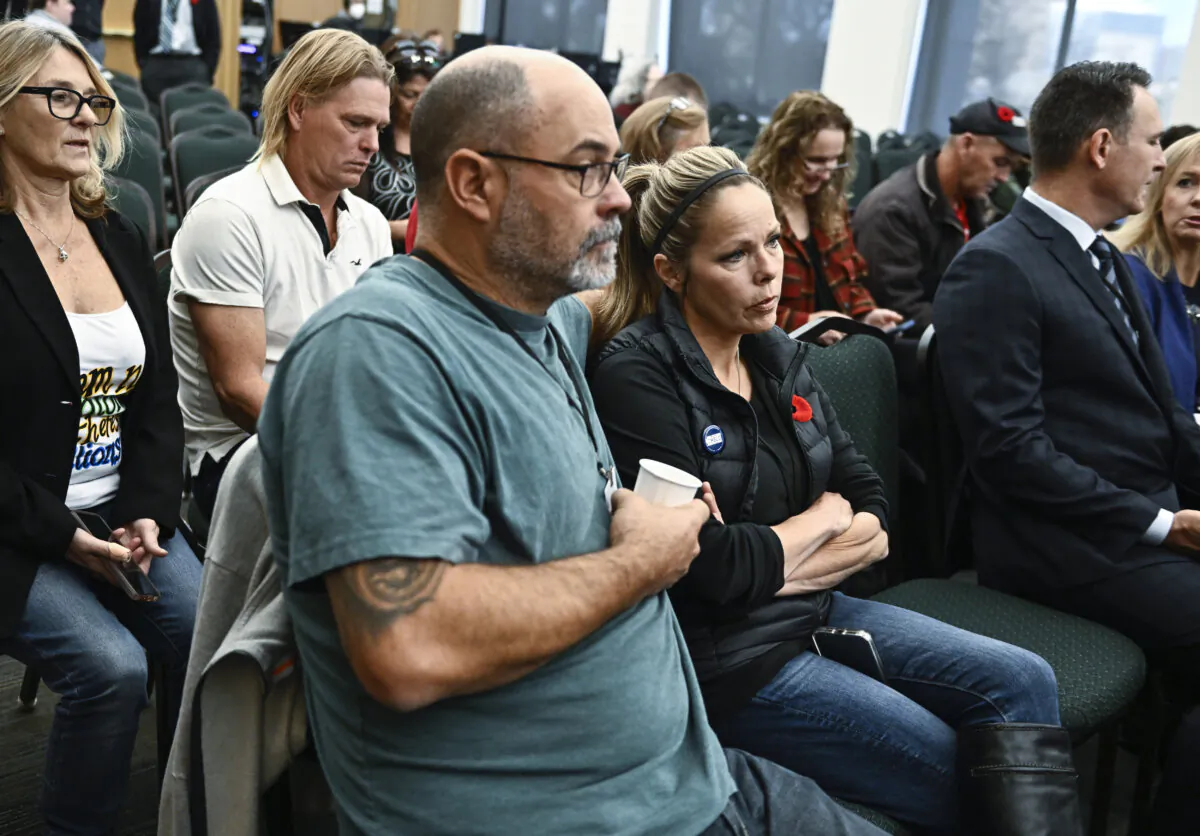

OTTAWA—Prosecutors in the case of Freedom Convoy organizers Tamara Lich and Chris Barber say they are seeking several years of jail time to deter a future “breakdown of public order.”
The Crown was initially seeking two years’ jail time for both defendants following the April verdict, but Crown prosecutor Siobhan Westcher said at the July 23 sentencing hearing that her office is now seeking seven years in prison for Lich and eight for Barber.
“The Crown acknowledges that it’s seeking an extraordinary sentence in this case,” Westcher told the court. “However, Mr. Barber and Ms. Lich are criminally responsible for extraordinary harm and profound impact to the public.”
Westcher said that the protest had “very vast” impacts on the Ottawa community and that the Crown’s proposed sentencing “accounts for the harm done.” She said 10 years of imprisonment is the maximum sentence for the offence of mischief, adding that it was “difficult to imagine an offence of mischief with greater impact than that committed by Mr. Barber and Ms. Lich.”
The Crown has also said it wants to seize and auction Barber’s truck “Big Red” that he used to travel from Saskatchewan to Ottawa for the three-week protest.
Lich and Barber were the main organizers of the Freedom Convoy, a protest that started in response to COVID-19 vaccine mandates and evolved into a larger protest against pandemic measures. The protest resulted in hundreds of vehicles arriving in Ottawa and parking in the downtown area for three weeks. It also sparked other protests across Canada in solidarity, involving vehicles that blocked ports of entry.
The federal government invoked the Emergencies Act on Feb. 14, 2022, which brought the demonstration to an end by giving law enforcement increased authority to arrest demonstrators and freeze the bank accounts of some of the individuals involved in the protest. Lich and Barber were arrested on Feb. 17, a day before police began their expanded action to end the protest in Ottawa.
Lich and Barber were found guilty of mischief and Barber was additionally found guilty of counselling others to disobey a court order, but the two were not found guilty of counselling mischief, intimidation, obstructing police, or counselling others to obstruct police.
Conservative Leader Pierre Poilievre and several other Conservative MPs have spoken out against the Crown’s requested sentence for the Convoy organizers in recent days.
Poilievre said on social media that many “rampant violent offenders” in Canada are released on bail, yet the Crown wants seven years of prison time for the Freedom Convoy organizers on mischief charges.
Crown Reads Statements From Residents
During the sentencing hearing, Crown prosecutor Westcher said that while the Freedom Convoy was not a violent demonstration, it was “not peaceful.” She framed the protest as a “prolonged civil disobedience with a clear intent of pressuring the government through disruption.”
Westcher read out a summary of victim impact statements from some Ottawa residents, which included an employee at a church who complained of having garbage left on the property, experiencing threatening behaviour by protesters, and feeling “ill” at the sight of pickup trucks years after the protest ended.
The Crown prosecutor also mentioned that hotels like the Lord Elgin and Chateau Laurier lost income, food banks like Shepherds of Good Hope and the Salvation Army were unable to serve some clients, and many Ottawa residents were unable to travel downtown and were negatively impacted by honking and diesel fumes.
Westcher also highlighted estimates of the cost of the protest. The City of Ottawa previously estimated a cost of $7 million for city services ranging from fire and paramedics to roads and transit. The Ottawa Police Service estimated it cost $55 million to police the downtown. Westcher said that while Lich and Barber were not responsible for “every dollar,” these numbers helped illustrate the scale of the mischief.
Westcher reiterated that Lich and Barber were not on trial for their political beliefs and that Canadians are free to express their beliefs. “What they are not free to do is counsel others to break the law, paralyze the city, or flout police and court orders under the banner of a peaceful protest,” she said.
‘Excessive’ Sentencing: Defence
Barber’s lawyer Diane Magas responded that the Crown’s sentencing request was not proportionate to the crime he was found guilty of, but is “excessive, unfit, unduly harsh, cruel, and unusual.”
Magas cited previous court cases around the 2010 G20 Summit, where protesters who destroyed property were not given lengthy jail sentences. “Look at these cases of mischief that actually put property damage in the millions of dollars, that actually put fear in police officers,” Magas said.
“That is the worst kind of mischief where no one got anywhere near a penitentiary term.”
Magas said Barber did not have control over all of the protesters during the Freedom Convoy and noted that he advised them to cooperate with police and attempted to work with law enforcement to move the trucks out of the downtown core.
Barber has strong family ties and is respected by his community in Swift Current, Sask., Magas added, noting that Barber’s ex-wife, ex-wife’s husband, and ex-wife’s father-in-law all wrote letters in Barber’s favour for the trial.
Barber’s lawyer said she would be requesting a discharge for Barber, as a criminal record would negatively impact his ability to support his family and pay bills through his trucking business.
Justice Heather Perkins-McVey said the Freedom Convoy case is a “challenge” because there is no similar precedent in caselaw and many of the convoy participants who had also been charged received their sentences for singular actions and not leadership over the larger group.
“Somewhere, I’ll have to make that determination, and it’s not going to be an easy one,” she said.
The hearing will continue on July 24, where Lich’s lawyer is expected to speak.
 Friends Read Free
Copy
Facebook
Tweet
Friends Read Free
Copy
Facebook
Tweet