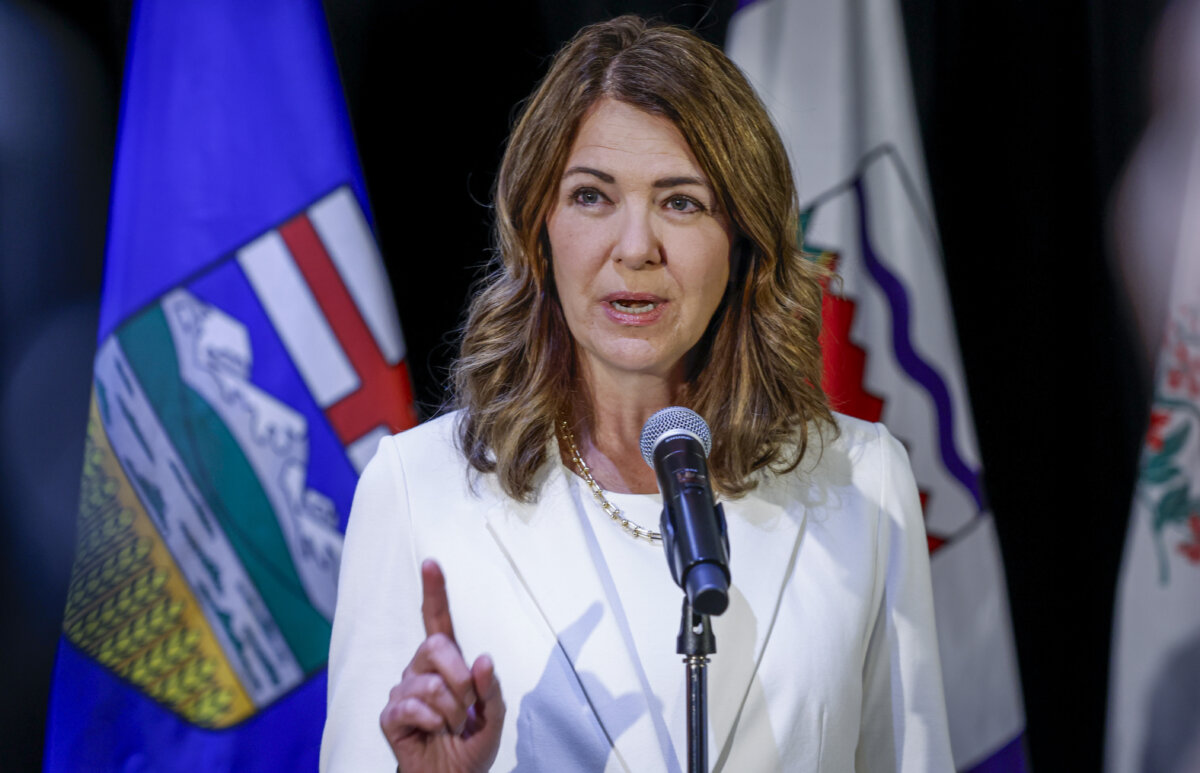

Alberta Premier Danielle Smith is challenging Manitoba Premier Wab Kinew’s criticism of her at the western premiers event last week about her province’s upcoming referendum question.
During the Western Premiers’ Conference in Kananaskis, Alta., on May 26, Kinew said Smith was wrong in her belief that a court ruling against a petition calling for a separation referendum is “anti-democratic.” He also said the court’s decision rightly called for proper consultation with First Nations.
Smith responded during her weekend radio program “Your Province, Your Premier,” criticizing the Manitoba premier’s comments.
“I would say, rather than lecturing Albertans about what they should and should not do—and should believe and shouldn’t—I would like to see other premiers give, as I am, reasons to feel confident in the western partnership and reasons to feel confidence in Canada,” she said.
Press Conference Disagreement
The disagreement between the two premiers began before the annual two-day meeting of western premiers, according to Kinew.
He spoke out after Smith answered a reporter’s question about the May 13 court decision that overturned a citizen-led petition asking for a referendum to separate from Canada.
The judge ruled that the petition drive was unlawful because First Nations were not adequately consulted by the Crown before the petition drive began.
Smith said she believed the ruling overstated the obligation to consult, adding that she thinks it should be mandated solely for major projects.
“We’ll make the arguments in court about what the limits to duty to consult ought to be, and we’ll see how that conversation goes,” she said at the press conference, adding that consultations shouldn’t be necessary for citizen-led petitions.
Kinew interjected, saying he also wanted to comment on the issue.
“That is not correct, a lot of what you just said there, Premier Smith, specifically, and we spoke about this, so I don’t mind repeating this,” Kinew said.
“It is not up to the petition gatherers to fulfill the duty to consult,” he said. “It is up to you, as the Alberta government, to fulfill the duty to consult, and in this case, when there is clearly going to be an impact on well-established existing hunting and fishing rights by putting up an international border if some would have their way, the judge ruled … that is going to infringe on rights, and so there is a duty to consult.”
Kinew posted a video clip of his exchange with Smith on social media, along with the comment “I love Canada.”
Kinew is indigenous and originally hails from the Onigaming First Nation in northwestern Ontario. He has been the premier of Manitoba since 2023 and leads the province’s New Democratic Party (NDP).
Smith responded during the press conference by saying the disagreement underscored the value of Canada’s court system, while also expressing her respect for the “difference of opinion.”
“I think we’ll wait to see how our court of appeals process goes and see what the courts have to say,” she added.
Smith commented further on the exchange during her May 30 radio show, saying western premiers should focus on ways they can collaborate to make their provinces stronger. She said the best way to do that right now is to work together on getting pipelines built.
“I know that Premier Kinew has said that he wants to get a Churchill pipeline built, he’s said ‘move a few Alberta barrels,’” she said. “I think that’s a really good message. He wants to talk about LNG export, which would also benefit us—and it would also benefit him, because if he had new sources of revenue it would reduce Manitoba’s reliance on equalization… about $5 billion a year in equalization payments.”
“So these are the ways in which I think the Western Premiers should work together,” she added.
Kinew last week suggested that with Canada embroiled in a trade war and a recession, it’s not the time to engage in discussions about separatism. He pointed to recent developments in building new energy projects and pipelines, adding that B.C. Premier David Eby has also been pushing for LNG projects.
“Now is the time to work together,” Kinew said after the meeting of western premiers, which also included British Columbia, Saskatchewan, Yukon, Northwest Territories, and Nunavut.
“Why don’t we hold off on this referendum talk for a year or two, so we can get these pipelines under construction? Because at the end of the day, we want Canada to succeed,” he said.
Ottawa and Alberta have recently agreed to build a new oil pipeline to the West Coast, contingent upon a private company taking on the project. Smith has said the agreement marks a positive step for Alberta and has used it to support her position that Alberta should remain in Canada.
Eby has opposed the project, saying the tanker ban in northwest B.C. should continue to be enforced.
Alberta Referendum
Smith announced on May 21 that a question would be added to the ballot in the upcoming provincial referendum to gauge voters’ thoughts on staying in Canada.
The question will read, “Should Alberta remain a province of Canada or should the Government of Alberta commence the legal process required under the Canadian Constitution to hold a binding provincial referendum on whether or not Alberta should separate from Canada?”
Smith has said she will campaign for the province to remain a part of Canada in the months leading up to the non-binding Oct. 19 referendum, adding that she plans to hold a number of town hall meetings this summer to convince Albertans that Confederation is the right choice.
The premier has also promised to accept the result of the vote, even if it’s not the one she wants.
Smith put the separation question on the ballot after the court ruling last month dismissed a proposed referendum petition regarding Alberta’s separation, which the organizers claimed had collected far more signatures than needed for it to be considered as a future referendum question. The court cited a lack of proper consultation with First Nations in its decision to prevent a separation referendum.
Smith also commented during her radio show about the court decision that prohibits Elections Alberta from validating the signatures on the separatist petition collected by the separatist organization Stay Free Alberta.
The organization has said it gathered more than 300,000 valid signatures for its petition, exceeding the 177,000 they needed for the document to be valid.
Smith said that even though the separatist petition hasn’t been validated due to the court ruling, it seems likely it surpassed the necessary threshold.
“I think in order to follow the spirit of the citizen petition law, that’s why I put forward the question we did,” she said, referring to her referendum question to determine if the province should hold a binding referendum on separation in the future.
The benchmark for resolving the matter in either direction will be a vote of 50 percent in favour plus one, Smith said.
The other questions listed on the referendum, announced in February, pertain to immigration reform and constitutional issues. Smith has said voting on these questions can help discontented Albertans send a message to Ottawa that change is needed.
 Friends Read Free
Copy
Facebook
Tweet
Friends Read Free
Copy
Facebook
Tweet