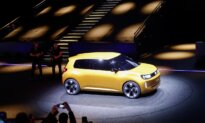

Sales of electric cars overtook those of gasoline-powered vehicles in the European Union in December 2025, for the first time, according to data published on Tuesday.
The European Automobile Manufacturers’ Association, which represents 17 car, truck, and bus manufacturers in the 27-member bloc, said 217,898 battery electric vehicles (EVs) were sold in December 2025, compared to 216,492 petrol (gasoline) cars.
Registrations of battery EVs were up 51 percent from December 2024.
There was a 5.8 percent rise in hybrid electric car sales and a 36.7 percent increase in plug-in hybrid car sales.
Together, all vehicles including some form of electric engine accounted for 67 percent of EU car registrations, up from 57.8 percent in December 2024.
Chinese EV maker BYD saw a 229 percent rise in vehicle registrations in December 2025, while U.S.-based Tesla fell by 20 percent, possibly as a result of the “Tesla Takedown” protests against Elon Musk.
Volkswagen saw a 10.2 percent rise in registrations, and Stellantis—which includes the Fiat, Citroen, Peugeot, and Chrysler brands—increased sales by 4.5 percent, while Renault’s fell 2.2 percent.
Overall, sales of cars in the EU rose to 10.8 million in 2025, up 1.8 percent on the year before.
But they remain well below the levels they were at prior to the COVID-19 virus arriving in Europe in the spring of 2020.
ACEA also said sales in the EU, Britain, and the European Free Trade Association area, which includes Norway, Switzerland, Iceland, and Liechtenstein, rose year-on-year by 2.4 percent to 13.3 million in 2025.
Competition From Chinese Manufacturers
Europe’s auto industry is fighting a battle on several fronts.
It faces competition from Chinese EV manufacturers such as BYD and Chery—owner of the Omoda and Jaecoo brands—which receive massive subsidies from the Chinese regime.
In 2024, the European Commission—the EU’s executive arm—imposed tariffs on Chinese EV makers, ranging from 7.8 percent to 35.3 percent.
“Fair competition is good,” the commission’s president, Ursula von der Leyen, said on May 8, 2024. “What we don’t like is when China floods our market with massively subsidized electric cars. And we have to tackle this, we have to protect our industry.”
The commission sought to resolve the dispute earlier this month.
On Jan. 12, the commission released a guideline document for EV exporters based in China regarding submitting price undertaking offers, which could replace the tariffs.
Then there were the 25 percent tariffs imposed by the U.S. government on automobiles and automobile parts coming from the EU.
On Sept. 25, 2025, the Trump administration formally lowered that figure and implemented 15 percent tariffs.
But a report published by the Cologne Institute for Economic Research in December 2025 said auto exports from Germany fell by almost 14 percent in the first nine months of 2025.
The third challenge for auto manufacturers is EU regulations, which are based on a climate agenda designed to curb carbon dioxide emissions.
In 2023, the EU announced a plan to ban traditional combustion engine cars by 2035.
But in December 2025, the European Commission unveiled plans to ease the ban.
“It sets an ambitious yet pragmatic policy framework to ensure 2050 climate neutrality and strategic independence while providing more flexibility to manufacturers,” the commission said.
Germany’s biggest auto manufacturer, Volkswagen, welcomed the decision, which needs to be ratified by the European Parliament.
“Opening up the market to vehicles with combustion engines while compensating for emissions is pragmatic and in line with market conditions,” Volkswagen said in a statement.
But Dominic Phinn, head of transport at the non-profit Climate Group, described it as a “tragic win” for the auto industry.
“The watering down of the petrol and diesel-engine phase-out flies in the face of leading companies across Europe, who are investing billions in electric fleets and desperately need the stability it provides,” he said.
Reuters contributed to this report.
 Friends Read Free
Copy
Facebook
Tweet
Friends Read Free
Copy
Facebook
Tweet