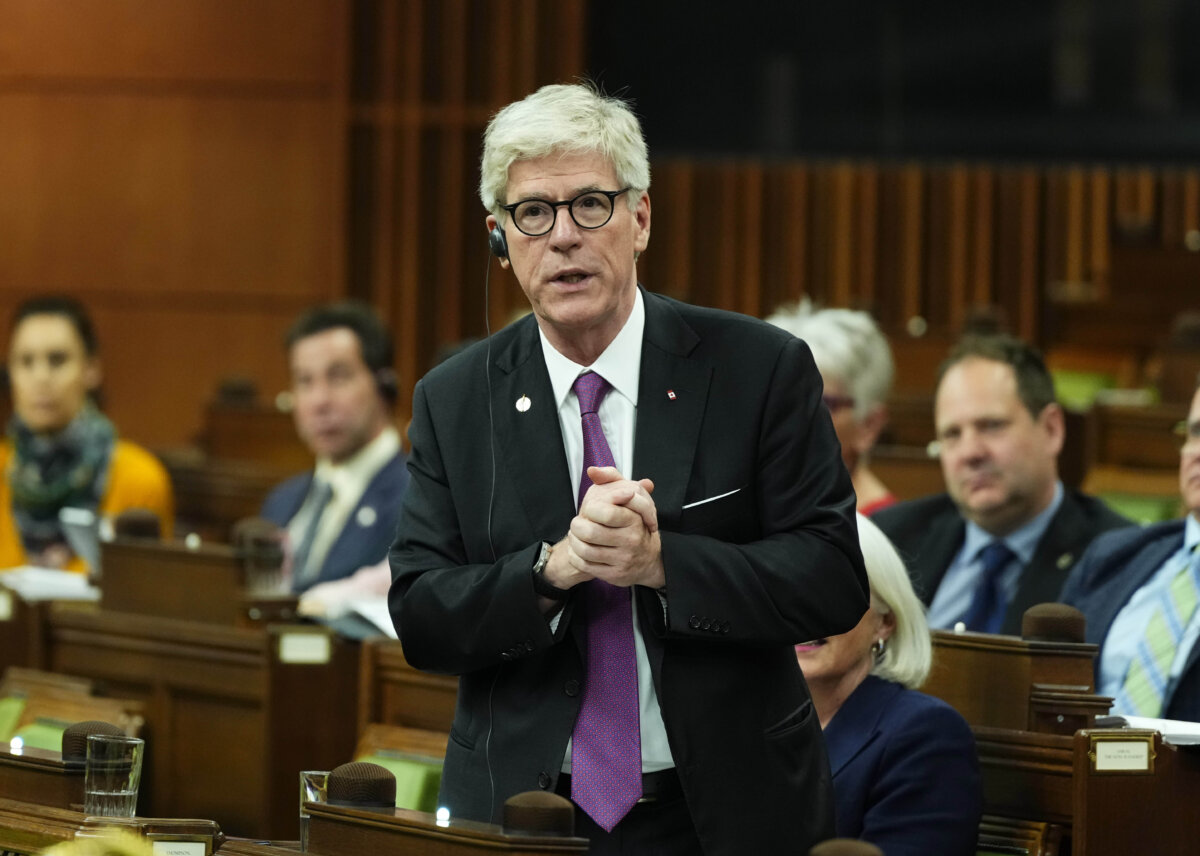
Canada’s critical mineral resources will play a key role in how Ottawa responds to escalating trade tensions with the United States, Energy Minister Tim Hodgson says.
Hodgson made the comments July 11, one day after U.S. President Donald Trump threatened to impose a blanket 35 percent tariff on Canadian imports. He made the comments during an event in Charlottetown announcing five new funding packages for Maritime energy projects totalling $26.57 million.
“Despite what the president may say, Canada has many important cards in these negotiations, and out of many of those cards, the most important ones are energy and natural resources. At the G7 it was abundantly clear Canada has the energy and minerals the world wants,” Hodgson said following the three-day Energy and Mines Ministers’ Conference (EMMC).
Hodgson touted his government’s Critical Minerals Action Plan, which he said “will help to mobilize capital, reduce dependence on non-democratic suppliers, and reward countries like Canada who mine the right way with high environmental and labour standards.”
This year’s EMMC focused on identifying key critical mineral projects that can position Canada as an industry leader, Hodgson said, noting that the use of artificial intelligence to strengthen geoscience data to support critical mineral exploration is also key.
“After all, as the prime minister says, we can give ourselves more than anyone else can take away, and that starts with the minerals beneath our feet,” the minister said.
Listing other initiatives on the file that his government has taken, he said Ottawa has begun a partnership for a pilot project with the Northwest Territories to help scan, digitize, and analyze areas of the territory with high critical mineral potential, particularly in the Slave Geological Province region.
The Slave Geological Province encompasses an area of 190,000 square kilometres located in the eastern part of the Northwest Territories and northwest Nunavut. It is recognized for its substantial mineral deposits, which include base metals, diamonds, and gold.
Hodgson said “advanced conversations” are also being held with B.C. and Ontario about critical mineral and energy exploration and he expects to have more to say on the topic in the near future.
Tariff Impact
Trump has sent more than 20 letters to U.S. trading partners this week, informing them of the tariff rates they will see on their exports into the United States if they do not broker trade deals with his administration. Washington is expected to announce new trade deals with a number of countries by Aug. 1.
Hodgson said Canada is confident about its position going forward despite Trump’s tariffs and their impact on the country’s natural resources, energy, mining, and manufacturing sectors.
“I will make the observation that sometimes what the president says is actually the opposite of what is true,” Hodgson said. “And so when he says, ‘we don’t need Canada’s autos, we don’t need Canada’s steel, we don’t need Canada’s aluminum, we don’t need Canada’s lumber, we don’t need Canada’s uranium, we don’t need Canada’s potash, we don’t need Canada’s electricity,’ I kind of think he needs all those things.”
In his July 11 letter to Carney, Trump said that “the flow of Fentanyl is hardly the only challenge we have with Canada, which has many Tariff, and Non-Tariff, Policies and Trade Barriers.”
“These Tariffs may be modified, upward or downward, depending on our relationship with your Country,” Trump said.
Jacob Burg contributed to this report.
 Friends Read Free
Copy
Facebook
Tweet
Friends Read Free
Copy
Facebook
Tweet