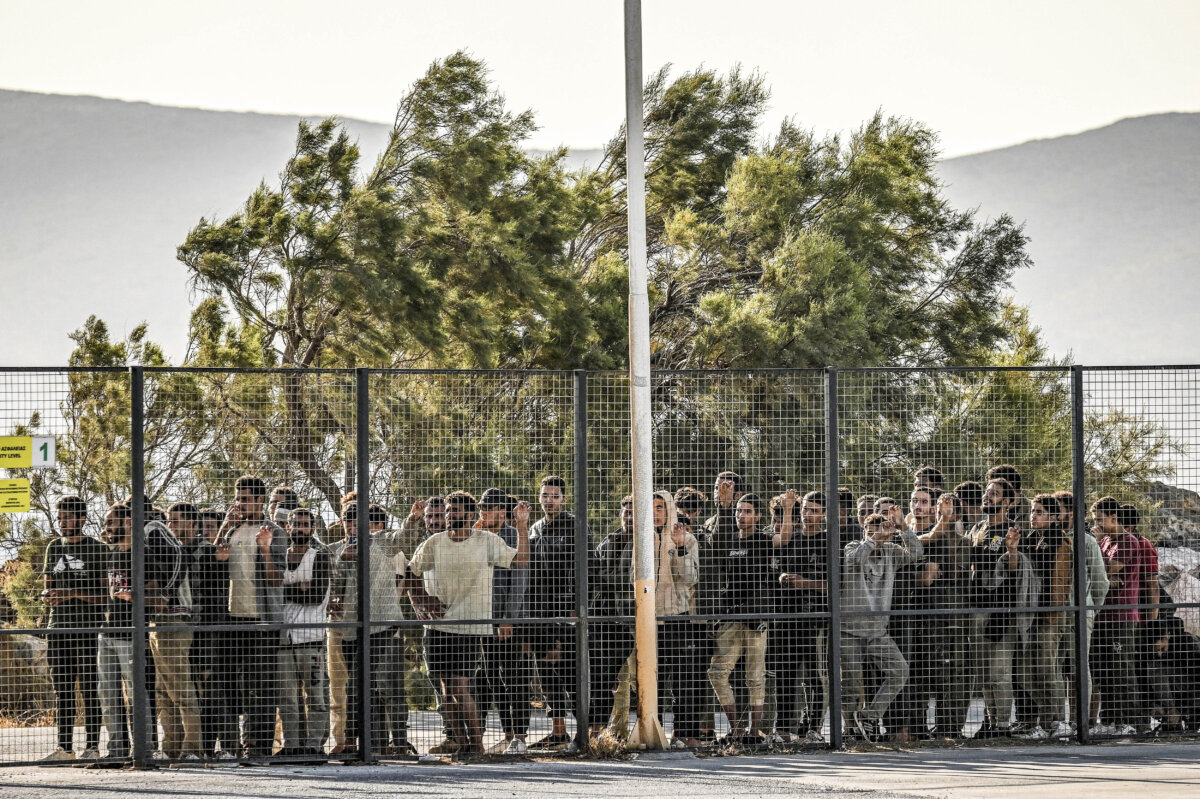

The European Union has reached a provisional deal on new rules that would allow member states to send illegal immigrants to “return hubs” outside the bloc, as Brussels seeks to speed up deportations.
In a June 1 statement, the Council of the EU said that the new rules impose obligations on third-country nationals who have no right to stay in member states to cooperate with the authorities.
It said that they have also put in place tools for enhancing cooperation between member states to envisage the establishment of return hubs in countries outside the EU.
“The new regulation will speed up the return process and increase returns of persons who have no legal right to stay in the EU,” Nicholas Ioannides, deputy minister for Migration and International Protection of the Republic of Cyprus, said in a statement on Tuesday.
The new regulation introduces a European Return Order, a form that member states must complete, including the key elements of the return decision.
In a June 2 post on X, Tomas Tobé, vice chair of the European People’s Party Group (EPP), said that “over 70 percent of people with rejected asylum applications do not return.”
Member of the European Parliament (MEP) François-Xavier Bellamy, the EPP negotiator on the deal, said in a post on X on Tuesday that four out of five non-EU nationals who have received a formal return decision from a Member State do not leave.
“That is not a functioning system,” said Bellamy.
EU figures show return orders are often not enforced.
In the fourth quarter of 2025, 117,545 third-country nationals were ordered to leave an EU country, while 33,860 were returned to third countries.
In 2024, European Commission President Ursula von der Leyen proposed striking deals with non-EU countries from which illegal immigrants originate, or through which they transit, in order to stop migrants in those countries as part of the EU Pact on migration and asylum.
She also suggested sending those with no right to stay in the EU to “return hubs” in non-EU countries, such as Egypt, Morocco, Algeria, Mauritania, Senegal, and Mali.
Illegal immigrants are entering the EU primarily via Mediterranean sea crossings from North Africa and by overland routes through Poland and the Balkans, according to data from Frontex, the European Border and Coast Guard Agency.
More than 1 million migrants entered the continent in 2015, amid wars in Syria and Iraq, according to estimates by the U.N. Refugee Agency.
Immigrants from seven countries are currently unlikely to be granted asylum in Europe, the European Commission said on April 16. The European Union’s executive branch said that Bangladesh, Colombia, Morocco, Tunisia, Egypt, India, and Kosovo should be designated as “safe third countries.”
The Netherlands and Uganda made arrangements for the return of immigrants via Uganda in September last year.
It said that this will involve “a small-scale pilot involving a transit hub for a limited number of foreign nationals who are required to leave the Netherlands,” a group that will include failed asylum seekers.
However, the Dutch government’s 2026 coalition agreement said cooperation with Uganda in this area would be put on hold following the country’s recent elections.
In a June 2 post on X, Charlie Weimers, a Swedish Democratic MEP and vice chair of the European Conservatives and Reformists Group, said that the new agreement signalled that “the era of deportations has begun.”
“We now have longer detention, real entry bans, and return hubs in third countries,” he said.
“If you try to enter Europe illegally, you will never make Europe your home.”
He said that for six years, the left-wing majority in the European Parliament had “blocked any serious attempt to modernise Europe’s returns system.”
He said that their focus “was on protecting illegal migrants through procedural delays and restricting enforcement.”
Weimers said that he negotiated tougher detention rules with longer periods and stricter regimes for those who do not cooperate, as well as stronger investigative measures to identify illegally staying third-country nationals and facilitate their return and readmission.
He said that the agreement expands the definition of security threats to include low-level repeat offenders, enabling longer detention, stricter regimes, and longer or indefinite entry bans.
He also said that entry bans have been lengthened significantly, up to 10 years as the general rule and up to 20 years in substantiated cases, and indefinite bans are possible for security threats.
The provisional agreement will now have to be endorsed by the Council and the Parliament.
The left-wing Socialists and Democrats Group in the European Parliament called the deal “controversial.”
It said that the agreement “tramples fundamental rights and takes migration policy backwards,” in a June 2 post on X.
It claimed that the process allows for “legally dubious Return Hubs,” ”ICE-style deportation raids,” and reduced voluntary return incentives.
Guy Birchall contributed to this report.
 Friends Read Free
Copy
Facebook
Tweet
Friends Read Free
Copy
Facebook
Tweet