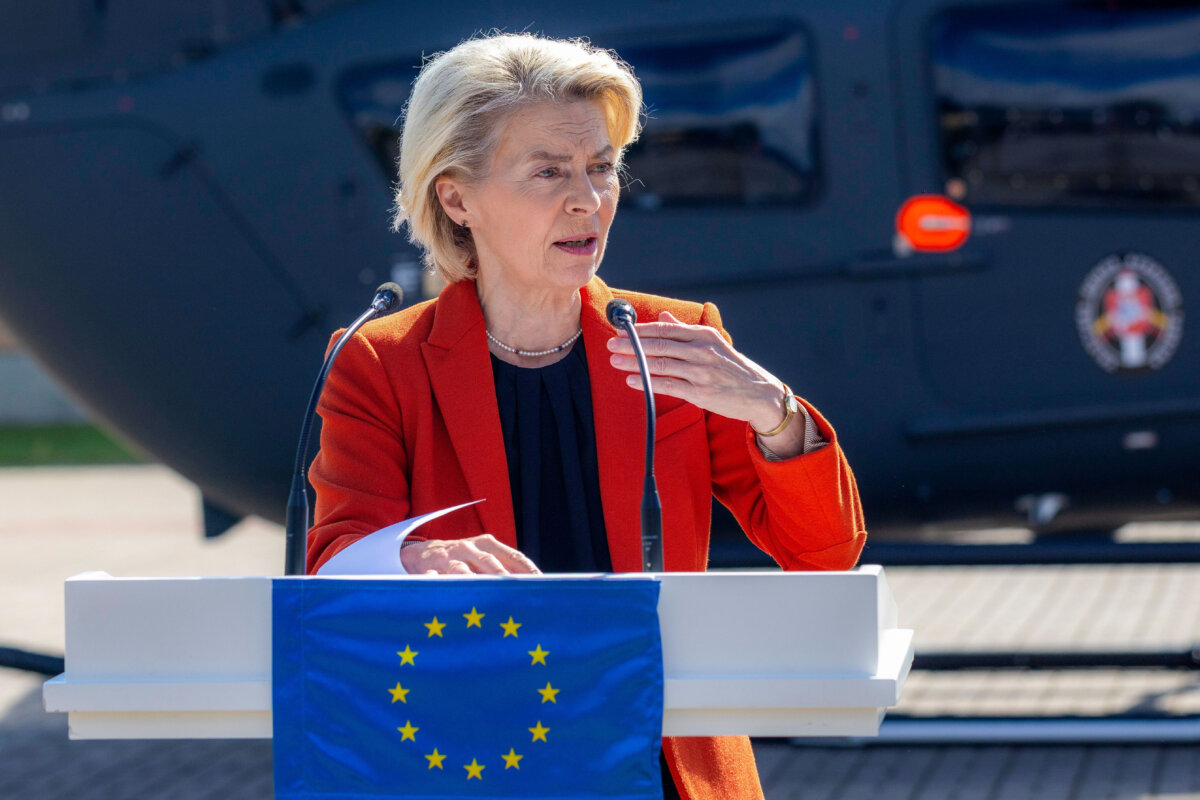

The European Commission on Oct. 16 proposed four flagship defense projects, including a drone wall and fortification of Europe’s eastern border, as part of measures to boost defense by 2030.
The new “Preserving Peace—Defence Readiness Roadmap 2030″ is necessary to deter “Russian aggression, prevent war and preserve peace,” European Commissioner for Defense and Space Andrius Kubilius said in a statement announcing the plans.
The plans outline four defense strategies: the European Drone Defense Initiative, the Eastern Flank Watch, the European Air Shield, and the European Space Shield.
The European Commission, the executive branch of the European Union, stated that these projects will “reinforce Europe’s ability to deter and defend across land, air, sea, cyber, and space while contributing directly to NATO capability targets.”
President of the European Commission Ursula von der Leyen said recent threats have shown that Europe is at risk.
“We have to protect every citizen and square centimetre of our territory,” she said in a statement. “And Europe must respond with unity, solidarity and determination. Today’s Defence Roadmap presents a clear plan with shared goals and concrete milestones on our path to 2030. Because only what gets measured gets done.”
‘Drone Wall’
While the commission presented four strategies for consideration, it stressed that the Eastern Flank Watch and the European Drone Defense Initiative are the most urgent projects.
The European Drone Defense Initiative—which has been referred to by Von der Leyen and others in the past as a “drone wall”—is envisaged as having a 360-degree approach, “as a multilayered, technologically advanced system with interoperable counter-drone capabilities” for detection, tracking, and neutralization.
The Eastern Flank Watch will “integrate the air defence and counter-drone systems with a set of ground defence systems with maritime security in the Baltic and Black Seas and systems for increased situational awareness, as well as internal security and border management.”

There is crossover between the projects, with the bloc noting that anti-drone capabilities will form a “core component” of the Eastern Flank Watch.
The drone wall is expected to be fully functional by the end of 2027, with the eastern flank defenses expected to be functional by the end of 2028.
The European Air Shield will protect the airspace of EU member states by creating an integrated, multilayered air and missile defense shield that will be fully interoperable with NATO’s command and control system. It is expected to be launched in the second quarter of 2026, according to the commission.
The European Space Shield is envisioned as being key to protecting space assets and services against what the bloc sees as a growing threat. The commission said this is also expected to be launched in the second quarter of 2026.
Russia’s ‘Hybrid Warfare’
The commission said that in five years, Europe will need capabilities for modern warfare and be in a defensive posture to deter adversarial action and respond to aggression.
The need to accelerate this buildup reflects increasing danger and the “evolving threat landscape,” the commission stated.
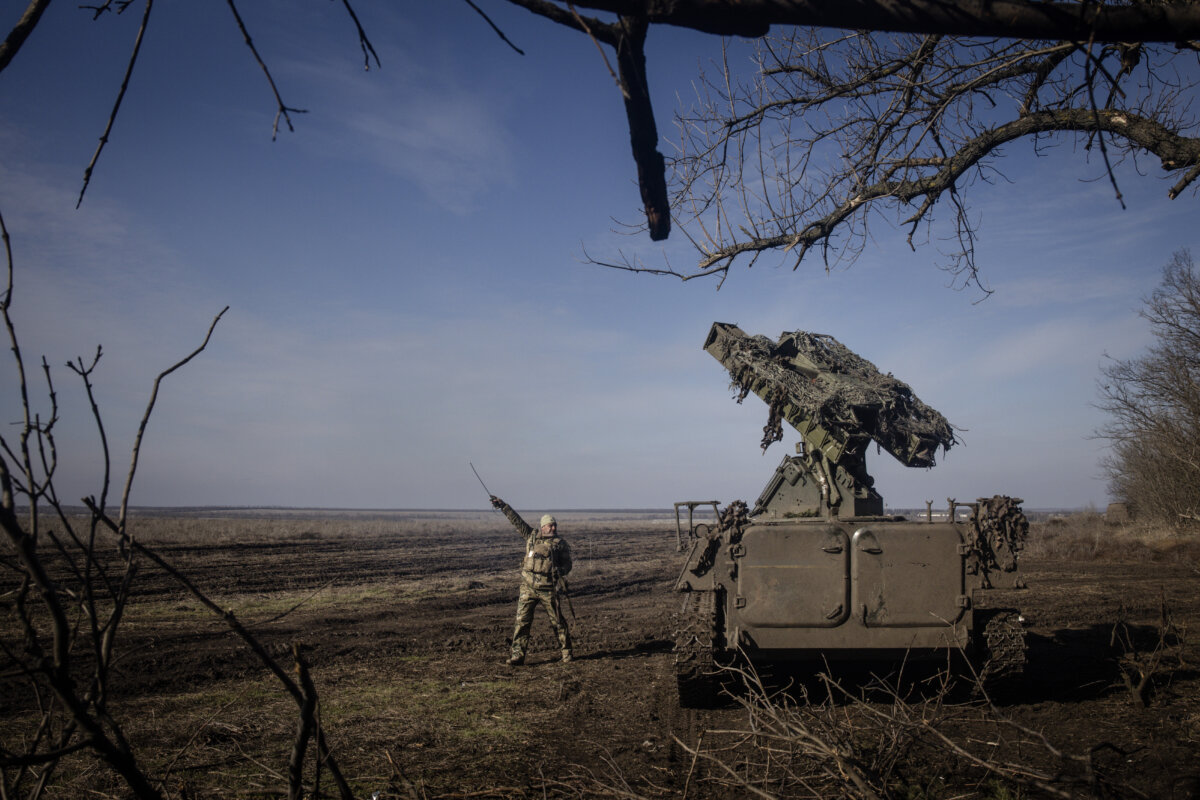
“This starts with Russia’s unprovoked, full-scale military aggression against Ukraine, which is reaching new heights of brutality and violence,” it stated. “Reckless provocations and acts of hybrid warfare against Member States, from cyberattacks to violation of air space are increasing. Russia has militarised its economy and society.”
The commission stated that “militarised Russia” poses a persistent threat to European security for the foreseeable future.
Sovereignty Over Defense
The commission said the plan will establish an EU-wide military mobility area, which will include harmonized rules and routes that will allow member states to respond quickly to threats to the continent while working in close cooperation with NATO.
The bloc’s executive branch stressed in the outline that member states need to be able to act independently and take responsibility for their own nation’s defense, as part of a broader strategy to act to defend Europe.
“Member States are and will remain sovereign for their national security and defence,” the commission stated. “At the same time, the complex threat landscape points to the need for Member States to act together, rather than fragmenting efforts across uncoordinated national initiatives.”
The European Council, made up of the leaders of the 27-member bloc, will decide whether to endorse the proposals by the end of 2025.
 Friends Read Free
Copy
Facebook
Tweet
Friends Read Free
Copy
Facebook
Tweet