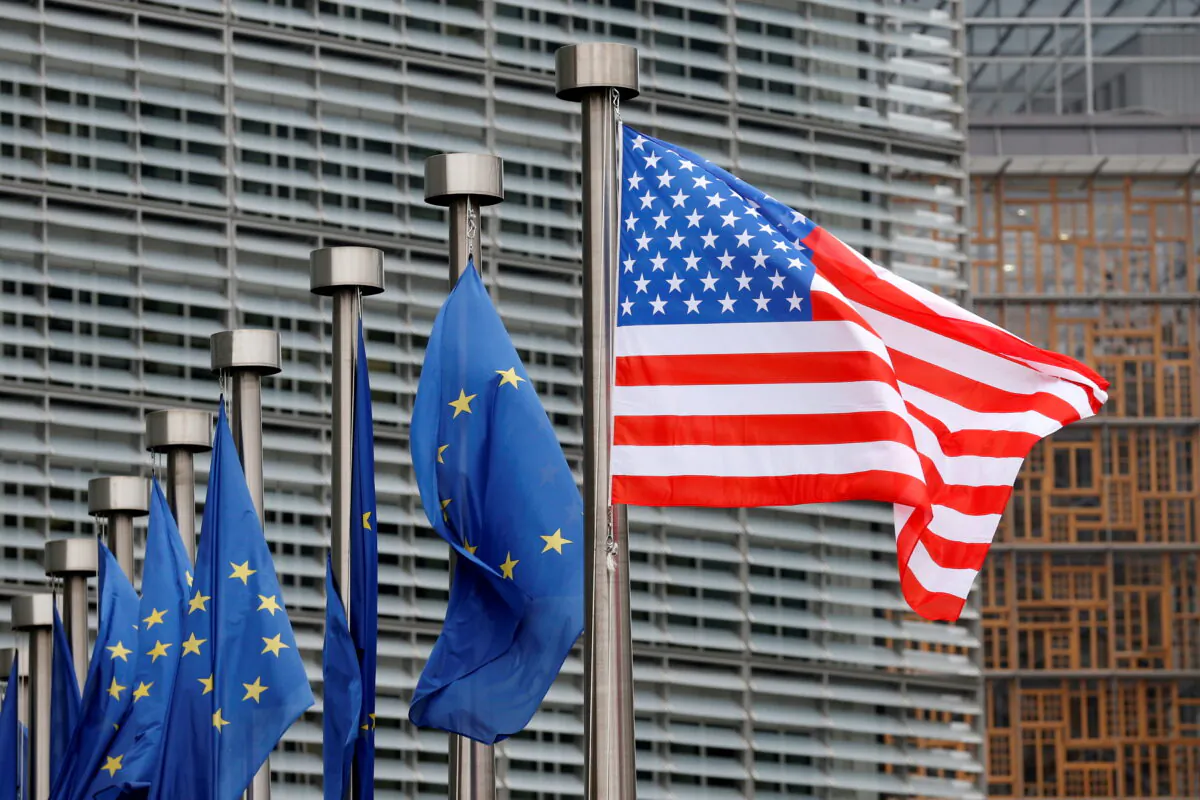

The European Union pushed back against American criticism of its tech rules amid ongoing trade negotiations with the United States.
The Digital Markets Act (DMA) reins in the power of very large online platforms (VLOPs) and very large online search engines (VLOSEs), including U.S. companies Alphabet, Amazon, Apple, Meta Platforms, and Microsoft.
The Digital Services Act (DSA) requires large online platforms to do more to tackle illegal and harmful content.
Violations of the legislation can lead to hefty fines being imposed, in some instances of up to 10 percent of their annual worldwide turnover for a first offense, and for repeated violations, this can increase to 20 percent.
Both laws have come under fire from the Trump administration, which says they unfairly target U.S. tech companies.
“Our legislation is not on the table. It is not open for negotiations, and this also includes, of course, our digital legislation,” European Commission spokesperson for tech sovereignty, defense, space, and research Thomas Regnier told a daily news conference in Brussels.
In response to a follow-up question, he doubled down, saying: “Our legislation will not be changed. The DMA and the DSA are not on the table in the trade negotiations with the United States.”
He added, “Our decision-making process and our sovereign decisions, and legislations, are not on the table.”
However, he said that the commission, which acts as the 27-nation bloc’s executive branch, wanted a deal and remained optimistic of reaching an accord with Washington by the July 9 deadline.
The comments from the commission came after President Donald Trump appeared to suggest that the legislation was up for discussion, in a post on Truth Social announcing the breaking off of trade deal talks with Canada on Friday.
Trump said Washington had terminated talks with its northern neighbor, with one of the reasons being that Ottawa “had announced that they are putting a Digital Services Tax on our American Technology Companies, which is a direct and blatant attack on our Country.”
“They are obviously copying the European Union, which has done the same thing, and is currently under discussion with us, also,” he said.
The White House has previously labeled legislation such as the DSA “extortion.”
A memorandum signed by Trump in February said: “Rather than position their own companies and workers for success, foreign governments have been taxing the success of America’s companies and workers.
“America’s economy will not be a source of revenue for countries that have failed to cultivate economic success of their own.”
Silicon Valley giants have frequently been penalized in Europe in recent years, with Apple, Microsoft, Meta, and Google all being fined by the EU or individual nations.
The EU is looking at 50 percent tariffs on its goods, which are currently slated to kick in on July 9.
Brussels already faces 25 percent levies on steel, aluminum, and cars, as well as reciprocal tariffs of 10 percent on almost all other goods.
Last month, the bloc proposed countermeasures on up to $107.2 billion (95 billion euros) of American imports if negotiations with Washington fail to remove the tariffs.
Negotiations are set to continue this week, with European Trade Commissioner Maros Sefcovic telling reporters he would travel to Washington on Tuesday and look to meet with U.S. Trade Representative Jamieson Greer and Commerce Secretary Howard Lutnick on Wednesday and Thursday.
He said that Brussels had received the first drafts of proposals from the United States for an eventual agreement.
“The ninth of July is round the corner, so for me, it’s always a good sign when we move from the exchange of views into the drafting process,” he said.
 Friends Read Free
Copy
Facebook
Tweet
Friends Read Free
Copy
Facebook
Tweet