
Fathers are finding it increasingly difficult to fulfil the role of a traditional provider because of mounting economic pressures, a new global survey suggests.
At the same time, many say they want to play a greater role in the lives of their children, but lack the financial support to do so.
According to Equimundo’s State of the World’s Fathers 2026 report (pdf), fathers want to provide equal care in the home and are doing so more than previous generations, but work and financial pressures often prevent them from participating.
The 14 countries studied included Australia, alongside Argentina, Brazil, Canada, Chile, China, Colombia, Croatia, Ireland, Mexico, Portugal, South Africa, Spain, and Türkiye.
Comparative samples were also drawn from the United States and the United Kingdom, bringing the total to 16 countries surveyed.
The report surveyed around 8,000 parents and caregivers through online panels, alongside 400 in-depth interviews. Researchers said the samples were not nationally representative.
“There is a perfect storm brewing around caregiving, driven by economic and social crises,” the report said. “Parents and other carers feel their governments, employers, and institutions are failing them by undervaluing and underinvesting in care.”
Researchers said many fathers described themselves as feeling “stretched to breaking point” as they attempted to balance financial pressures with caregiving responsibilities.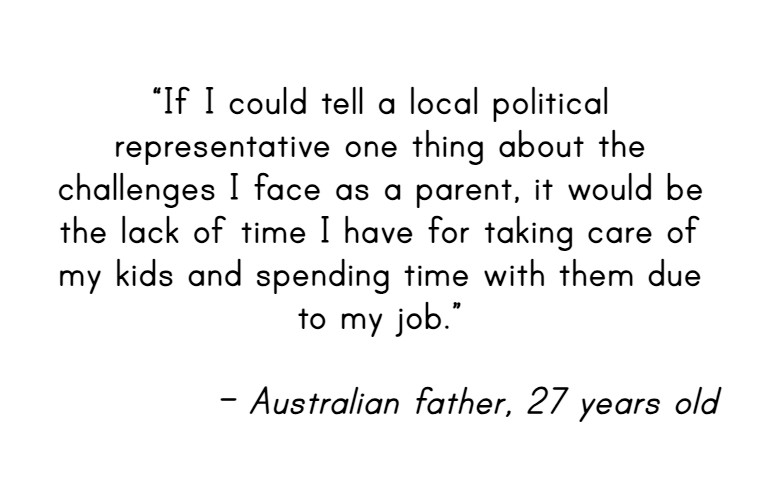 The study found that a quarter of fathers surveyed had been forced to refinance or sell their homes to help fund their care responsibilities, while half had taken on second or third jobs to make ends meet. Sixty percent worked overtime to cover expenses.
Three in four fathers said they lose sleep thinking about their financial future. At the same time, over 64 percent indicated they would be willing to pay higher taxes for more expanded public care services.
Despite the challenges, over 90 percent of fathers said they value unpaid care work as much as paid employment, while 87 percent said time with their newborns is a source of health and happiness.
Financial Stress Hits Men and Women Differently
Researchers found economic stress patterns differed between countries.
In lower-countries surveyed, economic stress is evenly distributed across age groups and genders.
In Australia, however, younger mothers aged between 18 to 30 reported significantly higher levels of economic stress than older mothers, with their situation noticeably improving after age 46.
Fathers, by contrast, economic insecurity remains relatively constant throughout their lives.
When asked to rank nine common concerns, 64 percent of fathers and 69 percent of mothers placed their children’s financial future among their top three worries.
Around 55 percent of both fathers and mothers also ranked their own financial security and ability to provide for their family among their major concerns.
The study examined 16 types of sacrifices parents report making for caregiving, spanning employment, finances, relationships, and personal wellbeing. In Australia, men reported rates of sacrifice comparable to, or slightly higher than, women across every category measured.
Younger Fathers Report Highest Levels of Distress
However, the way the sexes respond to parenting stress is markedly different.
Fathers have significantly greater odds than mothers of being in the high-distress group. Twenty-nine percent reported suicidal thoughts alongside chronic worry and heavy episodic drinking, with younger fathers the most likely to report severe distress distress.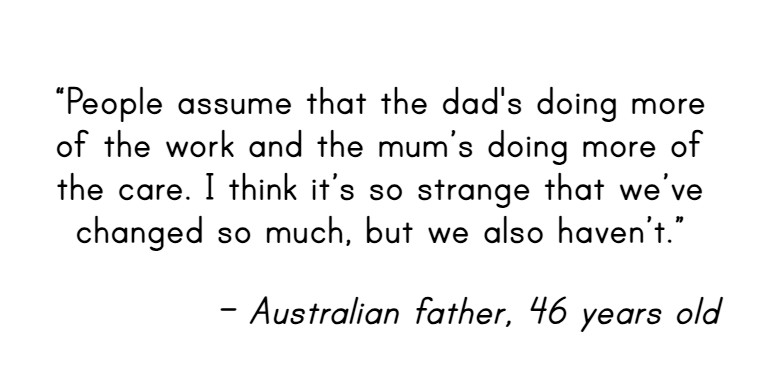 Outside financial stressors, fathers are more worried than mothers about their children’s online activity. Thirty-two percent of fathers identified it as a top three concern, compared with 26 percent of mothers.
“Perhaps because they recognise the harmful content they see online that is guided by algorithms adjusted for their gender,” the report suggests.
There are geographical distinctions in overall stress, with the United Kingdom and the United States consistently ranking highest, while Australia—along with Canada and Mexico—is rated “moderate.”
Return to Traditional Values
Researchers also found evidence of a return to more traditional gender attitudes, particularly among younger fathers.
Comparing the results with earlier surveys conducted in 2023 and before, the report found a “steep return to some more traditional attitudes” particularly among fathers, while attitudes among mothers were more mixed.
“In Australia, Brazil, Croatia, Ireland, and Spain, the older generation of men (46 to 65) are more egalitarian than the two younger cohorts (13 to 30 and 31 to 45),” the report said.
Both fathers and mothers continue to see financial provision as a father’s primary role, with 70 percent of fathers and 62 percent of mothers agreeing with that view.
Only a third of parents think that a father’s most important role was unpaid care and domestic work, including 30 percent of mothers and 35 percent of fathers.
Meanwhile, 58 percent of men in the study agree with the proposition: “I don’t think I am man enough unless I can provide for my family.”
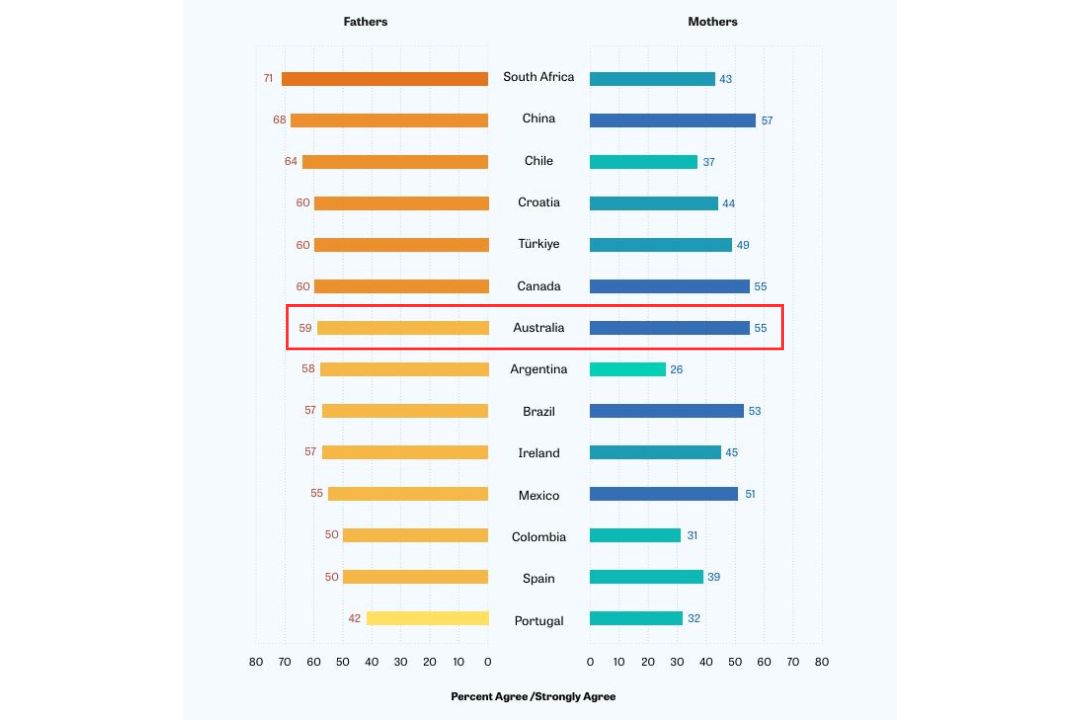
More than 50 percent of men in all countries except Spain and Portugal agreed or strongly agreed that “things are better if men do paid work and women do care work in the home.”
In Australia, more than 50 percent of women also agreed with the statement.
The report found couples who held traditional views about gender roles were significantly more likely to argue about the division of care responsibilities. Among those who reject traditional norms, 28 percent reported conflict over caregiving. That figure jumps to 68 percent among couples who embraced more traditional roles.
Researchers argued that traditional gender expectations are increasingly colliding with modern economic realities.
“Most families need two incomes now, but if both partners work and still believe women should do all the care, they enter an impossible situation that breeds resentment and conflict,” the report said.
“Even when controlling for everything else—age, employment, income, financial stress, and country—the pattern holds strong. Women with traditional beliefs: 80 percent higher odds of care conflict. Men with traditional beliefs: four times higher odds.”
Equimundo said analyses of care policies often overlook what most families want most: time together.
“Yet, families have to spend much of their psychological and physical energy on mere economic survival, to the detriment of themselves, their relationships, and their children, and other family members,” the researchers said.
The report concluded that governments, employers, and institutions needed to reduce the economic and social pressures surrounding care work and better support parents in balancing work and family life.
Research in Australia was conducted in assistance from The Fathering Project.