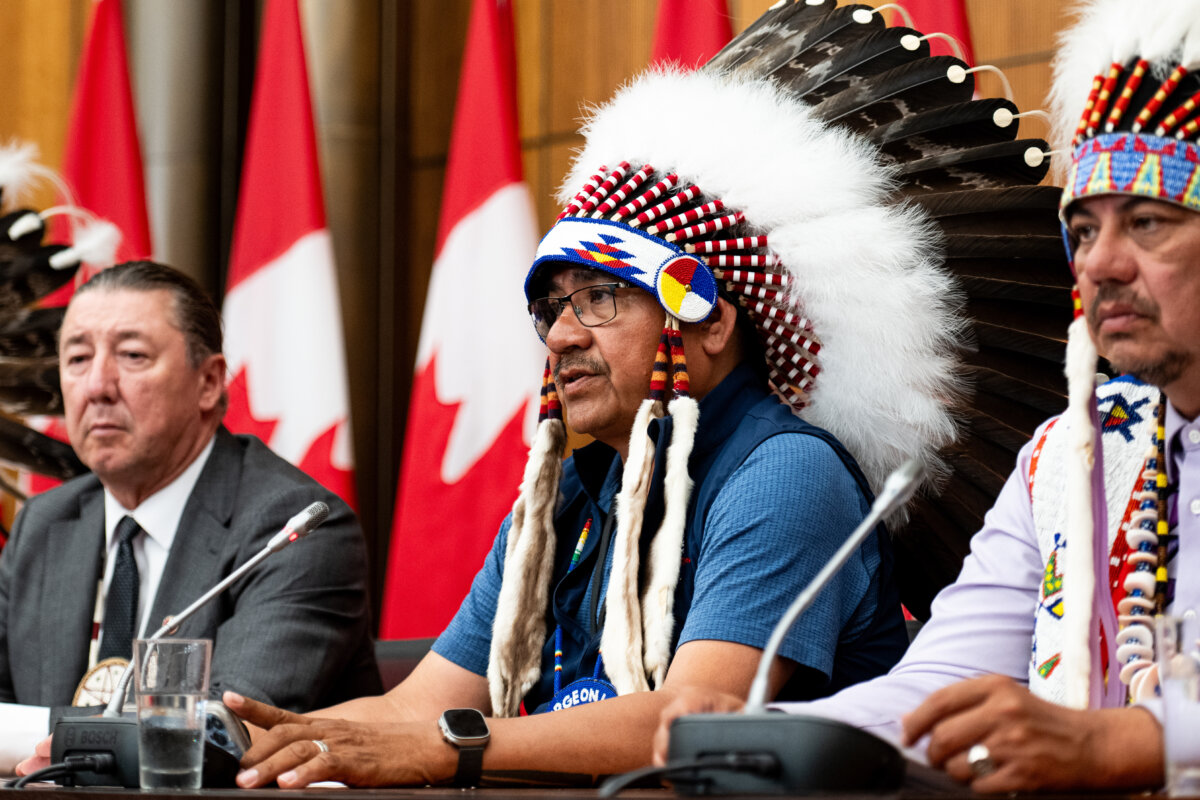

A northern Alberta First Nation is taking legal action against the provincial and federal governments and Alberta’s chief electoral officer over the approval of a citizen-initiated petition to separate the province from Canada, saying it infringes on treaty rights.
Sturgeon Lake Cree Nation (SLCN) filed a statement of claim on Jan. 5 in the Court of King’s Bench of Alberta, alleging that the province, the federal government, and Alberta’s chief electoral officer failed to protect treaty rights after the provincial election body issued a citizen initiative petition related to Alberta independence.
Elections Alberta on Jan. 2 announced that a petition for a referendum proposal, submitted by Mitch Sylvestre, CEO of the sovereignty advocacy group Alberta Prosperity Project (APP), could begin collecting signatures. The petition asks Albertans: “Do you agree that the Province of Alberta should cease to be a part of Canada to become an independent state?”
The SLCN plans to ask the court to pause the petition “to avoid the foreseeable harms that will result” from it, and argues that provincial separation cannot occur without First Nation consent.
“This petition will invite foreign interference and economic, societal and legal harm on all Canadians who live in Alberta, but especially all First Nations,” SLCN Chief Sheldon Sunshine said in a Jan. 2 statement.
Proponents of the petition have from Jan. 3 to May 2 to collect 177,732 signatures, the number required to equal 10 percent of the votes cast in the last provincial general election.
The SLCN says the petition’s approval was enabled by recently passed provincial legislation it calls “unconstitutional.” Last month, the province passed the Justice Statutes Amendment Act, 2025—formerly Bill 14—which amended several laws and included measures to remove barriers to citizen petitions.
The legislation allowed the APP to resubmit its petition after months-long delays from a legal review initiated in July 2025 by chief electoral officer Gordon McClure, who had raised concerns about the question’s constitutionality.
Before the legislation took effect, Court of King’s Bench Justice Colin Feasby ruled the proposed referendum question unconstitutional, saying it doesn’t guarantee the rights protected by the Canadian Constitution. He also said the question may infringe on treaty rights but did not rule on whether First Nations have a veto over the province’s potential separation.
“This decision has concluded that the transformation of provincial and territorial borders into international borders would contravene the Numbered Treaties by significantly impairing the exercise of Treaty rights by First Nations,” Feasby said in his Dec. 5 decision.
“This case has not decided that First Nations have a veto over Alberta independence nor has it considered whether or at what stage of the referendum process Alberta might have a duty to consult with First Nations.”
He added that the court also did not address whether any impacts on treaty rights from the province’s separation would be justified, as that was beyond the scope of the legal review.
Heather Jenkins, press secretary to Alberta Justice Minister Mickey Amery, declined to comment on the SLCN’s legal challenge.
“Alberta’s government recognizes and honours Treaty rights as recognized by section 35 of the Constitution Act, 1982,” she told The Epoch Times in a Jan. 6 statement. “As this matter is before the courts, Alberta’s government does not have any specific comment on this lawsuit.”
Elections Alberta also told The Epoch Times it doesn’t comment on active legal proceedings.
The province, through Bill 14, introduced amendments to the Referendum Act establishing that the Alberta government is not required to implement the results of a referendum if doing so would contravene the Constitution.
In another move in May last year to address concerns over potential referendums, the province amended the Referendum Act to establish that citizen-initiated petitions cannot infringe on indigenous treaty rights.
The amendment followed concerns raised by First Nations representatives after the province introduced referendum reforms that lowered the threshold for citizen-initiated petitions by reducing the number of required signatures and extending the collection period.
The APP says that there can be no “external vetoes” on the decision on the fate of the province. “Alberta’s path to a referendum requires only the consent of Albertans – not external vetoes,” the group said on Jan. 5.
 Friends Read Free
Copy
Facebook
Tweet
Friends Read Free
Copy
Facebook
Tweet