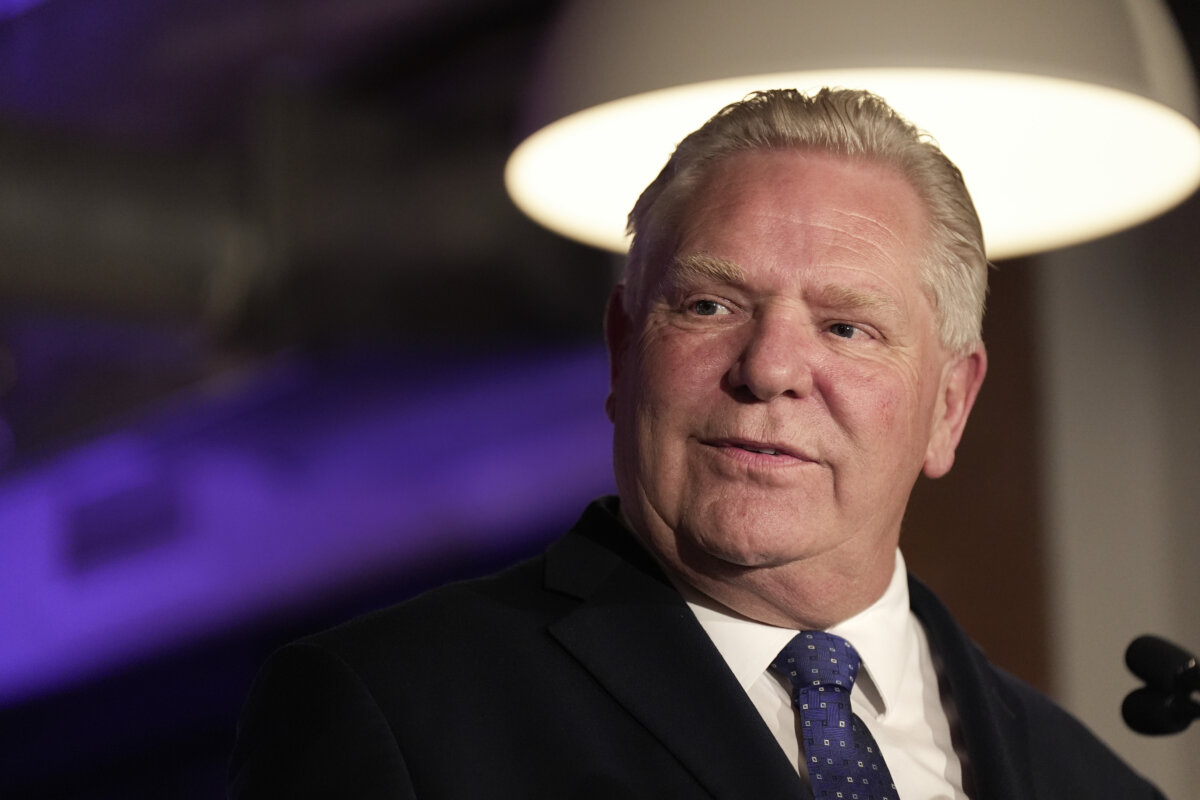

Premier Doug Ford says the two-year delay in opening the Volkswagen electric vehicle battery plant in southwestern Ontario shouldn’t cause concern.
Volkswagen subsidiary PowerCo Canada is attributing the delay at the $7 billion factory in St. Thomas, Ont., partly to a cooling in consumer appetite for electric vehicles.
A press release from PowerCo said the St. Thomas plant is expected to begin operations in 2029, with capacity for next-generation battery technology and future expansion “as market conditions evolve.” The release also announced PowerCo has hired EllisDon as the general contractor for the next phase of construction.
Ford said he’s confident that what is set to be Canada’s largest electric vehicle battery plant will be completed and operational within the timeline the company is now suggesting.
“I’m feeling good that they’re building the fourth largest facility building in the entire world, 16 million square feet,” Ford told reporters at Queen’s Park on Sept. 25. “What would make me worried is if they said they aren’t building, but they’re building and it’s going to be a massive, massive facility.”
Ford said it would create thousands of jobs in the area once it is complete.
Economic Development Minister Vic Fedeli offered similar remarks. “To us it’s a great news story the building is being built,” Fedeli said. “The investment is being made and we’re thrilled.”
The plant was announced in 2023, with $700 million in upfront capital costs from the federal government to build the factory. Ontario pledged another $500 million.
Together, the two governments are channelling $1.4 billion in total support, including some loans. The governments have also promised subsidies totalling more than $13 billion that are contingent upon production output levels.
Meanwhile, NDP Opposition Leader Marit Stiles characterized the delay as concerning.
“There’s no way that this is good news for people, this is not good news for workers who desperately need those jobs, for all the other spinoff industries that are relying on that, and also in a region which has already seen substantial layoffs,” Stiles told reporters at a media scrum at Queen’s Park on Sept. 28.
Conservative MP Andrew Lawton, who represents Elgin-St. Thomas-London South, said the pushed-back completion date isn’t “hugely surprising” to local residents, but the community wants to know what steps are being taken to move the project forward.
“The reality is this plant was supposed to be operating by 2027, and the Liberal government made a commitment, offered $13 billion in subsidies, moved mountains with the promise that it was going to create 3,000 jobs in the community,” he told reporters in Ottawa last week.
Pattern of Delays
Ford’s government has sought to develop a comprehensive electric-vehicle supply chain in Ontario, centred on extracting and processing critical minerals in northern Ontario before transporting them to battery manufacturing facilities in the southern part of the province.
Several manufacturers have delayed, suspended, or scaled back their plans in recent years.
Honda initially postponed its planned electric-vehicle battery manufacturing facility and assembly operations in Alliston by about two years in 2025, citing a slowdown in the EV market. The company subsequently suspended the Ontario EV project indefinitely in 2026.
Umicore paused construction of a planned battery-materials facility in Loyalist, Ont., in 2024, as part of a strategic review of its battery-materials business.
Automaker Ford delayed its plans for electric-vehicle production at its Oakville plant in 2024, including pushing back production of a planned electric SUV. General Motors ended production of its BrightDrop electric delivery van at its Ingersoll facility in 2025 after previously suspending production.
Stellantis and LG Energy Solutions initially established a battery manufacturing facility in Windsor under the NextStar brand. However, NextStar Energy shifted its focus toward energy storage solutions instead, and LG has since bought Stellantis out of that operation.
The auto sector has also been affected by U.S. President Donald Trump’s trade dispute with Canada.
The White House implemented a 25 percent tariff on Canadian-assembled passenger vehicles and light trucks and Trump has threatened to raise these tariffs to 50 percent beginning Jan. 1, 2027.
Canada’s retaliatory surtax adds up to a 25 percent charge on U.S.-manufactured vehicles imported across the border.
The Canadian Press contributed to this report.
 Friends Read Free
Copy
Facebook
Tweet
Friends Read Free
Copy
Facebook
Tweet