



For many of us, coffee is more than a beverage—it’s a switch we flip every morning to wake up and feel ready for the day. When we repeat that ritual day after day, coffee may do far more than boost alertness for a few hours.
Research has linked regular coffee drinking to changes in the gut microbiome, your cognitive function, and even your liver health. What exactly is going on inside your body when coffee becomes an everyday habit, and how can you optimize that effect?
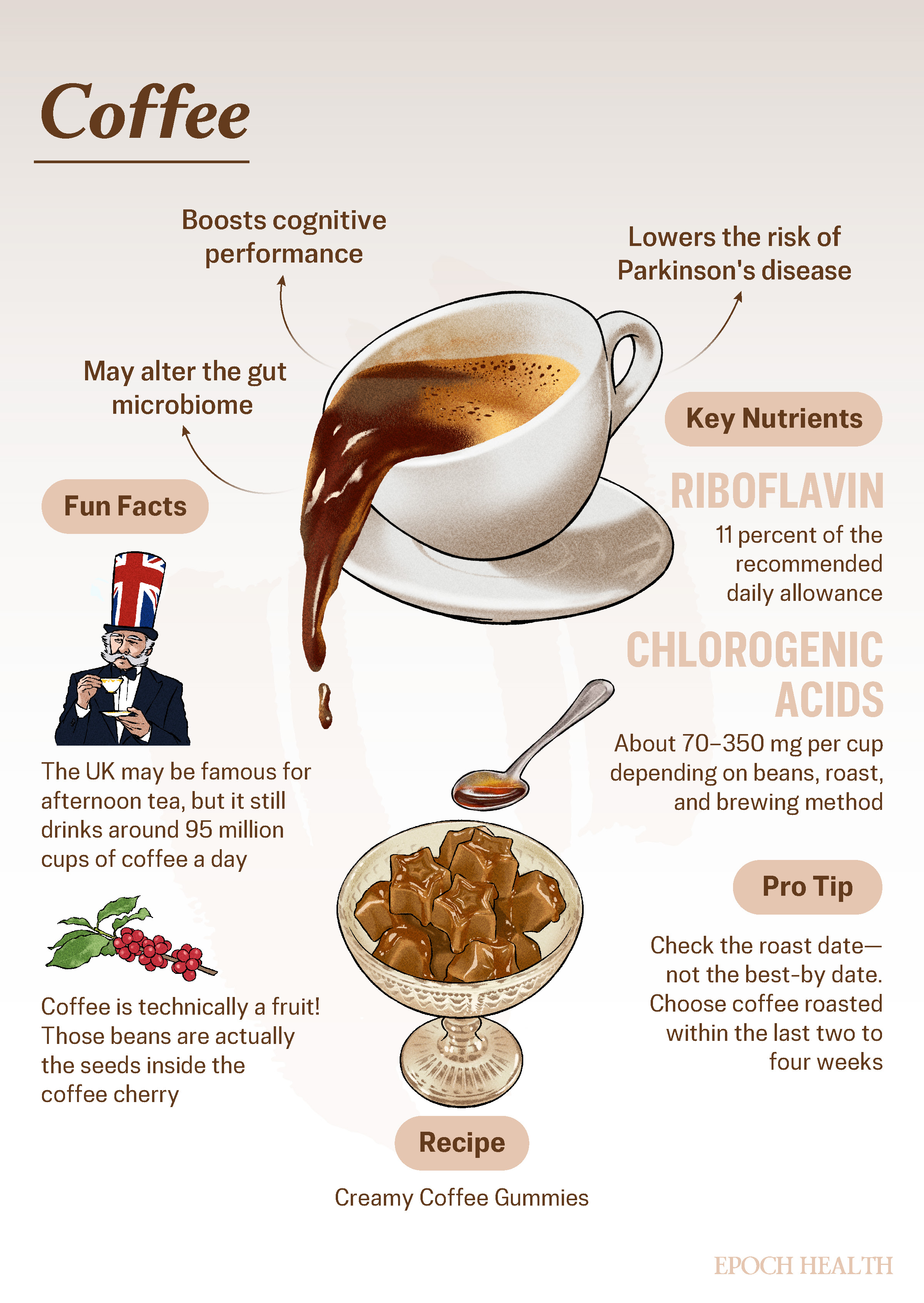 (Illustration by Ran/The Epoch Times)
One cup contains:
-
Chlorogenic Acids: About 70 to 350 milligrams, although the amount varies considerably depending on the beans, roast, and brewing method.
-
Riboflavin: 11 percent of the recommended daily allowance (RDA).
-
Pantothenic Acid: 6 percent of the RDA
-
Potassium: 3 percent of the RDA
-
Manganese: 3 percent of the RDA
[shortcut_anchor id=”anchor_1790360660246″ label=”Benefits”]Health Benefits[/shortcut_anchor]The effects of a daily coffee habit may reach further throughout the body than most people realize.
1. Alters the Gut Microbiome
A 2026 study published in Nature Communications found that coffee consumption altered the composition and activity of the gut microbiome. Coffee drinkers showed distinct microbial and metabolic profiles compared with non-coffee drinkers. Changes occurred after both caffeinated and decaffeinated coffee were introduced, suggesting that polyphenols and other compounds besides caffeine play a role.
The health significance of the microbiome changes remains uncertain, and the study reported mixed cognitive and behavioral findings.
“Coffee also affects the gastrointestinal tract. It increases stomach acidity and stimulates the release of hormones that aid digestion,” the authors of the study noted.
A large 2024 study involving more than 22,000 participants found that coffee consumption was strongly associated with differences in the gut microbiome, with 115 bacterial species positively associated with its intake. One species was 4.5 to eight times more abundant in coffee drinkers, and experiments showed that coffee stimulated its growth. The association was also seen among decaf drinkers, suggesting compounds other than caffeine are responsible. The researchers also linked the bacteria with specific compounds in coffee, though what that means for gut health remains unclear.
2. Boosts Cognitive Performance
It comes as no surprise that a daily cup of joe can get your brain moving. Research has shown that caffeine can help maintain alertness, attention, and reasoning speed, particularly when you’re sleep-deprived.
3. Lowers Risk of Type 2 Diabetes
Coffee also has metabolic benefits. A 2021 review found that habitual coffee drinking is consistently associated with a lower risk of Type 2 diabetes, for both caffeinated and decaffeinated coffee. A meta-analysis cited in the review found a significant association among people drinking more than three cups per day.
Researchers have proposed several possible explanations, including effects of coffee compounds on inflammation, oxidative stress, liver metabolism, and pancreatic function, but the mechanisms remain uncertain.
Supporting this, a meta-analysis published in Diabetes Care of 28 prospective studies involving more than 1.1 million people found that coffee drinking was associated with a progressively lower risk of Type 2 diabetes as intake increased. Compared with little or no coffee, six cups per day was associated with a 33 percent lower risk, and the association was seen with both caffeinated and decaffeinated coffee. While six cups is more than most people typically drink, the association was dose-dependent, with lower risk seen at lower amounts as well.
4. Protects Your Liver
A daily cup of joe may also affect your liver. A 2021 study published in BMC Public Health found that coffee drinkers had a 21 percent lower risk of chronic liver disease and a 49 percent lower risk of dying from chronic liver disease compared with non-coffee drinkers. Similar associations were found for ground, instant, and decaffeinated coffee, suggesting the potential liver benefits are not limited to caffeine.
Additionally, a 2017 systematic review and meta-analysis found that each additional two cups of coffee per day was associated with a 35 percent lower risk of liver cancer. Again, the association was seen with both caffeinated and decaffeinated coffee, although it was stronger for caffeinated coffee.
“Increased consumption of caffeinated coffee and, to a lesser extent, decaffeinated coffee are associated with reduced risk of HCC [hepatocellular carcinoma, the most common type of liver cancer], including in pre-existing liver disease,” the authors concluded.
A 2016 systematic review and meta-analysis published in Alimentary Pharmacology and Therapeutics found a relationship between coffee consumption and cirrhosis risk. Specifically, each additional two cups of coffee per day was associated with a 44 percent lower risk of cirrhosis and a 45 percent lower risk of death from cirrhosis.
5. May Promote Cardiovascular Health
Up to five cups of coffee per day is safe for most adults and may provide protective heart health benefits.
A 2018 review concluded that moderate coffee drinking—about two to five cups per day—is associated with lower risks of cardiovascular and all-cause mortality.
However, individual sensitivity and caffeine content vary based on the type of coffee.
6. Lowers Risk of Parkinson Disease
Coffee drinking has also been linked to a lower risk of Parkinson’s disease. A 2024 study published in Neurology found that people with the highest coffee intake had a 37 percent lower risk of developing Parkinson’s disease compared with non-coffee drinkers. Higher blood levels of caffeine and its metabolites measured years before diagnosis were also associated with lower Parkinson’s risk.
“The pattern is real, but I wouldn’t assume causation,” Ranya Belmaachi, a neuroscience-trained neurotechnology professional, told The Epoch Times in an email. However, there may be a biological explanation for the association.
“Caffeine blocks a particular receptor that sits in the brain’s movement circuitry and works against dopamine, which is exactly the system Parkinson’s damages,” Belmaachi said. “We know that target is meaningful because there’s an approved Parkinson’s drug that blocks that same receptor, more selectively than caffeine does.”
7. Improves Exercise Performance
Coffee’s caffeine content also provides a more immediate benefit: a boost at the gym. A 2022 systematic review and meta-analysis found that caffeine improved endurance running performance. Compared with a placebo, caffeine increased time to exhaustion and produced a small improvement in running time-trial performance. However, more research is needed in women and to determine the optimal dose.
A 2018 systematic review and meta-analysis found that caffeine produced small but significant improvements in upper-body strength and muscle power.
[shortcut_anchor id=”anchor_1790360706013″ label=”Absorption Utilization “]How to Increase Coffee’s Benefits[/shortcut_anchor]More isn’t necessarily better when it comes to coffee. In observational studies, approximately three to four cups per day were often associated with the lowest relative risks for several health outcomes. However, this does not establish an optimal intake for every person.
How coffee is roasted, ground, and brewed can change the amount of caffeine, polyphenols, and other compounds that make it into your cup. A few choices can also influence how coffee interacts with nutrients from the rest of your diet.
The roast level changes coffee’s chemical profile. Lighter roasts generally retain more chlorogenic acids, which are progressively broken down during roasting, although roasting also creates other potentially beneficial compounds.
“In general, the lighter the roast, the more chlorogenic acids remain. With a darker roast, the beans have been exposed to more heat for longer, so you lose a greater share of them. If maximizing chlorogenic acids is the goal, I would lean toward a light or medium-light roast,” Mario Idrovo, a certified Q grader with a master’s degree in coffee science and economics and founder of MI Coffee Institute, told The Epoch Times in an email.
Different brewing methods extract different amounts of caffeine, chlorogenic acids, and other compounds. Contact time, pressure, coffee-to-water ratio, and filtration all contribute to what’s ultimately in the cup.
“Longer contact methods and full immersion methods like French press or cold brew can pull a lot of soluble material from the grounds, including chlorogenic acids,” Idrovo said.
Espresso extracts coffee compounds quickly under pressure but uses relatively little water, while drip and pour-over methods fall somewhere in between.
Grind size affects the surface area of coffee exposed to water and therefore extraction. Finer grounds generally extract compounds more rapidly, while coarser grounds require longer contact with water.
The water temperature you use also affects extraction. Hotter water generally extracts coffee compounds more efficiently, but temperature works together with grind size and brewing time, so hotter isn’t necessarily better.
Paper filters capture much of the coffee diterpenes, cafestol, and kahweol, compounds that can raise LDL cholesterol. Unfiltered methods, such as French press and boiled coffee, allow more of these compounds to remain.
Coffee’s polyphenols can also reduce the absorption of non-heme iron when consumed with a meal. People concerned about their iron status may want to drink coffee between meals rather than alongside iron-rich foods or supplements.
[shortcut_anchor id=”anchor_1790360785147″ label=”Storage”]Optimal Storage [/shortcut_anchor]Coffee begins losing its flavor and aroma after roasting, but proper storage can help keep it fresh longer. The biggest enemies to its quality are easy to deter once you know what to look for.
“The main things you’re trying to protect coffee from are oxygen, light, heat, and moisture,” Idrovo said. “At home, I would keep the beans in an airtight, opaque container at room temperature and away from the stove, a sunny window, or anywhere else that gets warm.”
Idrovo doesn’t recommend storing coffee in the refrigerator. Coffee is porous and can absorb odors from other foods, while the refrigerator’s moisture can also work against freshness.
“Freezing is different. It can work,” he said. “But I would only do it if the coffee is divided into small, completely airtight and moisture-proof portions. You don’t want to keep taking the same bag out, letting it warm up and putting it back, because condensation becomes a problem.”
[shortcut_anchor id=”anchor_1790360891897″ label=”Pro Tips”]Pro Tips[/shortcut_anchor]Idrovo also has a few simple steps home brewers can take to make their best cup.
“If I could get someone to change only a few things at home, I’d tell them to buy whole beans and grind fresh, weigh their coffee and water instead of guessing,” he said. Because water chemistry can significantly affect flavor, use filtered water and be sure to keep your equipment clean.
Doing those things consistently, he says, will put you ahead of most home brewers.
For someone brewing at home, he recommends starting with a 1-to-16 ratio of coffee to water, water around 200 degrees Fahrenheit, and a medium grind for drip or pour-over coffee. From there, let taste be your guide.
“If it’s sour or weak, try grinding finer or extending the brew time a little. If it’s bitter or harsh, go coarser or shorten the time. Generally, an extraction of around 18 to 22 percent is where you’re getting plenty out of the coffee without pushing it into those harsher flavors.”
When it comes to picking the freshest bag at the store, Idrovo suggests reading the fine print: “The first thing I look for is an actual roast date. A ‘best by’ date doesn’t tell you nearly as much because that date can be a year away. Ideally, you’re buying coffee that was roasted within the last two to four weeks.”
Rather than stocking up on beans, he recommends buying smaller quantities that can be used while the coffee is still at its best. Once the bag is opened, it’s best to finish it within about a month.
“It doesn’t suddenly become bad after that, but you start losing those aromatics and the cup becomes flatter,” he said.
He also strongly prefers buying whole beans and grinding them right before brewing. “Once coffee is ground, it starts losing aromatic compounds very quickly through oxidation, ” he said.
Coffee also makes a flavorful addition to dishes in the kitchen. “I think coffee works best in food when you’re using it to add depth,” Idrovo said.
For desserts, he suggests espresso or very strong brewed coffee in dishes such as tiramisu, chocolate cake, and mousse.
“Coffee can amplify the flavor of chocolate rather than compete with it,” he said.
For a dry rub, Idrovo recommends finely ground coffee—almost espresso-fine—paired with red meats such as steak or brisket. “You get that earthy bitterness from the coffee playing against the sugar and spices, and a medium-dark roast works well for that,” he said.
Brewed coffee and espresso can also add depth and flavor to barbecue sauces, mole, and braising liquids.
There are a few things to keep in mind about decaf coffee as well. Coffee is decaffeinated while the beans are still green, before roasting, and the process can affect both its chemical composition and flavor.
Decaffeination doesn’t exclusively remove caffeine. “Some soluble compounds, including some chlorogenic acids and flavor precursors, can be lost during the process because caffeine extraction isn’t perfectly selective. That’s one reason a decaf can sometimes taste a little flatter or less complex than the regular version of the same coffee,” he said.
However, choosing decaf doesn’t necessarily mean sacrificing quality.
Ultimately, when all is said and done, Idrovo has one gold standard for the tastiest cup: “The best coffee is the coffee you like.”
[shortcut_anchor id=”anchor_1790360901880″ label=”Recipe”]Recipe: Creamy Coffee Gummies[/shortcut_anchor]For a different way to get your coffee fix, try it in gummy form. These creamy coffee gummies are a lightly sweet, bite-sized treat. The gelatin in them provides collagen-derived protein and gives them their signature chewy texture.
Yield: About 24 gummies, depending on the size of the mold
Prep time: 5 minutes
Chill time: 30 minutes
Total time: 35 minutes
Special Equipment: High-speed blender, gummy mold (optional)
Ingredients
-
1 cup brewed coffee, cooled
-
½ cup full-fat unsweetened coconut milk
-
2 tablespoons maple syrup
-
½ teaspoon vanilla extract
-
¼ cup grass-fed gelatin
Directions
Add all ingredients to a high-speed blender and blend until combined. Pour into a mold or baking dish and refrigerate until set (approximately 30 minutes). If using a baking dish, use a knife or spatula to cut into uniform pieces.
Precautions
For all its health benefits, coffee does come with some precautions to keep in mind.
1. Sleep Disruption: Caffeine can interfere with sleep even when consumed hours before bedtime. In one study, a 400-milligram dose of caffeine taken six hours before bedtime significantly disrupted sleep.
“Caffeine costs you sleep; worse sleep means more tiredness to suppress tomorrow, and the dose creeps up. The people who do well with coffee are usually the ones keeping it moderate, keeping it before early afternoon, and not using it to paper over a sleep debt that keeps growing underneath,” Belmaachi said.
2. Can ‘Borrow’ Energy: Caffeine primarily blocks adenosine, a chemical that builds up throughout the day and contributes to feelings of sleepiness. This can temporarily mask fatigue rather than correct its underlying cause.
“The surprising part is that caffeine doesn’t give you energy. It hides the fact that you’re running low. Caffeine doesn’t clear the adenosine. It keeps piling up behind the blockade. When the caffeine wears off, the full backlog hits at once,” Belmaachi said.
“That’s the afternoon crash. You didn’t lose energy, you just got the bill.”
3. Caffeine Dependence and Withdrawal: Regular caffeine consumption can lead to physical dependence. Abruptly stopping can cause withdrawal symptoms including headaches, fatigue, difficulty concentrating, irritability, and depressed mood, which typically begin within about a day of stopping caffeine.
“Withdrawal is real, not imagined. Skip a day, and you can get a headache, fatigue, and trouble concentrating for a few days. It’s a recognized diagnosis,” Belmaachi said.
Regular use also raises the question of how much of caffeine’s perceived benefit in habitual drinkers reflects a genuine boost versus the reversal of withdrawal.
“Which raises an honest question researchers still argue about: For a daily drinker, is the morning cup lifting you above normal, or just returning you to normal after an overnight dip you caused yourself? Probably some of both,” Belmaachi said.
4. Anxiety and Palpitations: Caffeine stimulates the central nervous system and can cause jitteriness, anxiety, and a racing or pounding heartbeat, particularly at higher doses or in people more sensitive to caffeine.
“The useful zone is about one to two cups. Jitters and anxiety climb steeply past four or five, and much earlier for anyone prone to anxiety or panic,” Belmaachi said.
5. High/Raise Blood Pressure: Caffeine can cause a temporary spike in blood pressure, particularly in people who don’t regularly consume it. Habitual coffee drinkers often develop some tolerance to this effect, but people with high blood pressure may want to monitor their intake.
6. Digestive Symptoms: Coffee stimulates activity in the gastrointestinal tract and may trigger symptoms in some people. Depending on the person, drinking coffee may lead to digestive symptoms such as reflux or increased bowel activity.
7. Your Cup May Be a Source of Microplastics: The container can matter as much as the coffee. Research suggests disposable coffee cups can release micro- and nanoplastics into hot beverages. Using a glass, ceramic, or stainless-steel cup can reduce contact with plastic.
Caffeine also crosses the placenta, and a developing fetus metabolizes it much more slowly. Pregnant women are generally advised to keep total caffeine intake below 200 milligrams per day, including caffeine from coffee, tea, soda, energy drinks, chocolate, and medications.
Caffeine and coffee can also interact with certain medications, either by altering how a drug is absorbed or metabolized or by intensifying effects such as increased heart rate. People taking prescription medications should check with their doctor about whether they need to separate their medication from coffee or limit caffeine.
“When someone tells me their coffee tolerance suddenly changed, I ask about their medications,” Belmaachi said.
Children and adolescents are more sensitive to caffeine’s effects, in part because their smaller size means the dose is larger relative to their body weight. Because caffeine can also be found in tea, soda, energy drinks, chocolate, and some medications, parents should consider a child’s total daily caffeine intake, not just coffee.
There is also evidence that coffee can contain mycotoxins, pesticide residues, and acrylamide, a compound that forms during roasting. At high exposures, these substances may pose health risks, although the amounts typically found in coffee are generally low. How coffee is grown, stored, roasted, and brewed can influence the levels that end up in your cup.
[shortcut_anchor id=”anchor_1790360909413″ label=”Fun Facts”]Fun Facts[/shortcut_anchor]
-
Coffee is technically a fruit—the beans are seeds of a fruit, the coffee cherry.
-
Coffee beans are green before roasting.
-
Dark roast doesn’t necessarily mean more caffeine.
-
Caffeine evolved as a plant defense mechanism—it can deter insects.
-
While the British are known for their affinity for afternoon tea, they certainly don’t shun coffee—the UK alone drinks around 95 million cups of coffee per day.