



The cup that keeps your coffee warm may be the very thing that makes it less safe to drink.
A recent study found that heat can release thousands to hundreds of thousands of microplastics into a beverage, depending on the cup material and temperature, raising questions about one of the world’s most common daily habits.
Heat and Cup Choice Matter
The study, published in the Journal of Hazardous Materials: Plastics, found that heat is a key driver of microplastic release from disposable containers. Microplastics leached regardless of the temperature at which the beverage was held, but leaching levels increased as the temperature rose.
Researchers first analyzed data from 30 peer-reviewed studies on microplastic release from various plastic products, focusing on factors such as temperature and soaking time.
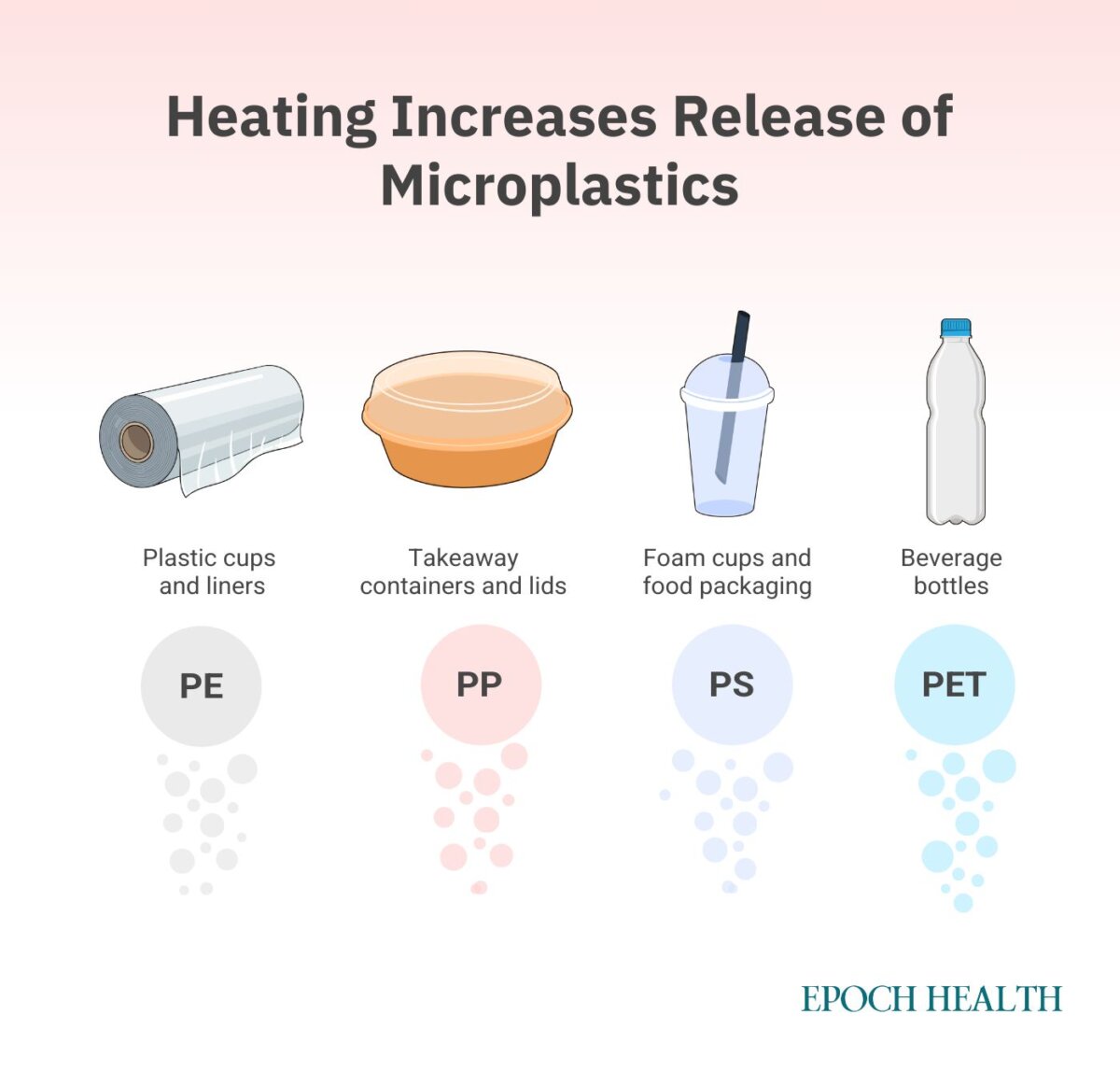
Products made of polyethylene (PE), polyethylene terephthalate (PET), polypropylene (PP), and polystyrene (PS) showed significant increases in microplastic release as temperatures rose. The most pronounced effects were in the high-temperature range typical of hot beverages.
PE is commonly used in plastic cups and liners, PP in takeaway containers and lids, PS in foam cups and food packaging, and PET in beverage bottles. Among these, PET generally showed the smallest increase in release with rising temperature, suggesting greater thermal stability than the other types.
Across studies, higher temperatures, especially above 140 degrees Fahrenheit (F), were linked to a sharper rise in very small particles—less than one micrometer—relative to larger particles, suggesting that heat accelerates surface breakdown.
Cups and food containers showed much stronger temperature-related increases in microplastic release than bottles, which are usually made from more heat-resistant plastics and are less often used with hot liquids.
The extent of leaching varied widely depending on the material and study design. Some individual studies found single conditions yielding hundreds or even multiples of hundreds of thousands of particles per liter of water at high temperatures.
The time that a beverage was left in the container wasn’t as consistent a driver of microplastic leaching as temperature.
The Cup Experiment
For a real-world measure, researchers collected hundreds of coffee cups made of two major types: PE plastic cups and paper cups lined with a polyethylene coating, which look like paper but have a thin inner plastic layer to make them waterproof.
The study had two parts. The first involved analyzing existing research, and the second involved the real-world experiment. Although the review included several common plastics such as PE, PET, PP, and PS, the experimental portion of the study focused specifically on two plastic types, which were identified as among the most commonly used to-go cup types.
In the experiment, the cups were filled with purified water, whose minerals and ions were removed to avoid background contamination, at 41 degrees F and 140 degrees F to simulate iced and hot coffee temperatures. The water was left to sit for 30 minutes—a duration chosen to reflect typical beverage contact time rather than long-term storage—while covered to avoid airborne contamination. Microplastics that leached into the water were then collected by filtration and analyzed.
The authors noted that temperature alone may not fully reflect real-world beverages, because factors such as coffee acidity and milk fat could further influence how plastics shed particles.
Both cup types leached microplastics at both temperatures, but PE plastic cups released more than PE-coated paper cups. Raising the water temperature from cold to hot increased microplastic release from PE cups by roughly one-third, while the increase for PE-coated paper cups was much smaller.
Using microscopes to examine the inner surfaces, the researchers found that heat exposure increased the surface roughness of polyethylene cups, creating a more uneven, damaged surface prone to shedding particles.
Their chemical analyses showed little evidence that the heat changed the plastics’ chemical composition, indicating that the increase was driven by physical surface degradation rather than chemical breakdown.
The authors estimate that drinking one 10-ounce hot beverage per day could result in ingesting approximately 360,000 microplastic particles per year from PE cups, compared with approximately 240,000 particles per year from PE-coated paper cups.
More Complicated Than a Label
Lisa Zimmermann, a lead author of a 2025 review on microplastics from food packaging, who was not involved in the study, said microplastic release depends on more than just whether a product is labeled PE or PET. Even two plastics identified as polyethylene can differ substantially in chemical composition and manufacturing processes, which can influence the number of particles they shed.
“The individual product and its handling determines the microplastic release,” she told The Epoch Times, noting that more shaking and higher temperatures tend to release more particles than gentler handling and lower temperatures.
Jane Muncke, managing director and chief scientific officer at the Food Packaging Forum in Zurich, told The Epoch Times that paper coffee cups are also typically stacked during transport and storage. One cup’s exterior can touch another cup’s interior—a process known as set-off migration—allowing printing inks, if present, to transfer to the food-contact surface and potentially migrate into hot drinks.
“As printing inks often contain chemicals of concern, this can imply concerns for health,” Muncke said.
Why Scientists Are Concerned About Microplastics
Globally, an estimated 250 billion to 300 billion single-use disposable cups are discarded each year. Growing evidence suggests that these everyday products may also be a source of microplastic exposure.
Some studies suggest that microplastic exposure may trigger inflammation, oxidative stress, and immune responses, but researchers caution that there is still no clear consensus on how much accumulates in the body or what the long-term consequences may be.
“There is enough evidence to be concerned,” Desiree LaBeaud, a physician-scientist and epidemiologist at Stanford Medicine and one of the founders of Stanford’s interdisciplinary Plastics and Health Working Group, told The Epoch Times.
Sophia Young, a microplastics researcher at the University of Alberta, told The Epoch Times, “Plastics are ubiquitous, so complete avoidance isn’t realistic for most people.”
She said that the most effective way to reduce microplastic exposure is to cut back on direct contact with plastics.
Simple Kitchen Swaps to Reduce Plastic Exposure
Practical ways to reduce exposure while using plastics:
- Avoid heating food or drinks in plastic containers.
- Let very hot foods or drinks cool slightly before transferring them to plastic cups.
- Opt for reusable, non-plastic materials, such as glass, ceramic, and stainless steel, whenever possible.
- Minimize wear on plastic items, since scratched or degraded plastics shed more particles.
- Avoid plastic in both cups and preparation tools. Use a stainless-steel kettle and coffee makers without plastic components, and use metal filters instead of capsules.
- Choose paper tea bags or switch to loose-leaf tea, as some tea bags contain plastic.
Many people avoid plastics because of BPA (bisphenol A), a chemical that has raised concerns about potential hormone-disrupting effects. Samantha Romanick, an analytical chemistry fellow at the Environmental Working Group and a molecular biologist who studies the health effects of microplastic exposure, told The Epoch Times that although many plastics are labeled BPA-free, that does not mean they are free of other bisphenols. For that reason, she said, metal, glass, and ceramic remain the safest options for hot beverages.
If single-use plastics are unavoidable, one of the easiest ways to identify plastic types is by checking the recycling code—a number from one to seven stamped on the product, Young said. These numbers generally correspond to specific polymers, such as polyethylene, polypropylene, or polystyrene, which can offer an approximate sense of how a material might behave when exposed to heat.
Some experts point to compostable cups as an alternative. However, Zimmermann noted that even disposable cups made from compostable plastics are still plastics and therefore are just as prone to releasing microplastics as conventional plastics.
“In some cases, it may release even more, since compostable materials are designed to break down over time,” she said.
Romanick also noted that compostable materials may contain additional chemicals that give them their degradable properties.
The study does not prove that disposable cups directly cause disease. However, it does suggest that heat and cup material can influence how many plastic particles enter a drink.
For people looking to lower their overall exposure, one of the simplest ways to start may be to update a daily habit by choosing a better cup.