
Canada will begin formal discussions with the United States in January to review the United States-Mexico-Canada (USMCA) free trade agreement, the Prime Minister’s Office says.
Canada-U.S. Trade Minister Dominic LeBlanc will meet with his U.S. counterparts in mid-January to launch the formal USMCA negotiations, the PMO said in a readout of the first ministers meeting, which took place Dec. 18.
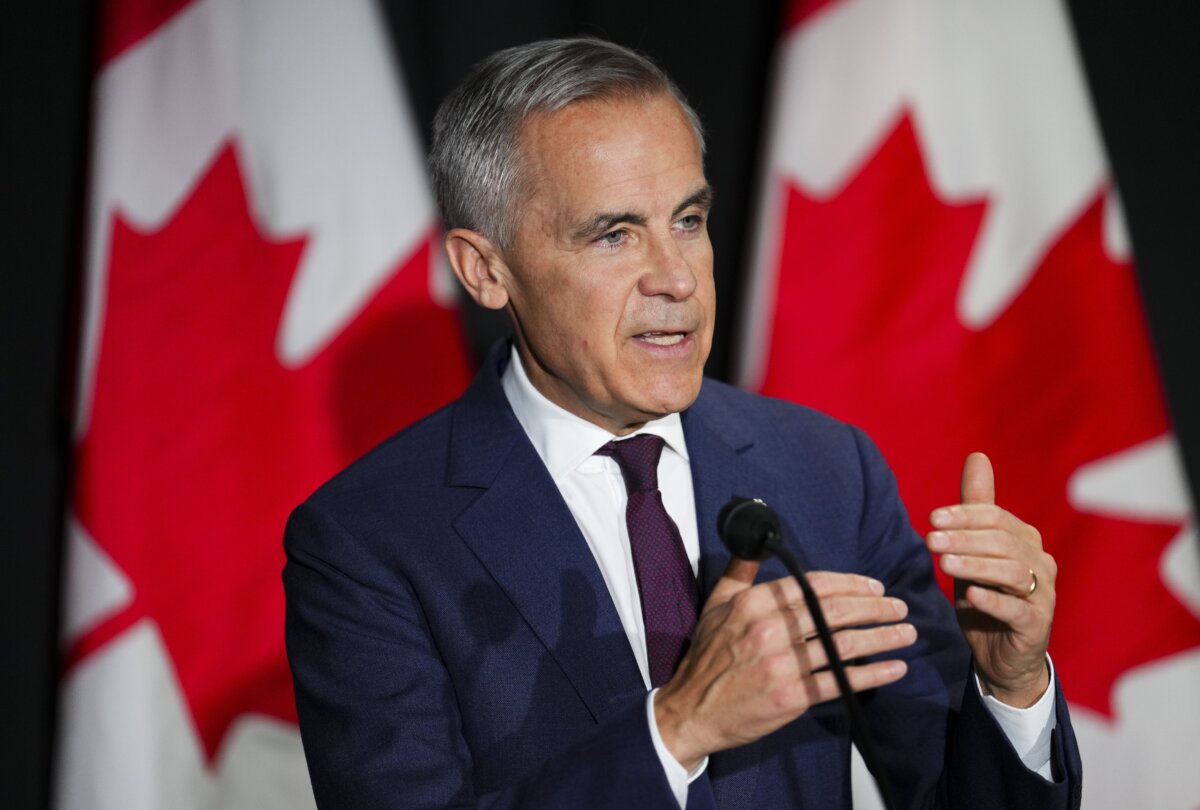
Prime Minister Mark Carney met virtually with Canada’s provincial and territorial leaders to brief them on trade talks with the United States, including preparations for USMCA negotiations, ahead of next year’s review. He intends to pursue additional trade agreements with other countries next year, according to the PMO.
Carney told reporters on Dec. 18 that Washington and Ottawa had been “close” to a deal after his last visit to Washington in October. He said Canada is still ready for a deal if the United States agrees to negotiate, but noted that he thinks it’s “unlikely” any trade deal will be reached before the joint review of the USMCA next year. The deal being worked on related to steel, aluminum, and energy.
“It was the case that we were close to an agreement. We didn’t get that agreement,” Carney said. “The terms of that agreement, from our perspective, are still on the table.”
Carney said the United States has not resumed talks on the deal he and U.S. President Donald Trump had discussed prior to trade negotiations breaking down in late October. He said the agreement would have benefited Canadian workers in the steel, aluminum, and energy sectors, as well as the United States “tremendously.”
“My judgment is that that is now going to roll into the broader [USMCA] negotiation… We’re unlikely, given the the time horizons coming together, to have a sectoral agreement. Although if the United States wants to come back on that in those areas, we’re always ready there,” he added.
Carney told CBC News during a Dec. 17 interview that the sectoral tariffs on steel, aluminum, and vehicles will “necessarily be part of our negotiation.” He said the United States will need to make a “choice” about whether it gains benefits from the free movement of items like steel, lumber, and automobiles across the Canada-U.S. border.
Canada has faced a 35 percent tariff on all Canadian goods exported to the United States not covered under the USMCA, along with higher sectoral duties on Canadian autos, steel, aluminum, copper, and softwood lumber. Carney has upheld that the USMCA is beneficial for Canada, saying approximately 85 percent of Canadian goods crossing into the United States are tariff-free under the trade pact.
Trump ended all trade talks between Canada and the United States on Oct. 23 after Ontario aired an anti-tariff advertising campaign on American networks. Trump said the campaign was misleading and meant to interfere with a U.S. Supreme Court decision on his administration’s use of tariffs.
US Trade Irritants
Carney’s comments on the USMCA review come as the Trump administration has also been messaging publicly on the matter.
U.S. trade representative Jamieson Greer said during closed-door remarks to members of U.S. Congress, a portion of which were released to the public on Dec. 17, that Canada’s dairy policies, digital streaming regulations, and provincial bans on U.S. alcohol are making the United States hesitant to renew the USMCA.
Greer said Canadian dairy rules “unfairly restrict market access for U.S. dairy products,” and go against the USMCA’s free-trade provisions.
While he said Canada must expand “market access for U.S. dairy” and stop the export of low-price Canadian dairy products into the United States if it wants Washington to renew the USMCA next July, he didn’t call on Canada to end its supply management program.
Carney said during an unrelated press conference on Dec. 18 that Ottawa will “continue to protect supply management.”
“Supply management is never on the table,” he added.
The issues raised by Greer are just one “subset of issues” from a broader conversation, Carney said, noting he expects Trump to raise more sticking points with Canada.
Carney also cited 54 non-negotiable conditions set by Mexico from its side of trade negotiations with the United States. The United States also has a list of grievances about its trade with Mexico related to supply chains, energy policies, and labour and environmental laws.
Carney told TVA on Dec. 17 that when discussing the upcoming USMCA review with Trump and Mexican President Sheinbaum in Washington on the sidelines of the FIFA World Cup draw earlier this month, there was no sign Trump intends to tear the agreement up.
Matthew Horwood and Paul Rowan Brian contributed to this report.
 Friends Read Free
Copy
Facebook
Tweet
Friends Read Free
Copy
Facebook
Tweet