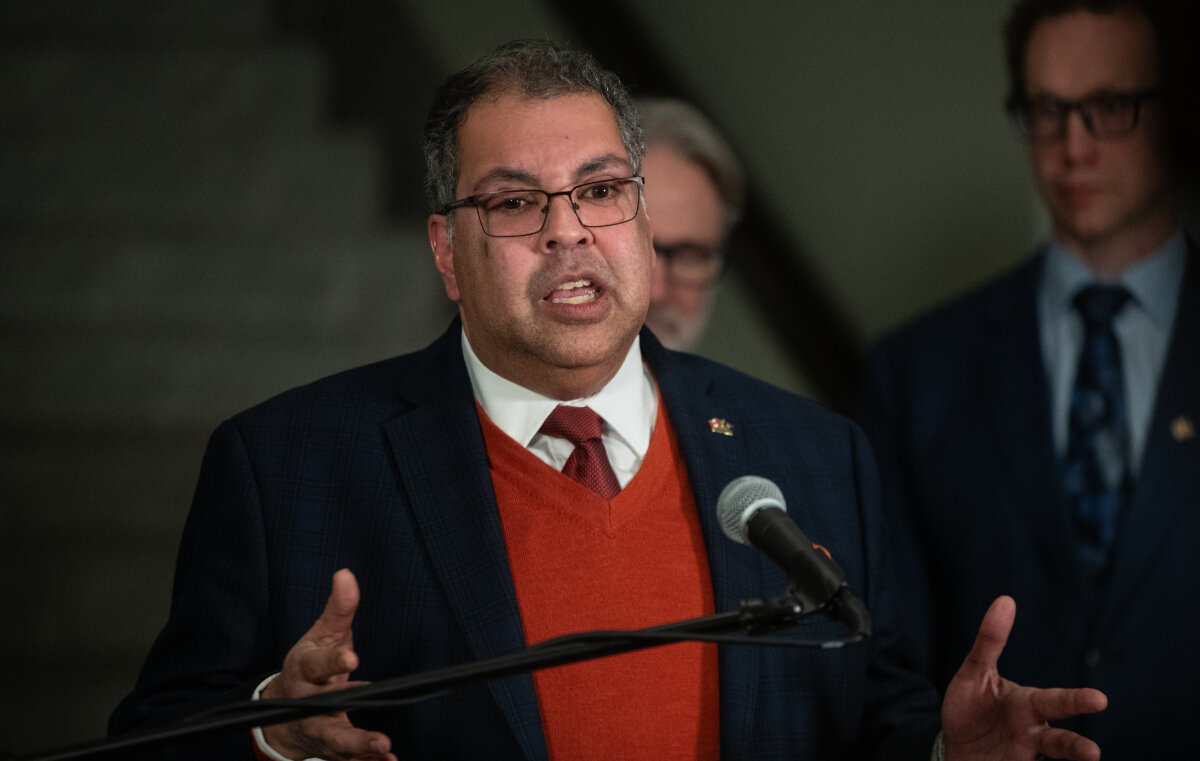

Former Calgary mayor Naheed Nenshi says he wasn’t informed that Calgary’s largest feeder main, which ruptured for a second consecutive year last week, had been flagged as high risk of failure while he was in office.
The Bearspaw South Feeder Main, which carries about 60 percent of Calgary’s potable water, was recommended for inspection in 2017, 2020, and 2022, but those inspections were deferred or redirected, even though the feeder was repeatedly recognized as a high consequence risk, according to an independent panel’s report released Jan. 7 on the feeder main’s 2024 failure.
Nenshi, who served as Calgary mayor from 2010 to 2021 and currently leads Alberta’s NDP Opposition, says council was not made aware of the urgency of the issue at the time, leaving him and his colleagues without the information needed to make key decisions.
“The report is saying that that kind of information didn’t filter up to the key decision-makers, which is a big problem,” Nenshi said on CBC Radio’s “The Calgary Eyeopener” on Jan. 8.
The Bearspaw South Feeder Main broke on Dec. 30, 2025, in Calgary’s northwest, causing flash floods and triggering city-wide water restrictions. The same feeder had burst in early June 2024, leading to restrictions across the city and surrounding municipalities.
The city is currently under Stage 4 water restrictions, which prohibit large outdoor water use, including for rinks or snow-making, and require organizations, such as recreation facilities, to implement water reduction plans.
The panel’s report says the risk of failure along parts of the Bearspaw South Feeder Main was first identified more than two decades ago, following a similar rupture involving the same type of pipe at another water main, the McKnight feeder main, in 2004.
It says that despite “repeated identification” of that risk, the city prioritized other critical needs and initiatives, “repeatedly deferring” the feeder main’s inspection, monitoring, and risk mitigation. It adds that the deferral was likely the result of underestimating the risk of failure, not fully grasping its potential impacts, focusing on other city priorities, and occasional periods of operating budget constraints.
“The mistake, I think, in looking at the report, was that we were so focused on growth infrastructure, in other words, pipes and new parts of the city… that it was difficult to keep in mind the old stuff,” Nenshi said.
The report says the deferral of action on the feeder main continued for more than two decades, reflecting “systemic gaps” in the water utility’s approach to managing critical infrastructure.
The document points to gaps in governance, saying these were partly caused by city council lacking the visibility and expert support needed for effective oversight. It adds that the reporting council received was “high-level,” providing only limited information on operations and risk performance.
“Council also had limited access to the independent technical expertise required to provide oversight to management and evaluate complex trade-offs between service, cost, and reliability,” the report says, adding that many critical decisions were never brought up to council.
Nenshi said it shouldn’t be inferred that his administration delayed repairs to the water system, as the city spent “billions of dollars in capital over time on the system while I was there,” but that he takes responsibility for not looking into the situation further.
“I can’t say this is all administration’s fault, because your job as [city council] is to make sure that you are asking all the right questions,” he said. “Clearly we should have been digging more deeply, and I will take responsibility for that.”
The report provides several recommendations, including improving risk management and maintenance practices, creating a dedicated water utility department, and establishing an independent expert water utility oversight board.
Calgary Mayor Jeromy Farkas has advocated “sparing no expense” to build a replacement line for the feeder main. Council this week voted to act on the report’s recommendations.
“We have to remember that right now we are dealing with a ticking time bomb,” Farkas told reporters on Jan. 7. “Below our feet, at the Bearspaw Feeder Main, is a ticking time bomb that can continue to go off… until we build that replacement line.”
 Friends Read Free
Copy
Facebook
Tweet
Friends Read Free
Copy
Facebook
Tweet