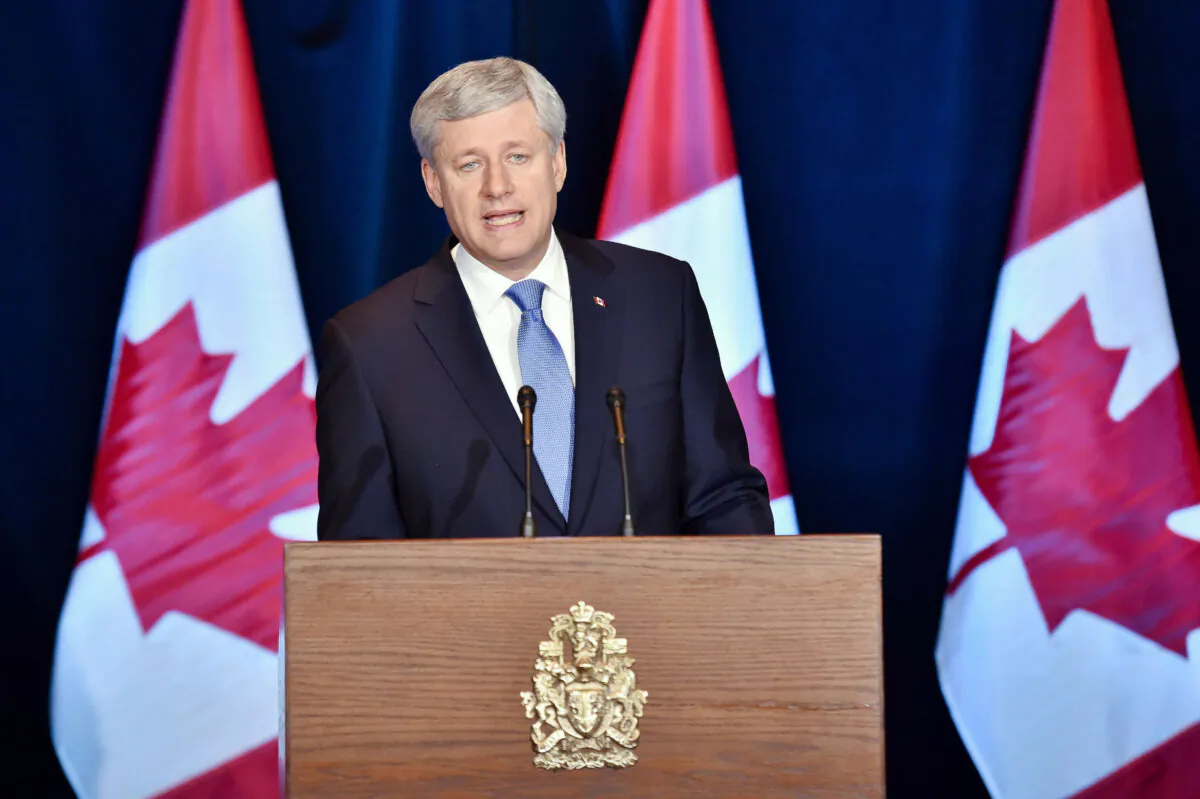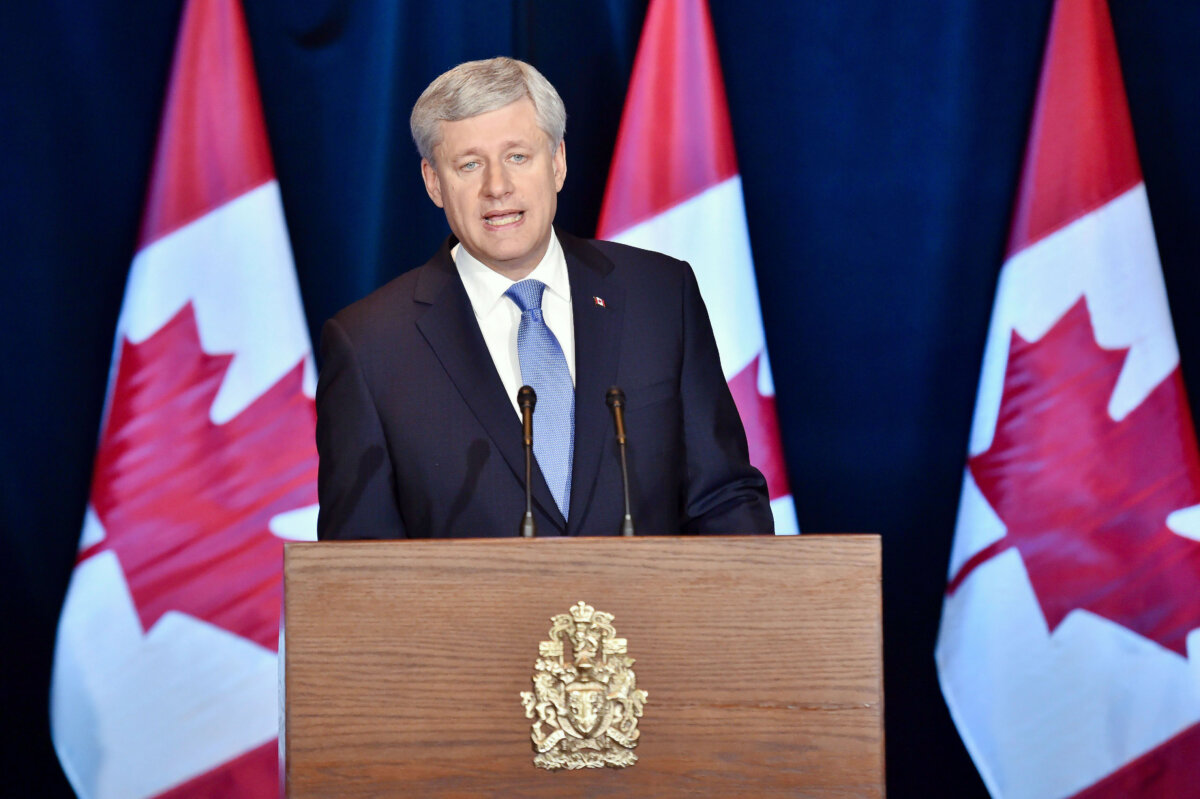
Former Canadian Prime Minister Stephen Harper says the West must dissuade China from launching an invasion of Taiwan, warning that such a war would “dwarf” the current conflicts in the Middle East and Ukraine.
“If China were to take Taiwan, or there were to be a war across the Taiwanese Strait, I mean, that would be a geopolitical problem that would dwarf—it would absolutely dwarf anything we’re seeing in the Middle East or in Ukraine,” Harper told audience members at a Canada-U.S. relations conference in Saskatoon on July 28.
The former Conservative prime minister said such a scenario would be a “major geopolitical catastrophe for the world,” and that the United States and its allies must continue to deter China from taking action against the island nation.
Taiwan is governed by remnants of the nationalist government of the Republic of China, which fled to the island in 1949 following the loss of the Chinese Civil War and established a democracy. Beijing maintains that Taiwan is a renegade province of the country, and has long sought to take control of it.
Then-commander of the U.S. Indo-Pacific Adm. John Aquilino said last year that the Chinese regime is preparing for a possible invasion of Taiwan in 2027. The United States officially has long had a policy of “strategic ambiguity” regarding whether it would protect Taiwan in the event of a Chinese invasion.
The People’s Liberation Army has given increasing signals that could be interpreted as preparations to invade the island in recent years, such as escalating its aircraft patrols close to the island, building and training on a replica of Taipei’s presidential district in the region of Inner Mongolia, and constructing advanced landing craft for amphibious assaults.
The Canadian government has vowed as part of its Indo-Pacific Strategy to work with allies to “push back against any unilateral actions that threaten the status quo” in the Taiwan Strait.
Russia and Iran
Harper said Russia, China, and Iran are “three major revisionist powers” that are working together to threaten the “American, Western-led world order.” He labelled Russian President Vladimir Putin as a “dangerous expansionist bully” for his war against Ukraine, which Harper said is also “not a perfect country,” but is an ally of Canada.
Harper dealt with Putin numerous times while he was prime minister from 2006 to 2015, and during a 2014 G20 meeting, he reportedly told Putin to “get out of Ukraine.” His remarks came as Russia was occupying the region of Crimea, which it would later annex, with Russian special forces without identifying insignia.
“He and I had a notoriously bad relationship by the end. Quite deliberate on my part, actually,” Harper told the audience. “At the end, I was calling him out on this stuff all the time, and quite getting under his skin, actually, which I enjoyed.”
Harper also addressed the U.S. bombing of Iranian nuclear facilities back in June, saying U.S. President Donald Trump “deserves a lot of credit for this.”
“I have been saying for 15 years at least that the single biggest threat of nuclear war was Iran ever getting a nuclear weapon,” Harper said, adding that he had told several U.S. presidents that the “only way to ever stop that would be military action.”
The U.S. strikes on the three nuclear sites of Fordow, Natanz, and Isfahan came following nearly two weeks of fighting between Israel and Iran, and shortly after the military action, the two Middle Eastern countries came to a truce.
 Friends Read Free
Copy
Facebook
Tweet
Friends Read Free
Copy
Facebook
Tweet