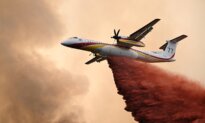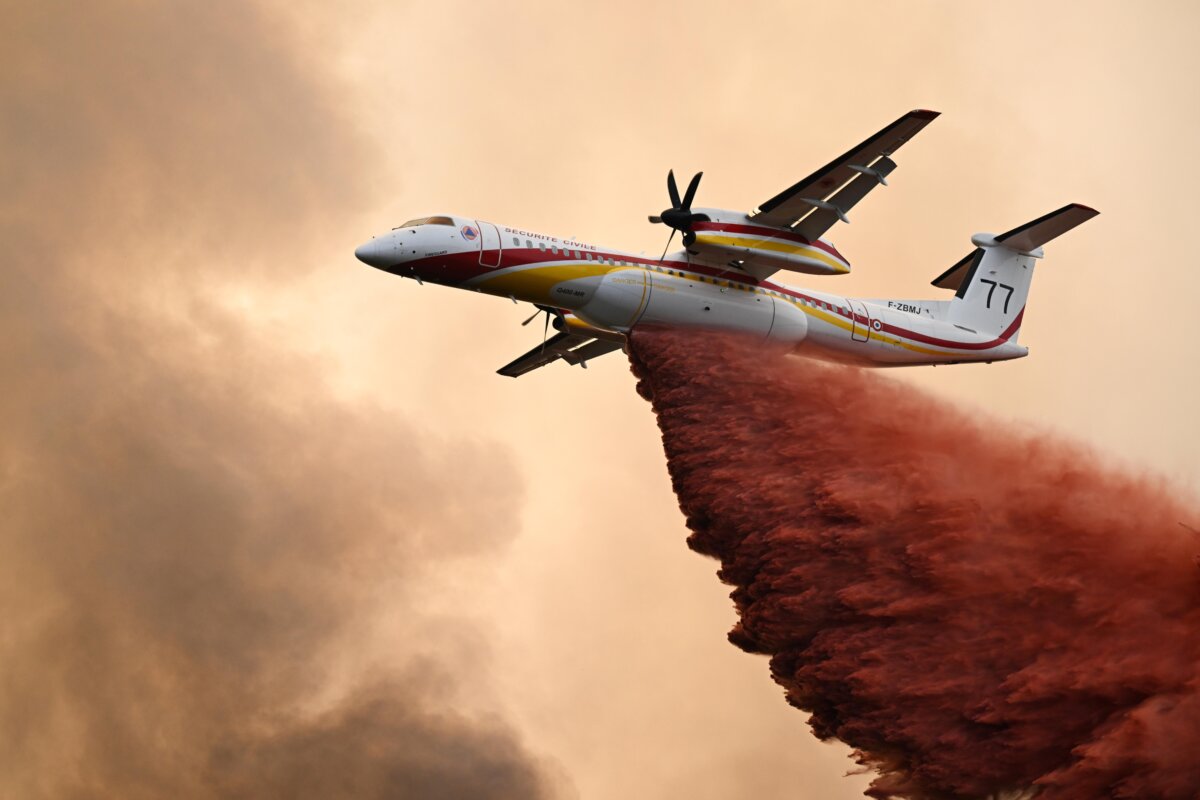

Firefighters in southwestern France on July 29 entered an eighth day of battling the worst wildfire in the country’s recorded history—a blaze outside Bordeaux that has burned an area four times the size of Paris—as two firefighters died in Greece and a punishing mix of heat, drought, and wind fanned flames across Southern Europe.
The fires have set off one of the largest evacuation operations Europe has ever seen, displacing more than 300,000 people from homes and vacation sites in France and Spain at the height of the crisis, according to the European Commission.
Authorities in the Gironde department, the wine country surrounding Bordeaux, said the blaze had been stabilized but cautioned that conditions on July 29, forecast by Météo-France to be the hottest and driest day of the week with temperatures near 104 degrees Fahrenheit (40 degrees Celsius), were “unfavorable.”
The local prefecture reported that several fires had reignited inside zones that had already burned, notably around Lège and Marcheprime on opposite edges of the fire, a day after nearly 4,000 people were ordered out of coastal areas along the Atlantic.
The fire, since breaking out on July 22, has left some 104,000 acres (42,000 hectares) of pine forest charred and destroyed 240 homes, French authorities said.
At its peak, it drove roughly 220,000 people from the Gironde area alone, while another 36,000 were evacuated in the neighboring Landes area and 3,000 in the Var region on the Mediterranean coast, according to Interior Minister Laurent Nuñez.
More than 2,000 firefighters remain engaged on the ground, backed by the army, the gendarmerie, farmers, and volunteers, Benoit Vega, communications officer for the Gironde fire and rescue service, told The Epoch Times.
“This is the eighth day, just think of it,” Vega said, citing short nights, exhaustion, and some injuries. “They are tired, they are worn out, but they are still there.”
‘Zombie Fires’ in Tinder-Dry Land
The fire has lost intensity, Vega said, but crews are now contending with fire jumps and flare-ups that would be manageable in normal weather. The greatest threat lies underground: “At ground level, in the peat, there is stagnant fire that will move and potentially trigger a new outbreak in another area.”
Vega, who flew a night reconnaissance mission aboard a Caracal helicopter to map hot spots for ground crews, said full extinction could take months.
After fires struck the same region in 2022, he recalled, new outbreaks linked to the initial blaze occurred months later. “It smolders,” he said.
Nothing is won at this stage, according to Luc Langeron, head of the prevention division at Entente Valabre, a French public agency specializing in forest fires. “There are zombie fires, which can bury themselves in the ground for weeks on end,” Langeron told The Epoch Times, warning against any prognosis, positive or negative.
With no rain, depleted soils, and vegetation under severe water stress, even a light breeze becomes a hazard, Langeron said, pointing to fires in the Var in 2003 that spread at high speed through bone-dry vegetation despite moderate winds. “It is over the long haul that things will play out,” he said.
Some relief is reaching the Atlantic coast. Météo-France announced that a marked cooling arriving overnight would allow heat warnings for the Gironde and Landes areas to be lifted on July 30, even as high temperatures intensify in the east: the agency placed the Moselle and Meurthe-et-Moselle areas near the German border under “very high” fire danger for July 30, while 65 departments across the country were already listed at elevated risk on July 29.
Drought now covers all of mainland France, with soils approaching the record dryness measured in August 2022, according to Météo-France, and more than 448 square miles (1,160 square kilometers) have burned nationwide this year, the Interior Ministry said.
The EU’s European Drought Observatory reported that conditions remained critical across most of Europe in mid-July and worsened in the continent’s central-western regions.
Deaths in Greece, Records in Spain
In Greece, two firefighters died on July 29 while battling a wind-driven wildfire in the Rethymno region of Crete, the country’s fire department said. They were among about 125 firefighters deployed against the blaze, supported by four helicopters and four water-dropping planes.
The department said they “fell heroically in the line of duty,” though the circumstances of their deaths were not immediately clear.
In Spain, where the government declared a national emergency for wildfires for the first time, a fire in the hills of Ávila province west of Madrid has become the largest in the country’s history, scorching more than 123,000 acres (50,000 hectares). About 79,000 people were evacuated and another 30,000 ordered to stay indoors at the peak of the crisis.
Tens of thousands of Spaniards have since begun returning home as crews made progress around Madrid and Ávila, although a fire in the eastern province of Castellón remained out of control as the country entered its fourth heat wave of the summer, with temperatures expected to exceed 104 degrees Fahrenheit (40 degrees Celsius).
Prime Minister Pedro Sánchez said Spain could “begin to see the light at the end of the tunnel” while cautioning that the days ahead would be especially challenging.
The head of the EU’s Emergency Response Coordination Centre warned on July 29 that Greece and Italy face heightened wildfire risk in the coming weeks.
Back in the Gironde, Vega said his crews harbor no illusions of a quick victory.
“We will get there,” he said, “but not today.”
 Friends Read Free
Copy
Facebook
Tweet
Friends Read Free
Copy
Facebook
Tweet