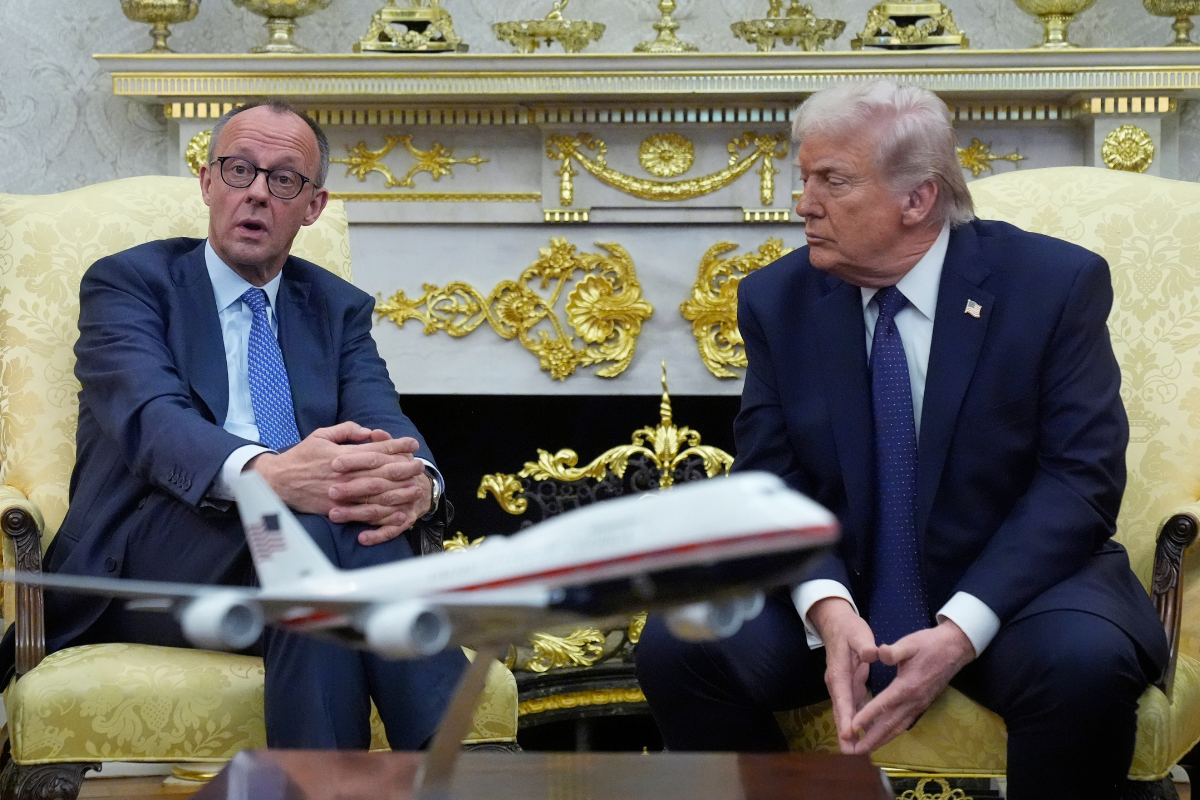
German Chancellor Friedrich Merz has played down talk of a rift with U.S. President Donald Trump after the White House announced a big drawdown of troops stationed in Germany.
Last week, Merz—a conservative who became chancellor last year—said the United States appeared to have no strategy for the Middle East conflict and said it was “being humiliated” by the Iranian leadership.
In response, in a post on Truth Social on April 30, Trump wrote, “The Chancellor of Germany should spend more time on ending the war with Russia/Ukraine (Where he has been totally ineffective!), and fixing his broken Country, especially Immigration and Energy, and less time on interfering with those that are getting rid of the Iran Nuclear threat, thereby making the World, including Germany, a safer place!”
Merz had earlier insisted he had a good relationship with Trump.
But on May 1, the U.S. Department of War said it would be reducing its military presence in Germany by 5,000 soldiers.
Trump told reporters on May 2, “We’re going to cut way down. And we’re cutting a lot further than 5,000.”
In an interview with Germany’s public broadcaster, ARD, which was aired on May 3, Merz said: “I have to accept that the American president has a different view on these issues than we do.
“But that does not change the fact that I remain convinced that the Americans are important partners for us.”
When asked whether the troop drawdown was linked to the row over Iran, Merz said, “There is no connection.”
“I am not giving up on working on the transatlantic relationship,” Merz told ARD. “Nor am I giving up on working with Donald Trump.”
The European Union’s foreign policy chief, Kaja Kallas, said the drawdown decision emphasizes that “We have to really strengthen the European pillar in NATO.”
“There has been a talk about withdrawal of U.S. troops for a long time from Europe. But of course, the timing of this announcement comes as a surprise,” Kallas said, speaking at a European Political Community summit in the Armenian capital, Yerevan, on May 4.
NATO Secretary-General Mark Rutte also played down the drawdown but pointed out that “there has been at this point disappointment on the U.S. side” about its NATO allies’ lack of support for Washington’s actions in confronting the Iranian regime.
“I would say the Europeans have heard a message. They are now making sure that all the bilateral basing agreements are being implemented,” Rutte said.
Norwegian Prime Minister Jonas Gahr Store, speaking at the same summit, said the drawdown decision should not be exaggerated.
“I do not see those figures as dramatic, but I think they should be handled in a harmonious way inside the framework of NATO,” Store said.
Trump has repeatedly called on Europeans to take greater responsibility for their own security.
In July 2024, the Biden administration announced it had reached an agreement with Berlin to periodically deploy surface-to-surface Tomahawk missiles to Germany from 2026.
But in his May 3 interview, Merz said Trump had never committed to this plan, and he suggested the United States had a shortage of Tomahawks.
“If I’m not mistaken, the Americans don’t have enough themselves at the moment,” Merz said.
Trump has repeatedly clashed with leaders of other NATO nations over defense and national security issues.
In July 2020, the White House announced it was to withdraw 12,000 of the 36,000 troops stationed in Germany.
But Trump lost the presidential election four months later, and the Biden administration did not follow through with the proposal, so there remain around 36,000 U.S. troops permanently stationed in Germany.
In 1987, during the Cold War, there were more than 239,000 U.S. troops in West Germany, a figure that was reduced to below 70,000 in unified Germany by 2000. It continued to fall until Russia invaded Ukraine in February 2022.
The Associated Press and Reuters contributed to this report.
 Friends Read Free
Copy
Facebook
Tweet
Friends Read Free
Copy
Facebook
Tweet