
Economic uncertainty caused by U.S. President Donald Trump’s tariffs on Canada took centre stage at a recent three-day summit of Great Lakes governors and premiers in Quebec City.
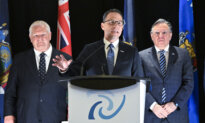
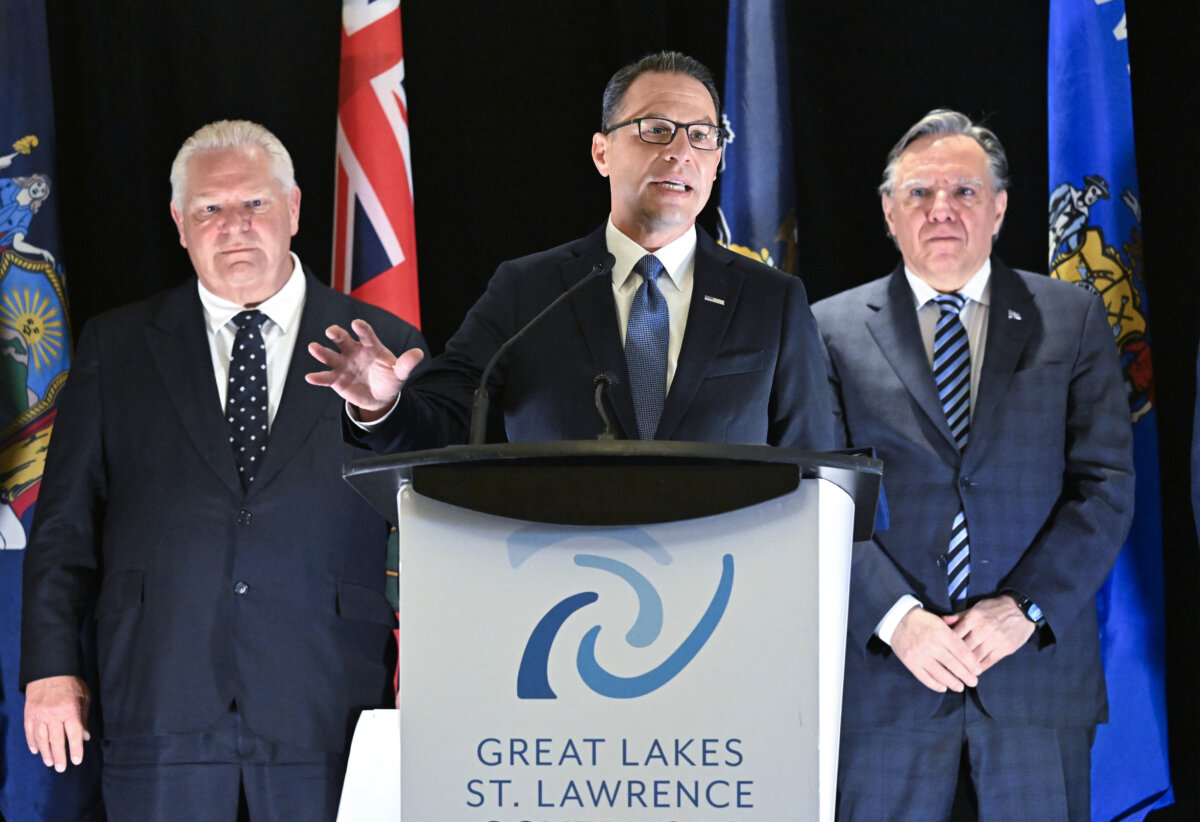
Quebec Premier François Legault and Ontario Premier Doug Ford were joined by Pennsylvania Governor Josh Shapiro, and Wisconsin Governor Tony Evers at the Great Lakes St. Lawrence Governors & Premiers summit.
The group unites leaders from Ontario and Quebec with their counterparts in states bordering the Great Lakes. The biennial meeting is the group’s first since Trump returned to the White House in January.
The Oct. 6 press conference to close the summit largely focused on the trade relationship between Canada and the United States as well as the Oct. 7 meeting at the White House between Trump and Prime Minister Mark Carney.
Shapiro, a Democrat, criticized Trump while speaking to reporters, saying his tariffs don’t benefit either country. He called on Trump to “re-evaluate his tough-guy approach” to Canada and suggested he use his Oct. 7 meeting with Carney to mend the relationship between the two countries.
Carney and a number of cabinet ministers are set to meet with the U.S. president at the White House today. The Prime Minister’s Office has characterized the meeting as a direct discussion centred on mutual priorities in establishing a new economic and security partnership between Canada and the United States.
Shapiro said it’s not in the long-term interests of his country to be at odds with Canada, adding that his constituents are already experiencing the strain from the trade war. He said farmers and business owners are feeling the economic burden as the costs of conducting business increase.
“This is not a zero sum game. I don’t believe that if a Canadian does well, a Pennsylvanian has to be worse off,” he said. “I think there are ways that we can all be lifted up.”
Ford had similar comments about today’s meeting at the White House, saying he hoped Trump would refrain from attempting to direct Carney’s actions but he also urged the president to prioritize “certainty.”
“You never know what comes out of a meeting with President Trump, he’ll say one thing one day and change his mind the next day again,” Ford said. “We need certainty for our economies. Hopefully they can come out with a great deal, a fair trade deal for both sides of the border.”
Evers and Legault were more restrained in their remarks, but they also called on the president to focus on “certainty.”
“The uncertainty out of Washington, D.C., is a problem and it shouldn’t be a problem,” Evers said, noting that both countries are in “difficult times right now”
“There’s no reason why our countries can’t resolve these problems,” he added.
Legault described certainty as important for businesses and investors on both sides of the border.
“What will happen next week? What will happen with the renegotiation of the USMCA next year?” he said, referring to the United States-Mexico-Canada Agreement. “We really need to have more certainty about the future.”
Trump-Carney Meeting
Trump has said he expects Carney to bring up tariffs during his White House visit because a growing number of Canadian companies are moving to the United States due to his tariff strategy.
“I guess he’s going to ask about tariffs, because a lot of companies from Canada are moving into the United States,” Trump told reporters on Oct. 6. “They’re losing a lot of companies in Canada.”
Trump recently increased tariffs on Canadian products not covered by the USMCA to 35 percent. The move came after Carney’s government in August quietly removed all of the tariffs that Canada had earlier slapped on American goods with the exception of its 25 percent tariffs on U.S. steel, aluminum, and auto imports.
Carney has said Canada still has the best tariff rate compared to other countries, since the vast majority of Canadian products are exempt under the USMCA.
“Canada currently has the best trade deal with the United States,” Carney said on Aug. 22. “And while it’s different from what we had before, it is still better than that of any other country.”
The first official visit between the two leaders took place in early May at the White House. The two leaders also met this past June in Alberta at the G7 summit.
Carney is expected to be accompanied by minister responsible for Canada-U.S. trade Dominic LeBlanc, who said Oct. 2 that while he believes trade issues between the United States and Canada are “resolvable,” challenges are likely to “remain for some time.” Also accompanying the prime minister on this trip will be Foreign Affairs Minister Anita Anand and Industry Minister Mélanie Joly.
Paul Rowan Brian contributed to this report.
 Friends Read Free
Copy
Facebook
Tweet
Friends Read Free
Copy
Facebook
Tweet